
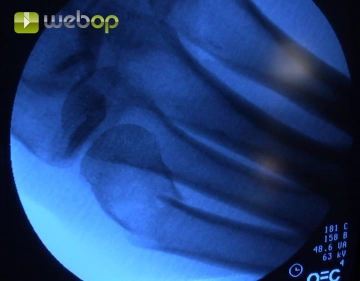
Subcapital fractures of the 5th metacarpal bone represent the most common fracture of the hand (almost one-sixth of all hand fractures). While a palmar angulation of the metacarpal head up to 45 degrees is tolerated, even a minimal rotational error of 5 degrees constitutes a significant functional impairment of the hand that must be corrected.
An excellent option to surgically address these fractures is intramedullary K-wire fixation. This indirect method has already proven itself in other bones of the extremities (tibia, femur, humeral head) and is a long-established procedure in pediatric trauma surgery to stabilize forearm fractures.
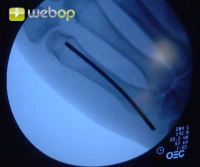
The procedure is minimally invasive. The fracture is not surgically exposed and directly fitted with an implant; instead, a wire is introduced through the medullary cavity of the bone away from the fracture, stabilizing it from within. This avoids passing through the extensor mechanism of the MP joint, thus preventing adhesions of extensor tendons and joint capsule with the dreaded extension contracture of the joint.