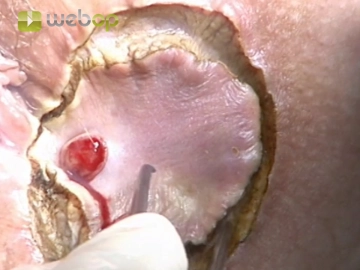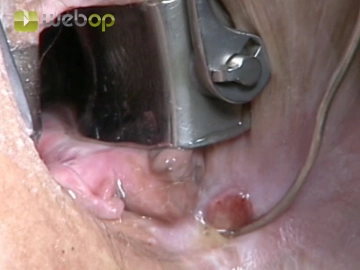
With the patient in lithotomy position, perform a digital rectal examination followed by slow and careful dilation of the anal sphincter. Insert the Parks retractor After careful retrograde probing and instillation of contrast agent, the inner internal opening of the fistula is found high in the anal canal at 5 o'clock.
-
Assessing the fistula
![Assessing the fistula]()
Soundsettings -
Excising the external opening of the fistula
![Excising the external opening of the fistula]()
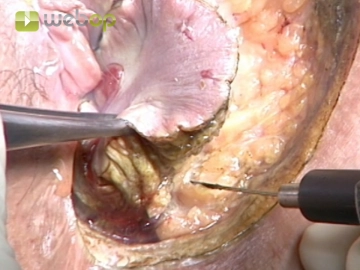
Soundsettings After carefully debriding the fistula tract, excise the tissue around the external opening. The indurated ischioanal tissue delimits it from the healthy surrounding tissue. The plan is to create a funnel-shaped wound with a wide opening.
-
Dissecting the fistula from ischioanal fatty tissue
![Dissecting the fistula from ischioanal fatty tissue]()
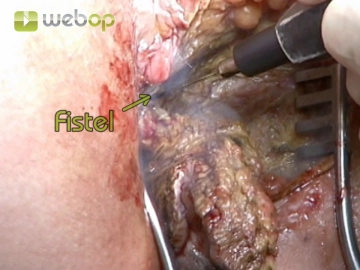
Soundsettings Perform the lateral incision where the tissue becomes soft, i.e. where it is no longer inflamed or scarred.
-
Dissecting the fistula at the external anal sphincter
Soundsettings For the medial dissection tightly follow the external margin of the anal sphincter.
-
Excising the extrasphincteric segments of the fistula
![Excising the extrasphincteric segments of the fistula]()
Soundsettings Both planes of dissection meet deep in the field where the fistula passes through the anal sphincter. Transect the external fistula tract there.
-
Inserting a silicone seton
![Inserting a silicone seton]()
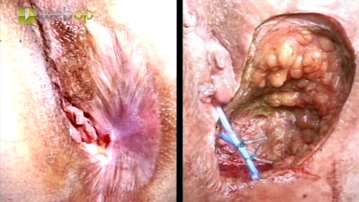
Soundsettings After careful debridement of the fistula (e.g. with a curette), pass an elastic seton drainage (e.g. Vessel-Loop) through the fistula tract. In our example the seton is a vessel loop both ends of which are either tied or anchored with Mersilene sutures.