Start your free 3-day trial — no credit card required, full access included

Perioperative management - Open incisional hernia repair with retromuscular mesh augmentation

  1. Indications

    Emergency surgery:

    • Incarceration

    Elective surgery:

    • Imminent incarceration
    • Persistent complaints
    • Social deprivation
    • Persistent disability to work
    • Increasing size of fascial defect or hernia content because “each large incisional hernia once started as a small incisional hernia”!
  2. Contraindications

    In elective surgery, the skin must be free of any infection; pressure sores and superficial skin infections must first be treated conservatively.

    The indication for incisional hernia repair in patients with cirrhosis of the liver and ascites must be assessed critically because liver function might have to be optimized first before surgery.

    Good respiratory status not compromised by acute infections is also important. In case of respiratory infection elective surgery must be postponed.

  3. Preoperative diagnostic work-up

    Incisional hernia is a clinical diagnosis and easily recognized with the patient standing. Also, examine the patient supine when he/she is relaxed. In most reducible incisional hernias, the margin of the fascia is easily palpated Asking the patient to elevate the upper trunk allows good assessment of the surrounding muscles and the size of the fascial defect.

    Apart from measuring the size of the fascial defect and content of the hernia sac, ultrasonography provides a good anatomical view of the abdominal wall. Important questions are: Location and size of the abdominal muscles, such as the rectus abdominis in median incisional hernias and the lateral abdominal muscles in incisional hernias outside of the rectus sheath.

    In previously repaired incisional hernia, the pertinent OR not would be helpful, particularly if the patient had already undergone mesh repair. Apart from the precise surgical technique employed (extra-/intraperitoneal mesh placement, augmentation or bridging of the fascial defect), the type of mesh material would also be important.

    CT and/or MRI studies are not mandatory. In our experience, these studies have their place in gigantic incisional hernias because there they permit better assessment of the abdominal wall.

    Depending on the size of the finding and patient morbidity, preoperative diagnostic lung function testing is important to prevent, as much as possible, postoperative respiratory complications.

  4. Special preparation

    • The most important step is the detailed preoperative informed consent of the patient, which should touch not only on the general risks but particularly on the possibility of seroma formation in the wound.
    • We have found the emphasis on postoperative respiratory therapy and ambulation especially helpful.
    • If at all, bowel preparation is only performed in very large incisional hernias.

    No other special preparation is required.

  5. Informed consent

    General part:

    • Bleeding
    • Secondary bleeding
    • Hematoma
    • Thrombosis
    • Embolism
    • Injury to adjacent structures such as intestines, nerves, vessels and bladder
    • Impaired intestinal passage (atony/ileus)
    • Secondary healing
    • Infection
    • Abscess
    • ICU stay, if needed.

    Special part:

    • Limited movement
    • Chronic pain
    • Wound seroma
    • Mesh migration
    • Mesh infection
    • Mesh rupture
    • Recurrence
  6. Anesthesia

    • Due to the extensive anatomical dissection in retromuscular mesh augmentation this procedure is performed under general anesthesia.
    • Experience has shown that pain management by peridural catheter improves the postoperative course.
  7. Positioning

    Positioning
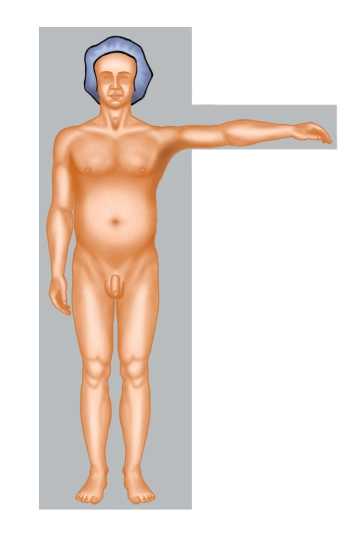
    • Supine, possibly one arm adducted.
    • Depending on the size of the hernia the patient should be slightly hyperextended during dissection and returned to neutral position during closure of the fascia.
  8. Operating room setup

    Operating room setup

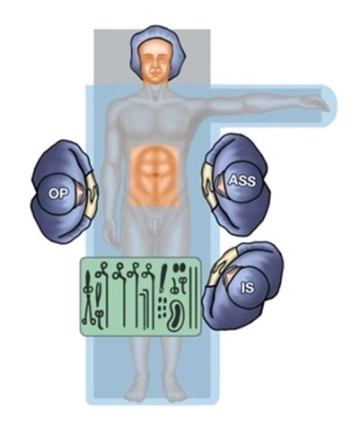
    Generally, the operation starts with the surgeon on the right side and the assistant facing him/her, while the scrub nurse stands to the left of the assistant. With this setup, first expose the tissue for the mesh bed on the left, i.e., on the side of the assistant. Depending on the intraoperative overview or lack thereof, the surgeon may swap places when exposing the opposite side.

  9. Special instruments and fixation systems

    Other material:

    Implants: Non-absorbable, large pore meshes with reduced surface area, e.g., made of polypropylene, polyester, PVDF

  10. Postoperative management

    Postoperative analgesia: Nonsteroidal anti-inflammatory drugs usually suffice; if necessary, they can be enhanced by opioid analgesics.

    Follow this link to PROSPECT (Procedures Specific Postoperative Pain Management).

    This link will take you to the International Guideline Library.

    Deep venous thrombosis prophylaxis: Routine thrombosis prophylaxis with low-molecular-weight heparin (e.g., weight adapted Clexane® s.c.) for the duration of the hospital stay.

    This link will take you to the International Guideline Library.

    Ambulation: As soon as possible.

    Physical therapy: Immediate intensive postoperative respiratory therapy and early ambulation.

    Diet: In vigilant patients, oral liquids may be offered 4-6 hours after surgery. Gradually reintroduce oral liquids and light food the next day and then return to standard diet, depending on the extent of surgery and indigestion.

    Bowel movement:  In case of no bowel movement by postoperative day 3, administer a regular or return-flow enema.

    Work disability: The duration of work disability depends on the extent of the operation and patient morbidity. Following surgery, the patient should avoid strenuous physical activity for 3-4 weeks. Otherwise the patient may exercise as tolerated by pain level.