Start your free 3-day trial — no credit card required, full access included

Anatomy - Right hemihepatectomy

  1. Functional Liver Anatomy

    Functional Liver Anatomy

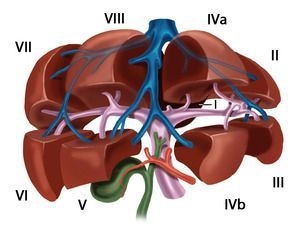
    The liver is macroscopically divided into a larger right lobe and a smaller left lobe (volume ratio approx. 80 : 20) by the falciform ligament and the insertion of the ligamentum teres hepatis on the diaphragmatic surface, as well as the sagittal fissure on the visceral surface, although this morphological division does not correspond to the functional structure of the liver. The functional division of the liver is determined by the branching of the portal structures: portal vein, hepatic artery, and bile duct. These three anatomical structures branch not only at the porta hepatis but also predominantly in the same direction within the parenchyma. Each liver segment is completely independent from the other segments in terms of blood supply and bile drainage and can be surgically removed without endangering the function of the remaining liver.

    The term “functional anatomy” thus refers to a substructuring of the liver, which is based on the delimitability of hemodynamically independent parenchymal districts and whose knowledge is essential for the operative strategy in liver resection procedures.

  2. Portal Vein and Hepatic Veins

    The functional division of the liver is based on the portal branching into individual, mutually independent subunits, the segments.

    Usually, the portal vein divides in the hepatic hilum into a right and left main trunk. The boundary of these supply areas lies in the Cava-gallbladder line (“Cantlie line“). Through renewed bifurcation of the respective portal vein trunk, on the right side an anteromedial as well as a posterolateral trunk arises for the liver segments V/VIII or VI/VII. The left main trunk runs transversely to the left and then as the umbilical part anteriorly and ends at the insertion site of the ligamentum teres hepatis in the so-called Recessus Rex. The left portal main trunk gives off branches for the two left-lateral segments II and III as well as for the median segments IVa and IVb. A special position is taken by the caudate lobe, as it can receive strong inflows from the left and also from the right portal vein main trunk.

    According to Couinaud, eight portal venous liver segments are distinguished, which, starting with the caudate lobe as segment I, are numbered clockwise:

    Segment I

    Caudate lobe

    Segment II/III

    lateral left liver lobe

    Segment IV

    left paramedian sector (quadrate lobe)

    Segment I/II/III/IV

    left liver half

    Segment V/VIII

    right paramedian sector

    Segment VI/VII

    right lateral sector

    Segment V/VI/VII/VIII

    right liver half

    The liver is traversed in a caudocranial direction by three main venous trunks, namely the right, middle, and left hepatic vein, which divide the liver into a total of four hepatic sectors. The left hepatic vein drains almost exclusively the left-lateral liver lobe and usually unites shortly before its inflow into the vena cava with the middle hepatic vein, which runs along the Cava-gallbladder line. The right hepatic vein runs between the posterolateral and anteromedial segments. The caudate lobe has its own venous drainage, which consists of multiple small veins that open directly dorsally into the vena cava, the so-called Spieghel veins.

    The portal hila of the liver segments II, III and IV lie extrahepatically and can be relatively easily dissected in the anterior section of the left umbilical fissure. The hila of the right-sided liver segments lie intrahepatically. Exceptions occur occasionally and usually concern segment VI. Even more variable than the anatomy of the portal vein is that of the hepatic veins.

    Variants

    Portal Vein System

    • Anomalies of the portal vein bifurcation almost always affect the right portal vein main trunk
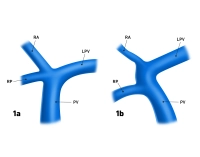
    • Portal vein trifurcation: right main trunk is missing, instead there are two branches for the right double segments V/VIII and VI/VII (Fig. 1a); occasionally one of the right branches can also originate from the left portal vein main trunk (Fig.1b)
    • Variants of the left portal vein system rarely affect the main trunk, but almost always the division: several small portal vein branches instead of two segment branches IVa/IVb, occasionally also additional, intermediate branch between the segment branches II and III
    40_LAV_01_a_b_Pfortader_Lebervenen

    Fig. 1a and 1b: PV = portal vein, LPV = left portal vein, RA = right anterior portal vein branch, RP = right posterior portal vein branch

    Hepatic Veins

    • Variants of the hepatic veins are more common than those of the portal vein system
    • Deviations from the hepatic sectors described by Couinaud particularly affect the territories of the right and middle hepatic vein 
  3. Hepatic Arteries

    The common hepatic artery arises from the celiac trunk, in rare cases it originates directly from the aorta or the superior mesenteric artery. After giving off the gastroduodenal artery, the proper hepatic artery divides in the hepatic hilum into the right and left hepatic arteries. Not infrequently, additional extrahepatic branches are found, such as the artery for segment IV, which usually arises from the left hepatic artery just before the umbilical fissure.

    Variants
    • Deviations from the normal distribution type are found in 30% of cases
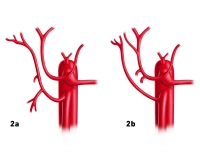
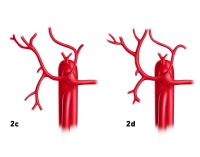
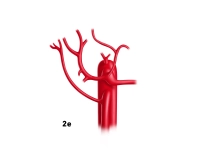
    • the most common anatomical variants are a replaced or accessory hepatic artery from the superior mesenteric artery (Fig. 2a-b) or from the left gastric artery (Fig. 2c-d)
    • occasionally both variants occur together (Fig. 2e)
    40_LAV_02_a_b_Leberarterie
    40_LAV_02_c_d_Leberarterie
    40_LAV_02_e_Leberarterie
Bile Ducts

The extrahepatic portion of the left hepatic duct is approximately 3-5 cm long and arises

Activate now and continue learning straight away.

Single Access

Activation of this course for 3 days.

US$9.40  inclusive VAT

Most popular offer

webop - Savings Flex

Combine our learning modules flexibly and save up to 50%.

from US$7.29 / module

US$87.56/ yearly payment

price overview

general and visceral surgery

Unlock all courses in this module.

US$14.59 / month

US$175.10 / yearly payment

to top