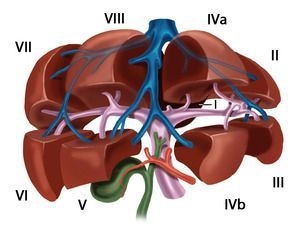
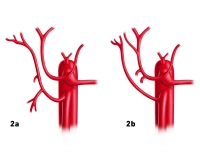
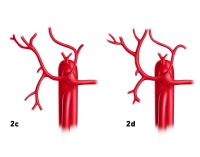
The functional division of the liver is based on the portal branching into individual, mutually independent subunits, the segments.
Usually, the portal vein divides in the hepatic hilum into a right and left main trunk. The boundary of these supply areas lies in the Cava-gallbladder line (“Cantlie line“). Through renewed bifurcation of the respective portal vein trunk, on the right side an anteromedial as well as a posterolateral trunk arises for the liver segments V/VIII or VI/VII. The left main trunk runs transversely to the left and then as the umbilical part anteriorly and ends at the insertion site of the ligamentum teres hepatis in the so-called Recessus Rex. The left portal main trunk gives off branches for the two left-lateral segments II and III as well as for the median segments IVa and IVb. A special position is taken by the caudate lobe, as it can receive strong inflows from the left and also from the right portal vein main trunk.
According to Couinaud, eight portal venous liver segments are distinguished, which, starting with the caudate lobe as segment I, are numbered clockwise:
The liver is traversed in a caudocranial direction by three main venous trunks, namely the right, middle, and left hepatic vein, which divide the liver into a total of four hepatic sectors. The left hepatic vein drains almost exclusively the left-lateral liver lobe and usually unites shortly before its inflow into the vena cava with the middle hepatic vein, which runs along the Cava-gallbladder line. The right hepatic vein runs between the posterolateral and anteromedial segments. The caudate lobe has its own venous drainage, which consists of multiple small veins that open directly dorsally into the vena cava, the so-called Spieghel veins.
The portal hila of the liver segments II, III and IV lie extrahepatically and can be relatively easily dissected in the anterior section of the left umbilical fissure. The hila of the right-sided liver segments lie intrahepatically. Exceptions occur occasionally and usually concern segment VI. Even more variable than the anatomy of the portal vein is that of the hepatic veins.
Variants
Portal Vein System
- Anomalies of the portal vein bifurcation almost always affect the right portal vein main trunk
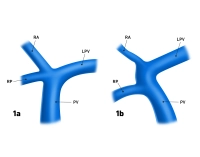
- Portal vein trifurcation: right main trunk is missing, instead there are two branches for the right double segments V/VIII and VI/VII (Fig. 1a); occasionally one of the right branches can also originate from the left portal vein main trunk (Fig.1b)
- Variants of the left portal vein system rarely affect the main trunk, but almost always the division: several small portal vein branches instead of two segment branches IVa/IVb, occasionally also additional, intermediate branch between the segment branches II and III
Fig. 1a and 1b: PV = portal vein, LPV = left portal vein, RA = right anterior portal vein branch, RP = right posterior portal vein branch
Hepatic Veins
- Variants of the hepatic veins are more common than those of the portal vein system
- Deviations from the hepatic sectors described by Couinaud particularly affect the territories of the right and middle hepatic vein