Start your free 3-day trial — no credit card required, full access included

Hybrid-NOTES - Sigmoid Resection

  1. Creation of Pneumoperitoneum / Placement of Working Trocars

    Video
    Creation of Pneumoperitoneum / Placement of Working Trocars
    Soundsettings

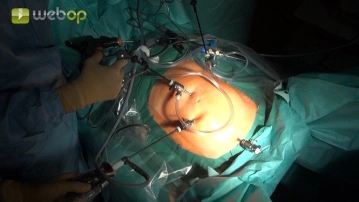
    Creation of pneumoperitoneum by puncturing the abdominal cavity subcostally on the left with the Veress needle.

    Placement of the first trocar (5mm) with a blunt obturator approximately 3 cm cranial to the navel. After an orienting inspection of the abdominal cavity, three additional 5mm trocars are introduced under vision (5mm optics) in the left-lateral mid-abdomen and in the right mid-abdomen. Finally, the fourth trocar is placed suprapubically.

    Tip:

    Before each incision, the skin is infiltrated with a local anesthetic.
  2. Preparation on the Gerota's fascia from medial and transection of the inferior mesenteric vein

    Preparation on the Gerota's fascia from medial and transection of the inferior mesenteric vein
    Soundsettings

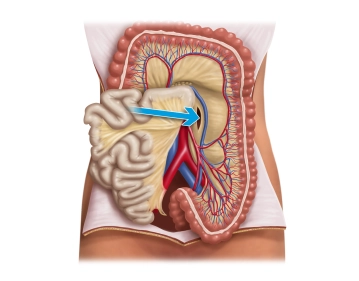
    Careful incision of the peritoneum medial to the inferior mesenteric vein and layer-wise, mostly blunt dissection of the mesocolon and descending colon from the Gerota's fascia from medial to left lateral up to the abdominal wall, after identifying the correct dissection plane.

    Tip:

    The small vessels should all be directed dorsally during the dissection.

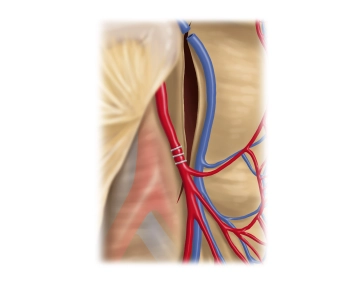
    Caudal to the lower edge of the pancreas, the mesenteric vein is initially sealed multiple times centrally and peripherally with so-called "virtual clips" and then transected. Then, preparation directly along the peritoneum cranially to reach the omental bursa ventral to the anterior surface of the pancreas without capsule injury. By opening the bursa and the initially prepared cavity ventral to the Gerota's fascia, the remaining adhesions to the pancreas are carefully released towards the left flexure.

  3. Mobilization of the Left Colonic Flexure

    Soundsettings

    For the complete mobilization of the left flexure, the greater omentum is dissected from the transverse colon starting from the middle towards the left, thereby opening the omental bursa. This is followed by the transection of the splenocolic ligament and the last pancreaticocolonic connections. Subsequently, the left colonic flexure is detached from all dorsal structures while preserving its mesentery and thus its blood supply, creating the conditions for an adequately long resection and a tension-free anastomosis.

  4. Transection of the Inferior Mesenteric Artery

    Transection of the Inferior Mesenteric Artery
    Soundsettings

    The mobilization of the descending mesocolon is now continued caudally, and the peritoneum of the right-sided mesosigmoid base is incised to expose and clearly identify the inferior mesenteric artery from the dorsal side through layer-appropriate, mostly blunt dissection. It is transected between clips with the Bowa sealing instrument distally, ensuring the safe preservation of the hypogastric plexus.

  5. Detachment of the Colon from the Lateral Abdominal Wall

    Soundsettings

    Next, the embryonic and post-inflammatory adhesions of the sigmoid colon, as well as the peritoneal fold of the left paracolic gutter, are released, thereby fully mobilizing the left hemicolon from the lateral abdominal wall. The left ureter is not denuded in the process but is clearly identified and carefully preserved.

  6. Preparation of the Proximal Rectum

    Preparation of the Proximal Rectum
    Soundsettings

    The lateral peritoneal reflection folds of the rectum are incised on both sides, and the mesosigmoid and upper mesorectum are dissected in layers while preserving the dorsal autonomic nerve plexus. In this case, post-inflammatory adhesions to the left ovary must be severed. In the area of the planned distal transection site, the rectum is circumferentially skeletonized.

    Note:

    The preparation should extend distally beyond the high-pressure zone of the rectosigmoid junction (marked by the disappearance of the appendices epiploicae and the taeniae).

Transvaginal Resection

The oral resection plane is established in the upper sigmoid/descending transition, clearly above t

Activate now and continue learning straight away.

Single Access

Activation of this course for 3 days.

US$9.30  inclusive VAT

Most popular offer

webop - Savings Flex

Combine our learning modules flexibly and save up to 50%.

from US$7.19 / module

US$86.33/ yearly payment

price overview

general and visceral surgery

Unlock all courses in this module.

US$14.38 / month

US$172.70 / yearly payment