Start your free 3-day trial — no credit card required, full access included

Perioperative management - Ileostomy placement

  1. Indications

    Indications

    Stomas are often created during abdominal surgeries, whether in emergency situations or elective procedures.

    The indication for and type of stoma creation depend on the underlying disease and the general situation.

    • Neoplastic diseases → Prevention of ileus during neoadjuvant treatment or inoperability
    • To protect high-risk anastomoses (protective ileostomy) or due to the removal of sphincters after radical oncological bowel resections
    • Anastomotic insufficiency
    • Emergency situations such as after abdominal trauma, intestinal ischemia, ileus, or bowel perforation
    • Protective placement before, for example, extensive proctological procedures (fistula surgery)
    • Chronic inflammatory bowel diseases
    • Functional disorders such as severe fecal incontinence, evacuation disorder
    • Congenital intestinal anomalies (malformations)

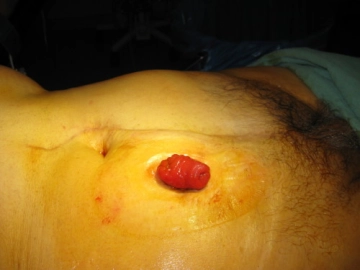
    In the presented example, it is an ileostomy created during an open rectal carcinoma operation.

    Types of stomas:

    • Temporary versus permanent stomas, possibly considering the need for complete diversion of stool passage to keep the subsequent bowel segment dry.
    • End stomas (split stomas, where the bowel ends after resection are separately diverted as end stomas) versus loop stomas (resection stomas where the bowel ends after resection are sutured posteriorly and then diverted together).
    • Modified split stoma where the efferent limb of a loop stoma is blindly closed at the abdominal wall level. This combines the advantages of complete diversion of stool passage with those of easy reversal without re-laparoscopy or -tomy.
    • Hartmann's situation with rectal blind closure and end colostomy. Here, a re-laparoscopy or -tomy is required in any case (reconnection surgery Hartmann II).

    An end stoma is usually created when, at least in the long term, reversal is not planned or possible.

    If the stoma is to be temporary, a loop stoma is usually created. A small bowel stoma is typically created in the terminal ileum or, if that is not possible, in the most distal small bowel segment.

    Optimal is the transrectal placement in the lower abdomen above the arcuate line. The better muscular and fascial support here is intended to prevent a parastomal hernia or prolapse.

    Due to anatomical proximity, the transverse stoma is best placed in the upper abdomen, and the ileo- and sigmoidostomy in the lower abdomen.

    Special situation protective stoma in colorectal carcinoma:

    In low anterior resection with TME, a protective stoma is generally indicated, with an ileostomy being preferable to a colostomy. An ileostomy is easier and less complicated to reverse. Parastomal hernias and stoma prolapses occur less frequently. However, fluid loss syndrome is much less common with a colostomy, and obstruction issues after reversal are also less frequent.

  2. Contraindications

    Ethical reasons

  3. Preoperative Diagnostics

    • Medical History
    • Clinical Examination
    • Laboratory
    • Optional: Ultrasound (dependent on examiner)

    Imaging usually available due to underlying conditions (indication), e.g., CT or contrast X-ray (gastrointestinal passage), MRI, rectoscopy, histology. Therefore, additional preoperative diagnostics are usually not required.

  4. Special Preparation

    Preparatory Measures:

    • Fasting depending on indication: For planned procedures, 6 hours of food abstinence and 2 hours of clear fluid abstinence.
    • Possibly laxative measures for bowel cleansing (e.g., for rectal surgery with planned stoma)
    • Marking of the ileostomy: Stoma marking

    Ideally, the marking and subsequent instruction on stoma care should be performed by specially trained stoma therapists or an experienced surgeon.

    1. Trial marking on the lying or already sitting patient in the area of the right rectus abdominis muscle (navel height) in a 10 × 10 cm skin area, preferably without folds, scars, or bony protrusions.
    2. Verification of the intended position in motion (standing, bending).
    3. The chosen site should be easily visible and accessible to the patient and compatible with the position of the pants or belt.
    4. Determination of an alternative marking is recommended in case of intraoperative complications.
    5. Covering the marking with a skin-friendly adhesive tape.

    The position of the stoma significantly influences handling and care, and thus the patient's quality of life!

    • Single-shot antibiotic prophylaxis
  5. Informed consent

    The indication, the procedure of stoma placement (permanent or temporary – conventional or laparoscopic placement), further care of the stoma in the hospital and later at home, as well as psycho-social factors should be discussed with the patient. (How do I live with an artificial outlet? What do I need to consider in the future? Nutritional counseling.)

    General complications in (laparoscopic) surgeries:

    • General surgical risks (bleeding, rebleeding, thrombosis, embolism, HIT)
    • Possible conversion to open technique in case of complications
    • Post-laparoscopic shoulder pain syndrome
    • Wound healing disorder
    • Postoperative ileus
    • Adhesions

    Specific complications:

    Stoma complications are not uncommon and are also due to technical inadequacies such as circulatory disorders, lack of tension-free placement, or too narrow stoma canal and incorrect positioning. However, even with proper placement, not all complications are necessarily avoidable:

    • Parastomal hernia
    • Stoma prolapse
    • Stenosis of the stoma
    • Stoma fistula
    • Retraction (recession below skin level)
    • Peristomal inflammation
    • Stoma avulsion
Anesthesia

Intubation anesthesiaPossibly additional local infiltration ... - Operations in general, visceral a

Activate now and continue learning straight away.

Single Access

Activation of this course for 3 days.

US$9.40  inclusive VAT

Most popular offer

webop - Savings Flex

Combine our learning modules flexibly and save up to 50%.

from US$7.29 / module

US$87.56/ yearly payment

price overview

general and visceral surgery

Unlock all courses in this module.

US$14.59 / month

US$175.10 / yearly payment

to top