Start your free 3-day trial — no credit card required, full access included

Liver resection, left lateral

  1. Laparotomy and Exploration of the Abdominal Cavity

    Video
    Laparotomy and Exploration of the Abdominal Cavity
    Soundsettings

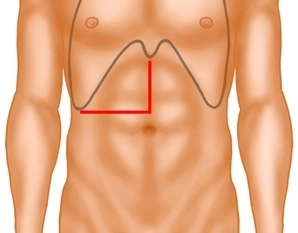
    The laparotomy is performed via a median incision with extension into the right flank, whereby the incision deviates just above the navel into the right flank. Then transection of the right-sided rectus musculature using bipolar scissors and opening of the peritoneum. The incision can be carried past the xiphoid on the left: This gains an additional good stretch, which facilitates the view, especially to the hepatic veins.
    Subsequently, the falciform ligament of the liver is detached close to the abdominal wall. After folding back the wound edges, insertion of the abdominal wall retractor and inspection of the situs: Exclusion of extrahepatic metastases or conspicuously large lymph nodes in the hilus in primary liver carcinomas; in the shown case, there is liver cirrhosis.

    Note:
    Small interventions on the left liver lobe up to left-lateral resections can also be performed via a median laparotomy, wedge excisions from the inferior segments IVb, V and VI via a subcostal incision.
  2. Mobilization of the Liver

    Video
    Mobilization of the Liver
    Soundsettings

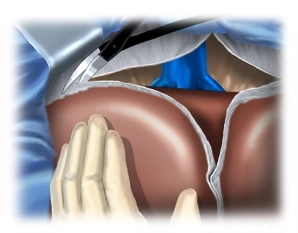
    The mobilization of the liver begins with the transection of the left triangular ligament (bipolar scissors). Subsequently, the liver is circumferentially freed from adhesions to the diaphragm, and the suprahepatic vena cava is exposed.

    Note:
    1. Prerequisite for a careful exploration, which includes bimanual palpation of the liver, is the complete mobilization of the liver.
    2. The complete mobilization of the liver is also helpful in managing possible bleeding complications.
    3. A tumor infiltration of the diaphragm does not represent a contraindication to resection. The affected portion of the diaphragm is resected en bloc with the tumor. The defect can almost always be closed directly.
    4. Due to the good accessibility of the left liver lobe, transection of the left triangular ligament can sometimes be omitted.

  3. Mobilization of the Gallbladder

    Video
    Mobilization of the Gallbladder
    Soundsettings

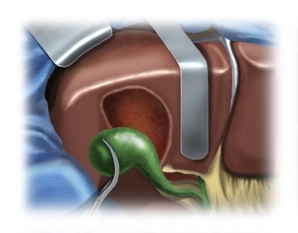
    The preparation begins with the incision of the serosa on the anterior side of the hepatoduodenal ligament. Then, the anterograde mobilization of the gallbladder from its liver bed down to the hepatoduodenal ligament takes place. The cystic artery is divided between Overholt clamps and ligated. The preparation step ends with the exposure of the cystic duct.

  4. Preparation of the hepatoduodenal ligament with lymph node dissection

    Video
    Preparation of the hepatoduodenal ligament with lymph node dissection
    Soundsettings

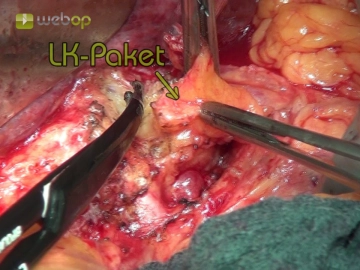
    The hilum preparation begins with the exposure of the left hepatic artery, which is looped. Subsequently, free preparation of the common hepatic duct and portal vein. Dissection of the lymph nodes.

    Note:
    1. During the preparation of the hepatic artery, care must be taken to preserve any branches that may depart to the contralateral side (in the film example: right).
    2. If no lymph node dissection is performed, the preparation in the liver hilum should be limited to the essentials to avoid vascular injuries and denudation of the bile duct.
    3. The portal vein bifurcation is prepared from the left in a left resection, and from the right in a right resection.
    4. The retrohepatic V. cava needs to be exposed only if the caudate lobe is resected as well.

Hilum Preparation

Continue the anatomical hilum preparation with display of the A. hepatica dextra crossing under the

Activate now and continue learning straight away.

Single Access

Activation of this course for 3 days.

US$9.40  inclusive VAT

Most popular offer

webop - Savings Flex

Combine our learning modules flexibly and save up to 50%.

from US$7.33 / module

US$87.98/ yearly payment

price overview

general and visceral surgery

Unlock all courses in this module.

US$14.66 / month

US$176.00 / yearly payment

Adverts
BiClamp® 201 T

... - Operations in general, visceral and transplant surgery, vascular surgery and thoracic surger

Activate now and continue learning straight away.

Single Access

Activation of this course for 3 days.

US$9.40  inclusive VAT

Most popular offer

webop - Savings Flex

Combine our learning modules flexibly and save up to 50%.

from US$7.33 / module

US$87.98/ yearly payment

price overview

general and visceral surgery

Unlock all courses in this module.

US$14.66 / month

US$176.00 / yearly payment

to top