Start your free 3-day trial — no credit card required, full access included

Perioperative management - Incisional hernia repair, Dynamesh® – IPOM

  1. Indication

    According to the guidelines of the EHS and AHS, the laparoscopic IPOM technique is recommended for larger primary and secondary abdominal wall hernias and in patients with an increased risk of wound complications. This particularly applies to patients with obesity (BMI >_ 30) and patients with a defect size greater than 4 cm. However, the defect should not exceed a size of 8 - 10 cm.

    The laparoscopic intraperitoneal mesh implantation currently represents the most common endoscopic, minimally invasive technique for the treatment of abdominal hernias worldwide. In Germany, however, there is a decline in this method due to fear of adhesiogenicity with the formation of prosthetic-intestinal fistulas despite improved meshes regarding their coating. Other reasons include an increased rate of acute and chronic postoperative pain, presumably due to mesh fixation on the inner abdominal wall. Additionally, the method is expensive due to significant material costs. Nevertheless, it is an important alternative technique.

    Secondary Abdominal Wall Hernias

    Incisional hernia is the most common complication after laparotomy with a prevalence between 3 and 40%, regardless of the abdominal wall closure chosen.

    Risk factors for the development of incisional hernias:
    BMI >­_ 25, male gender, recurrent incision, malignant disease, wound contamination, open surgery, COPD, positive family history.

    When determining the indication, the previous surgery should be at least 6 months prior.

    Closure of the Hernial Orifice:

    There are studies recommending an additional closure of the hernial orifice in IPOM to reduce the rate of recurrences, seroma formation, and pseudo-recurrences. For a small defect (< 3 cm), a direct closure of the defect is performed, and for larger defects, a so-called LIRA (intracorporeal rectus aponeuroplasty) with a knotless suture is used. In a recent study (Pizza F et al 2023), the superiority of hernial orifice closure could not be confirmed.
  2. Contraindications

    • Relative contraindication for large defects (> 10 cm) due to increased pain and recurrence rate
    • Giant hernia with no access for trocars (outside the planned mesh position!)
    • Split-thickness skin graft-covered former laparostoma/necrosis
    • Bacterial peritonitis (foreign material/mesh not in inflammation)
    • Ileus due to the risk of bowel perforation
    • Decompensated cardiorespiratory insufficiency
    • In severe cardiac and pulmonary pre-existing conditions, the benefits and risks of laparoscopy should be weighed, but even in higher-grade heart failure or respiratory impairment, laparoscopy under monitoring (blood pressure, pulse, ECG, oxygen saturation) is feasible.
    • Severe coagulation disorders (Quick < 50%, PTT > 60 s, platelets < 50 /nl) and pronounced portal hypertension with caput medusae, in both cases mainly due to the risk of bleeding from abdominal wall vessels.
  3. Preoperative Diagnostics

    • The abdominal wall hernia is a clinical diagnosis and can usually be well recognized in a standing patient. It is advisable to additionally examine the patient in a relaxed, lying position. When the patient is asked to lift the upper body, the fascial edge, the extent of the fascial defect, and the surrounding muscles can usually be assessed in reducible incisional hernias.
    • For smaller primary hernias, abdominal ultrasonography is a meaningful imaging procedure.
    • To determine the defect location and extent, especially in incisional hernias, and to depict the abdominal wall anatomy, CT is the best diagnostic procedure; alternatively, an MRI can be performed.
    • For previous incisional hernia repairs, a corresponding operative report is often helpful, especially if a mesh repair has already been performed. Here, in addition to the exact surgical technique (extra- or intraperitoneal mesh placement, augmentation or bridging of the fascial defect), the type of mesh material is particularly important.
    • In extensive findings, thorough cardiopulmonary functional diagnostics are necessary due to the increase in pressure after repositioning the eventrated intestines.

    EHS (European Hernia Society) Classification

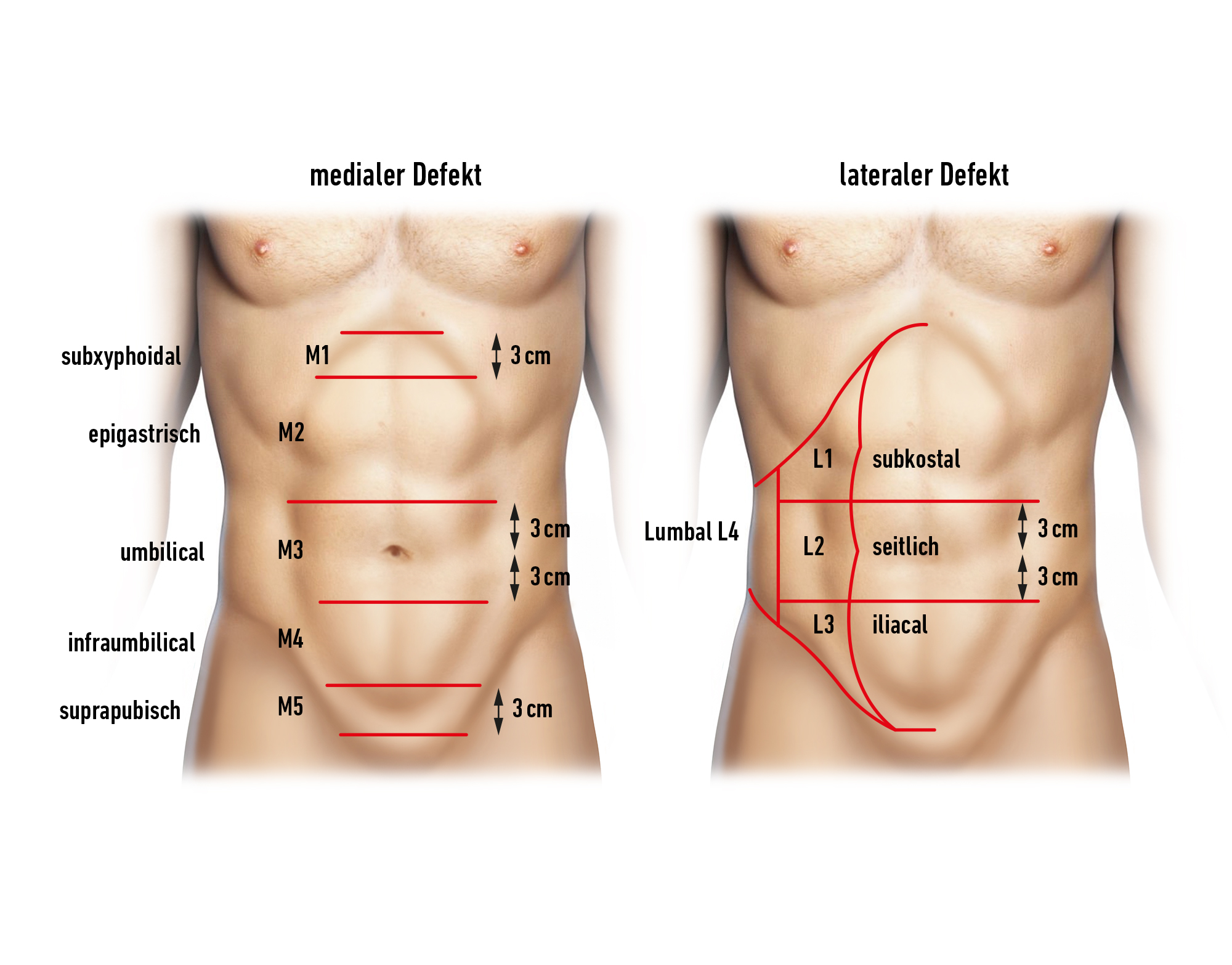
    To better characterize the present hernia, the EHS classification should be used.

    Classification of Primary Ventral Hernias

    Small (S)

    Medium (M)

    Large (L)

    < 2 cm

    ≥ 2 - < 4 cm

    ≥ 4 cm

    Midline

    Epigastric

    Umbilical

    Lateral

    Spigelian

    Lumbar

    The classification of secondary abdominal wall hernias is initially based on a medial or lateral defect location in the abdominal wall.

    70-PM-3

    The defect location of medial hernias is then more precisely delineated as subxiphoidal, epigastric, umbilical, infraumbilical, and suprapubic. Laterally, the defects are classified as subcostal, lateral, iliac, and lumbar.

    Further consideration is given to the defect width of the incisional hernia: W1 (< 4 cm), W2 (4 - 10 cm), and W3 (> 10 cm).

    If multiple hernia defects exist (mesh hernia, Swiss-cheese hernia), their size is determined by the total length and width.

  4. Special Preparation

    Single-shot antibiotic i.v. perioperatively (due to the use of foreign material/mesh), possibly continuation of therapy in case of intraoperative signs of inflammation or bacterial contamination.

  5. Informed consent

    General:

    • Pneumonia
    • Bleeding, hematoma
    • Wound infection/wound healing disorder
    • Thrombosis/embolism
    • Excessive scar formation

    Specific:

    • Implantation of synthetic material
    • Nerve injury/chronic pain
    • Seroma (usually present, mostly without therapeutic consequence)
    • Infection of the implant with the consequence of needing to remove it.
    • Recurrent hernia
    • Trocar hernias
    • Conversion to open procedure intraoperatively
    • Bowel perforation
    • Subsequent interventions
    • Lethality
Anesthesia

Intubation anesthesia for pneumoperitoneum ... - Operations in general, visceral and transplant sur

Activate now and continue learning straight away.

Single Access

Activation of this course for 3 days.

US$9.40  inclusive VAT

Most popular offer

webop - Savings Flex

Combine our learning modules flexibly and save up to 50%.

from US$7.29 / module

US$87.56/ yearly payment

price overview

general and visceral surgery

Unlock all courses in this module.

US$14.59 / month

US$175.10 / yearly payment

to top