Start your free 3-day trial — no credit card required, full access included

Evidence - Pancreaticoduodenectomy, pylorus-preserving, partial (OP according to Traverso)

  1. Summary of the Literature

    Pancreatic cancer is the fourth leading cause of cancer death in Europe and is expected to rank second in cancer mortality by 2030 [1]. The only potentially curative treatment option is surgical resection, which still achieves a 5-year survival rate of only 10% [2]. The aggressive tumor biology has led to the introduction of new, more effective chemotherapy regimens, both adjuvant and neoadjuvant, over the past 10 years, resulting in the establishment of multimodal therapy concepts.

    Indication for Surgery

    On the initiative of the German Society for General and Visceral Surgery (DGAV), evidence-based recommendations for the indication for surgery of pancreatic cancer have been defined, with the indication to be made by a tumor board of experienced pancreatic surgeons in accordance with guidelines, taking into account individual patient characteristics [3]. According to the recommendations, based on the systematic analysis of 58 original papers and 10 guidelines, there is an indication for surgery in histologically confirmed pancreatic cancer as well as in a high suspicion of a resectable pancreatic cancer [3, 4].

    Resectability

    The greatest chance of survival is with resection in healthy tissue, the R0 resection [5, 6]. Current guidelines now divide the R0 classification into "R0 narrow" (≤ 1 mm) and "R0 wide" (> 1 mm), depending on whether the carcinoma reaches less or more than one millimeter to the resection margin [7]. In addition to anatomical resectability (relationship between tumor and major visceral vessels), tumor biology and the general condition of the patient have been considered as co-determining resectability criteria since 2017 and have been included in the current S3 guidelines as the ABC consensus classification of resectability [8].

    ABC Criteria of Resectability According to the International Association of Pancreatology (IAP) Consensus

    (Click to enlarge)
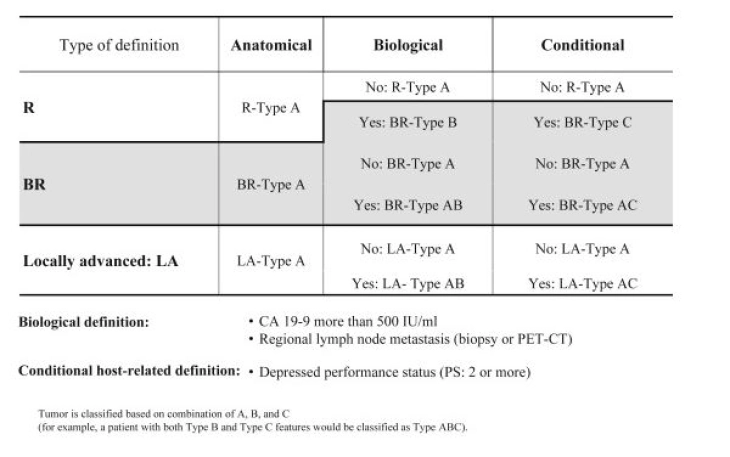
    35-25

    Source: Isaji S et al (2018) International consensus on definition and criteria of borderline resectable pancreatic ductal adenocarcinoma 2017. Pancreatology18(1):2–11.

    To assess anatomical resectability, the S3 guidelines recommend a contrast-enhanced 2-phase computed tomography [7]. Based on the anatomical resectability criteria, a tumor can be classified as primarily resectable, borderline resectable, and non-resectable or locally advanced [7].

    The assessment of biological resectability is most often based on the tumor marker CA 19-9. The threshold was defined as > 500 IU/ml, as above this value, resectability is given in less than 70% of cases and survival of less than 20 months is expected [8, 9].

    Another criterion is the ECOG Performance Status as conditional resectability, with patients having a status ≥ 2 having a poor prognosis [8].

    Mesopancreas

    The mesopancreas, the connective tissue region around the major vessels of the pancreatic region, which is densely traversed by blood and lymphatic vessels as well as nerve plexuses, has been discussed for several years [10]. Meta-analyses suggest that total mesopancreatic resection enables better oncological outcomes [11]. In pancreatic head resection, the complete removal of mesopancreatic tissue between the portal vein, hepatic artery, base of the celiac trunk, and superior mesenteric artery (Triangle Operation [12, 13]) is performed, while in left pancreatic resections (body, tail carcinomas), the radical antegrade modular pancreatosplenectomy (RAMPS [14]) is performed.

    [RAMPS: Depending on the extent of the tumor, an anterior is distinguished from a posterior RAMPS procedure, in which essentially more radical resection is performed dorsally. In anterior RAMPS, resection is performed with removal of Gerota's fascia and perirenal fat on the left side. In contrast, in posterior RAMPS, in addition to Gerota's fascia and perirenal fat, the left adrenal gland is also resected.]

    Vascular Resection

    In centers, venous resections have minimally increased morbidity and mortality, and adequate overall survival is enabled [15, 16]. According to the current S3 guidelines, vascular resection of the portal vein can be performed in cases of tumor infiltration ≤ 180° or in complex situations such as cavernous transformation with reconstruction [17]. Arterial resections, on the other hand, are very risky, often complex, and frequently require simultaneous venous reconstructions. Patients often do not benefit oncologically from extensive procedures and often show worse survival data than patients without vascular resection [18]. Therefore, arterial resections should be avoided outside of centers.

    Unexpected arterial resections can be avoided by early exposure to check for tumor-free status of the superior mesenteric artery and celiac trunk during a curative-intent pancreatic resection. The "Artery-first" strategy helps avoid futile procedures, allows better planning of vascular resections and reconstructions, and improves long-term survival for selected patients in centers with appropriate expertise [19].

    Oligometastasis

    The term oligometastasis appears for the first time in the current S3 guidelines and describes the presence of ≤ 3 metastases, which should only be resected within studies as part of a multimodal treatment concept [7]. No randomized studies are available yet, but resection of oligometastases seems to improve patient survival data compared to palliative chemotherapy, especially after neoadjuvant therapy [20 - 23]. In Germany, the HOLIPANC and METAPANC studies are currently addressing the issue [24].

    Neoadjuvant Therapy Concepts

    For patients with borderline resectable pancreatic cancer, the current guideline recommends preoperative chemotherapy or chemoradiotherapy, while for resectable carcinomas, it should not be performed outside of studies [7]. The recommendations are based on data from a meta-analysis and currently published study data [25, 26]. Since after neoadjuvant therapy, resectability in initially borderline resectable and locally advanced pancreatic cancers is difficult to assess morphologically, the guideline recommends surgical exploration to assess secondary resectability in stable disease [7, 27]. A decrease in CA 19-9 levels can also help in assessing secondary resectability [28, 29].

    Laparoscopic Techniques and Robotics in Pancreatic Cancer

    Pancreatic left and pancreatic head resections must be considered separately. For left resections in laparoscopic technique, the randomized controlled LEOPARD study showed faster recovery, less blood loss, and no higher complication rate compared to the open technique [30]. The combined analysis of the LEOPARD and LAPOPS studies confirmed the data [31]. Long-term quality of life remains unchanged with the laparoscopic technique [32]. A meta-analysis of the existing data showed comparable results for the R0 resection rate and the rate of adjuvant chemotherapy [33]. The median overall survival was the same for laparoscopic and open pancreatic left resections at 28 and 31 months, respectively [34].

    For pancreatic head resections, the 2019 published randomized and controlled LEOPARD-2 study showed higher mortality (90-day mortality 10%) in the laparoscopic group, which had no advantages over the open group in terms of postoperative pain, recovery, hospital stay, and quality of life [36]. A recent Chinese randomized study showed comparable mortality in laparoscopic pancreatic head resection with only slight advantage of the laparoscopic technique [37].

    Robotics has also been established in pancreatic surgery over the past 10 years. In addition to the technically simpler left resection, pancreaticoduodenectomy is increasingly being performed. However, a long learning curve is required [37], and a final evaluation regarding oncological outcomes is not yet possible. Only observational studies are available on the use of robotics for malignant indications, demonstrating feasibility and potential advantages of the minimally invasive technique [38, 39, 40]. According to international guidelines, a malignant indication is not a fundamental contraindication for robotics, but results from randomized controlled trials and thus high-quality results are not expected for another 3 to 5 years [41].

    Centralization of Pancreatic Surgery

    In high-volume centers for pancreatic surgery, postoperative mortality can be reduced and survival increased [42, 43, 44]. Against this background, the minimum volumes for complex pancreatic procedures in Germany will be increased from the current 10 to 20 resections per year from 2024, as decided by the Joint Federal Committee.

    Whipple Procedure versus Pylorus-Preserving Pancreatoduodenectomy (PPPD)

    Two surgical procedures are considered for the resection of pancreatic head and periampullary carcinomas, the classic resection according to Kausch-Whipple and the pylorus-preserving pancreatoduodenectomy. The latter has the advantage of preserved physiological food passage and reduction of dumping syndromes, postoperative weight loss, and reflux [45-52].

    More recent studies [49, 51, 52] have shown a lower transfusion rate and hospital stay for PPPD patients compared to the Whipple group. Postoperative morbidity did not differ significantly between the two groups. The occurrence of gastric emptying disorders was comparable in both groups (Whipple 23% vs. PPPD 22%). There was also no significant difference in surgical radicality (R0-Whipple 82.6% vs. R0-PPPD 73.6%). Long-term follow-up showed comparable overall survival rates.

  2. Currently ongoing studies on this topic

  3. Literature on this Topic

    1. Quante AS et al (2016) Projections of cancer incidence and cancer-related deaths in Germany by 2020 and 2030. CancerMed 5:2649–2656.

    2. Ducreux M et al (2015) Cancer of the pancreas: ESMO Clinical Practice Guidelines for diagnosis, treatment and follow-up. Ann Oncol 26(Suppl5):v56–v68.

    3. Brunner M et al (2021) Indications for the surgical management of pancreatic neoplasms. Z Gastroenterol.

    4. Takaori K et al (2016) International Association of Pancreatology (IAP)/European Pancreatic Club (EPC) consensus review of guidelines for the treatment of pancreatic cancer. Pancreatology 16(1):14–27.

    5. Hank T et al (2018) Validation of at least 1 mm as cut-off for resection margins for pancreatic adenocarcinoma of the body and tail. Br J Surg 105(9):1171–1181.

    6. Strobel O et al (2017) Pancreatic cancer surgery: the new R-status counts. Ann Surg 265(3):565–573.

    7. Leitlinienprogramm Onkologie (Deutsche Krebsgesellschaft, D.K., AWMF), S3-Leitlinie zum exokrinen Pankreaskarzinom, Langversion 2.0, 2021, AWMF Registernummer: 032-010OL. 2021.

    8. Isaji S et al (2018) International consensus on definition and criteria of borderline resectable pancreatic ductal adenocarcinoma 2017. Pancreatology 18(1):2–11.

    9. Hartwig W et al (2013) CA19-9 in potentially resectable pancreatic cancer: perspective to adjust surgical and perioperative therapy. Ann Surg Oncol 20(7):2188–2196.

    10. Negoi I et al (2018) Surgical anatomy of the superior mesenteric vessels related to pancreaticoduodenectomy: a systematic review and meta-analysis. J Gastrointest Surg 22(5):802–817.

    11. Zhou Q et al (2019) Assessment of postoperative long-term survival quality and complications associated with radical antegrade modular pancreatosplenectomy and distal pancreatectomy: a meta-analysis and systematic review. BMC Surg 19(1):12.

    12. Hackert T et al (2017) The TRIANGLE operation - radical surgery after neoadjuvant treatment for advanced pancreatic cancer: a single arm observational study. HPB 19(11):1001–1007.

    13. Schneider M et al (2019) Pancreatic resection for cancer-the Heidelberg technique. Langenbecks Arch Surg 404(8):1017–1022.

    14. Mitchem JB et al (2012) Long-term results of resection of adenocarcinoma of the body and tail of the pancreas using radical antegrade modular pancreatosplenectomy procedure. J Am Coll Surg 214(1):46–52.

    15. Mihaljevic AL et al (2021) Not all Whipple procedures are equal: proposal for a classification of pancreatoduodenectomies. Surgery 169(6):1456–1462.

    16. Nagakawa Y et al (2021) Surgical outcomes of pancreatectomy with resection of the portal vein and/or superior mesenteric vein and jejunal vein for pancreatic head cancer: a multicenter study. Ann Surg.

    17. Schmidt T et al (2020) Cavernous transformation of the portal vein in pancreatic cancer surgery venous bypass graft first. Langenbecks Arch Surg 405(7):1045–1050.

    18. Malczak P et al (2020) Arterial resections in pancreatic cancer—Systematic review and meta-analysis. HPB 22(7):961–968.

    19. Loos M et al (2022) Arterial resection in pancreatic cancer surgery: effective after a learning curve. Ann Surg 275(4):759–768.

    20. Damanakis AI et al (2019) Proposal for a definition of "Oligometastatic disease in pancreatic cancer". BMC Cancer 19(1):1261.

    21. Crippa S et al (2020) A systematic review of surgical resection of liver-only synchronous metastases from pancreatic cancer in the era of multiagent chemotherapy. Updates Surg 72(1):39–45.

    22. Hackert T et al (2017) Radical surgery of oligometastatic pancreatic cancer. Eur J Surg Oncol 43(2):358–363.

    23. Pausch TM et al (2021) Survival benefit of resection surgery for pancreatic ductal adenocarcinoma with liver metastases: a propensity score-matched SEER database analysis. Cancers 14(1):57.

    24. Gebauer F et al (2021) Study protocol of an open label, single arm phase II trial investigating the efficacy, safety and quality of life of neoadjuvant chemotherapy with liposomal irinotecan combined with Oxaliplatin and 5-fluorouracil/Folinic acid followed by curative surgical resection in patients with hepatic Oligometastatic adenocarcinoma of the pancreas (HOLIPANC). BMC Cancer 21(1):1239.

    25. Versteijne E et al (2018) Meta-analysis comparing upfront surgery with neoadjuvant treatment in patients with resectable or borderline resectable pancreatic cancer. Br J Surg 105(8):946–958.

    26. Versteijne E et al (2020) Preoperative chemoradiotherapy versus immediate surgery for resectable and borderline resectable pancreatic cancer: results of the Dutch randomized phase III PREOPANC trial. J Clin Oncol 38(16):1763–1773.

    27. Ferrone CR et al (2015) Radiological and surgical implications of neoadjuvant treatment with FOLFIRINOX for locally advanced and borderline resectable pancreatic cancer. Ann Surg 261(1):12–17.

    28. Tsai S et al (2020) Importance of normalization of CA19-9 levels following neoadjuvant therapy in patients with localized pancreatic cancer. Ann Surg 271(4):740–747.

    29. Heger U et al (2020) Induction chemotherapy in pancreatic cancer: CA 19-9 may predict resectability and survival. HPB 22(2):224–232.

    30. de Rooij T et al (2019) Minimally invasive versus open distal pancreatectomy (LEOPARD): a multicenter patient-blinded randomized controlled trial. Ann Surg 269(1):2–9.

    31. Korrel M et al (2021) Minimally invasive versus open distal pancreatectomy: an individual patient data meta-analysis of two randomized controlled trials. HPB 23(3):323–330.

    31. Korrel M et al (2021) Long-term quality of life after minimally invasive vs open distal pancreatectomy in the LEOPARD randomized trial. J Am Coll Surg 233(6):730–739.

    33. van Hilst J et al (2019) Oncologic outcomes of minimally invasive versus open distal pancreatectomy for pancreatic ductal adenocarcinoma: a systematic review and meta-analysis. Eur J Surg Oncol 45(5):719–727.

    34. van Hilst J et al (2019) Minimally invasive versus open distal pancreatectomy for ductal adenocarcinoma (DIPLOMA): a pan-European propensity score matched study. Ann Surg 269(1):10–17.

    35. van Hilst J et al (2019) Laparoscopic versus open pancreatoduodenectomy for pancreatic or periampullary tumors (LEOPARD-2): a multicenter, patient-blinded, randomized controlled phase 2/3 trial. Lancet Gastroenterol Hepatol 4(3):199–207.

    36. Wang M et al (2021) Laparoscopic versus open pancreatoduodenectomy for pancreatic or periampullary tumors: a multicenter, open-label, randomized controlled trial. Lancet Gastroenterol Hepatol 6(6):438–447.

    37. Boone BA et al (2015) Assessment of quality outcomes for robotic pancreaticoduodenectomy: identification of the learning curve. JAMA Surg 150(5):416–422.

    38. Raoof M et al (2018) Oncologic outcomes after robot-assisted versus laparoscopic distal pancreatectomy: analysis of the national cancer database. J Surg Oncol 118(4):651–656.

    39. Nassour I et al (2020) Long-term oncologic outcomes of robotic and open pancreatectomy in a national cohort of pancreatic adenocarcinoma. J Surg Oncol 122(2):234–242.

    40. Zhao W et al (2018) Safety and efficacy for robot-assisted versus open pancreaticoduodenectomy and distal pancreatectomy: a systematic review and meta-analysis. Surg Oncol 27(3):468–478.

    41. Kirchberg J et al (2019) Evidence for robotic surgery in oncological visceral surgery. Chirurg 90(5):379–386.

    42. Krautz C et al (2018) Effect of hospital volume on in-hospital morbidity and mortality following pancreatic surgery in Germany. Ann Surg 267(3):411–417.

    43. Finks JF et al (2011) Trends in hospital volume and operative mortality for high-risk surgery. N Engl J Med 364(22):2128–2137.

    44. de Wilde RF et al (2012) Impact of nationwide centralization of pancreaticoduodenectomy on hospital mortality. Br J Surg 99(3):404–410.

    45. Bloechle C et al. (1998) Prospective randomized study to evaluate quality of life after partial pancreatoduodenectomy according to Whipple versus pylorus preserving pancreatoduodenectomy according to Longmire-Traverso for periampullary carcinoma. Chirurgisches Forum für experimentelle und klinische Forschung Vol.1: 661–664.

    46. Paquet K (1998) Comparison of Whipple’s pancreaticoduodenectomy with the pylorus-preserving pancreaticoduodenectomy- a prospectively controlled, randomized long-term trial. Chir Gastroenterol 14:54–58.

    47. Lin P et al (1999) Prospective randomized comparison between pylorus-preserving and standard pancreaticoduodenectomy. Br J Surg 86:603–607.

    48. Wenger F et al. (1999) Gastrointestinal quality of life after duodenopancreatectomy in pancreatic carcinoma. Preliminary results of a prospective randomized study: pancreatoduodenectomy or pylorus-preserving pancreatoduodenectomy. Chir Z Alle Geb Oper Medizen 70:1454–1459.

    49. Tran KT et al (2004) Pylorus preserving pancreaticoduodenectomy versus standard Whipple procedure: a prospective, randomized, multicenter analysis of 170 patients with pancreatic and periampullary tumors. Ann Surg 240:738–745.

    50. Seiler C et al (2005) Randomized clinical trial of pylorus-preserving duodenopancreatectomy versus classical Whipple resection – long term results. Br J Surg 92:547–556.

    51. Srinarmwong C et al (2008) Standard Whipple’s operation versus pylorus preserving pancreaticoduodenectomy: a randomized controlled trial study. Med J Med Assoc Thail 91:693–693.

    52. Taher M et al (2015) Pylorus Preserving Pancreaticoduodenectomy vs. Standard Whipple’s Procedure in Case of Carcinoma head of the Pancreas and Periampullary Carcinoma. Mymensingh Med J 24:319–325.

  4. Reviews

    1. Hai H, Li Z, Zhang Z, Cheng Y, Liu Z, Gong J, Deng Y. Duct-to-mucosa versus other types of pancreaticojejunostomy for the prevention of postoperative pancreatic fistula following pancreaticoduodenectomy. Cochrane Database Syst Rev. 2022 Mar 15;3:CD013462

    2. Hüttner FJ, Klotz R, Ulrich A, Büchler MW, Probst P, Diener MK. Antecolic versus retrocolic reconstruction after partial pancreaticoduodenectomy. Cochrane Database Syst Rev. 2022 Jan 11;1:CD011862.

    3. Hyman DW, Almerey T, Mujkanovic A, Hammons I, Tice M, Stauffer JA. Comparing Post-Operative Outcomes of Pancreaticoduodenectomy for Pancreatic Ductal Adenocarcinoma: Neoadjuvant Therapy Versus Surgery First Approach. Am Surg. 2022 Aug;88(8):1868-1874

    4. Kokkinakis S, Kritsotakis EI, Maliotis N, Karageorgiou I, Chrysos E, Lasithiotakis K. Complications of modern pancreaticoduodenectomy: A systematic review and meta-analysis. Hepatobiliary Pancreat Dis Int. 2022 Apr 25. pii: S1499-3872(22)00118-7.

    5. Ouyang L, Zhang J, Feng Q, Zhang Z, Ma H, Zhang G. Robotic Versus Laparoscopic Pancreaticoduodenectomy: An Up-To-Date System Review and Meta-Analysis. Front Oncol. 2022 Feb 25;12:834382.

    6. Petrucciani N, Crovetto A, DE Felice F, Pace M, Giulitti D, Yusef M, Nigri G, Valabrega S, Kassir R, D'Angelo F, Debs T, Ramacciato G, Aurello P. Postoperative Pancreatic Fistula: Is Minimally Invasive Surgery Better than Open? A Systematic Review and Meta-analysis. Anticancer Res. 2022 Jul;42(7):3285-3298.

    7. Vladimirov M, Bausch D, Stein HJ, Keck T, Wellner U. Hybrid Laparoscopic Versus Open Pancreatoduodenectomy. A Meta-Analysis. World J Surg. 2022 Apr;46(4):901-915

    8. Xu D, Wu P, Zhang K, Cai B, Yin J, Shi G, Yuan H, Miao Y, Lu Z, Jiang K. The short-term outcomes of distal pancreatectomy with portal vein/superior mesenteric vein resection. Langenbecks Arch Surg. 2022 Aug;407(5):2161-2168

    9. Zhang B, Yuan Q, Li S, Xu Z, Chen X, Li L, Shang D. Risk factors of clinically relevant postoperative pancreatic fistula after pancreaticoduodenectomy: A systematic review and meta-analysis. Medicine (Baltimore). 2022 Jul 1;101(26):e29757.

  5. Guidelines

  6. literature search

    Literature search on the pages of pubmed.