
In 1973, the Greek military doctor G. Karydakis presented a new technique for the surgical treatment of pilonidal sinus in "The Lancet," which is still performed under his name today [1]. Karydakis' considerations were based on the etiology of pilonidal sinus postulated by Patey, namely the penetration of hairs into the skin of the natal cleft and the formation of foreign body granulomas [2, 3]. The operation aimed to flatten the natal cleft and create a scar lateral to it. This was achieved through an asymmetrical, elliptical excision of the skin, enclosing the fistulas in the midline. On the opposite side, a subcutaneous flap was mobilized, and a three-layer wound closure then led to the desired result.
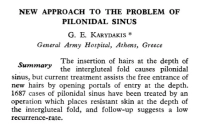
Source: Karydakis GE. New approach to the problem of pilonidal sinus. Lancet. 1973 Dec 22;2(7843):1414-5. (Click to enlarge)
Karydakis performed the flap technique named after him on 1687 patients and reported on the results in a large study [1]. Of the patients followed up, 8.5% had wound healing disorders, and 9 out of 754 developed recurrences (1.3%). However, it must be noted that the follow-up only included 40% of the operated patients.
Karydakis published a follow-up study in 1992 [4]. Among 5876 operated patients, he reported a recurrence rate of less than 1%. This time, all patients (!) were supposed to have been followed up, with the follow-up period ranging from 2 to 20 years. Despite the low recurrence rate, Karydakis stated that he had identified the cause of the recurrences: In some patients, sufficient lateralization of the wound was not achieved, causing the wound to cross the natal cleft, leading to recurrences. Several patients developed skin expansion over time, resulting in a neo-cleft where new pits developed.
Among the studies on the Karydakis flap published since the mid-1990s, the work by Kitchen in 1996 is particularly noteworthy [5]. The author found a recurrence rate of 4% after 2 years and a wound dehiscence rate of 9% in 141 patients operated on using the Karydakis technique. 23% of the patients had previous operations. The Kitchen study is significant because it provides a precise guide to incision and reconstruction.
In studies from the last 15 to 20 years, recurrence rates after the Karydakis flap ranged from 0 to 6% after 5 years of follow-up, and wound infection rates ranged from 8 to 23% [5, 6-11].
Five prospective randomized studies from Turkey compared the Karydakis technique with the Limberg flap [8, 12-15]. In one study, a statistically significantly higher recurrence rate was found after the Karydakis operation compared to the Limberg flap (11% vs. 2% [12]), while in three other studies, no significant differences in recurrence frequency between the two methods were found (2–5% vs. 3–7%). In two studies, it was shown that the wound dehiscence rate of the Karydakis flap was significantly higher than that of the Limberg flap (26% vs. 8% in Ersoy [15] and 15% vs. 4% in Arslan [12]). After the Karydakis flap, wound healing was smoother in two studies compared to the Limberg flap (11% vs. 21% in Ates [13] and 18% vs. 38% in Bessa [8]). Recurrence rates for Limberg and Karydakis flaps are lower compared to primary open procedures [16, 17]. However, the follow-up period in the study by Sevinc et al. is only 24 months [17], while other authors consider a minimum follow-up period of 5 years necessary for a solid assessment.
In their 2018 meta-analyses, the working groups of Prassas and Sahebally found that the wound dehiscence and wound infection rates of the Karydakis and Limberg flaps were equally low. The Limberg group had a lower seroma rate [18, 19]. Compared to Karydakis, pain intensity seems to be lower in the Limberg group [20]. Wound healing disorders predominantly occurred near the anal canal and the midline [21, 22].
The German S3 guideline for the treatment of pilonidal sinus as of 2020 states that the Karydakis procedure can be considered as one of the plastic procedures [8, 13-15].