Start your free 3-day trial β€” no credit card required, full access included

Anatomy - Seton drainage for high transsphincteric anal fistula

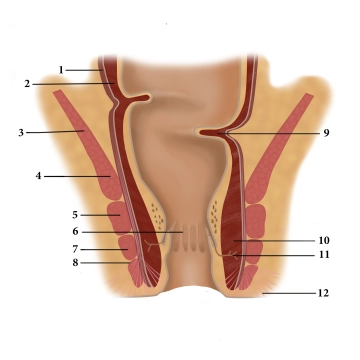
  1. Anal Canal (Canalis analis)

    Anal Canal (Canalis analis)

    (1) Longitudinal muscular tunic, (2) Circular muscular tunic, (3) Levator ani muscle, (4) Puborectalis muscle, (5) Deep anal sphincter, (6) Anal columns, (7) Superficial anal sphincter, (8) Subcutaneous anal sphincter, (9) Kohlrausch fold, (10) Internal anal sphincter, (11) Proctodeal gland, (12) Corrugator ani muscle

    Three muscles form the closure apparatus in the wall of the lower rectum:

    1. The internal anal sphincter is a thickening of the last circular fibers of the smooth colon muscle and is innervated by the sympathetic nervous system.
    2. The levator ani muscle, on the other hand, is voluntarily innervated (sacral plexus) and includes the puborectalis muscle attached to the pubic bone. It acts as a large sling around the anal canal, bending it functionally forward.
    3. The external anal sphincter is also striated and is suspended between the center of the perineal region (perineal body) and the coccyx. It is voluntarily innervated by the pudendal nerve. Its contraction closes the anal canal terminally.
      The different innervation of the three closing muscles provides additional security against failures and resulting incontinence.

    In the mucosa of the anal canal, there are numerous longitudinal folds (anal columns) that have dense arterial plexuses with venous drainage. Upon contraction of the sphincter muscles, they quickly fill and the mucosa swells, adheres together, and thus provides a gas-tight seal. Hemorrhoids and venous thromboses are known vascular complications of this region.
    Defecation occurs partly through the relaxation of the closure mechanisms (initiated by voluntary muscles, emptying of the erectile tissue) and partly through active abdominal pressure and intestinal peristalsis.
  2. Rectum

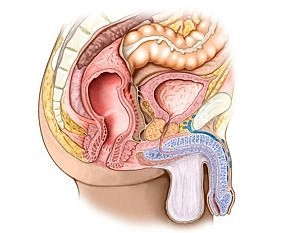
    Rectum

    Functionally, the rectum serves as a fecal reservoir, preventing continuous defecation. It directly follows the sigmoid colon and, like it, has an S-shaped anterior/posterior and lateral curvature (sacral, anorectal, and lateral flexures). Typically, the rectum is divided into three sections:

    1. Ampulla recti (main reservoir, ventral to the sacrum)
    2. Anal canal (see below, closure region between the anorectal flexure and the skin opening)
    3. between 1 and 2, an unspecified section that extends at a right angle from 1 and transitions at a right angle into 2. Here, typical folds (Kohlrausch folds) are found in the mucosa.
      Adjacent structures of the rectum are dorsally the sacrum and coccyx, laterally the regional lymph nodes next to the internal iliac artery and vein, the sacral plexus, and parts of the autonomic nervous system, as well as the ureter and adnexa. Ventrally, in females, are the uterus and vagina, and in males, the bladder and prostate/seminal vesicle. Caudally is the pelvic floor.

    Read more about the histology of the rectum here.

  3. Vascular Supply

    Vascular Supply

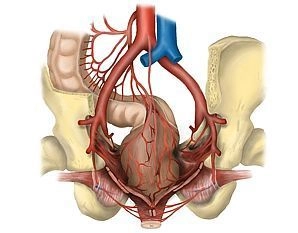
    The rectum is supplied arterially by three main vessels:

    • the superior rectal artery (from the inferior mesenteric artery) via the sigmoid mesocolon (note: transection of this artery at the level of the sigmoid leads to ischemia of the upper rectum!)
    • the middle rectal artery (from the internal iliac artery), running cranially to the levator ani muscle
    • the inferior rectal artery (from the internal pudendal artery), below the levator ani muscle

    Under the mucosa of the rectum, the veins run as the rectal venous plexus. They drain the blood of the organ in the upper section as the superior rectal vein via the inferior mesenteric vein to the liver, in the middle and lower sections via the middle and inferior rectal veins and via the internal iliac vein to the inferior vena cava (portocaval anastomosis). Medications administered via suppositories thus enter the organism unmetabolized only if they are not pushed into the drainage area of the superior rectal vein.
    Corresponding to the vascular supply, the lymph of the rectum is also drained: The large group of inferior mesenteric lymph nodes forms its own group at the upper rectum (superior rectal lymph nodes), likewise, the internal iliac lymph nodes take lymph from the middle rectum (from the pararectal lymph nodes), and the superficial inguinal lymph nodes take lymph from the lower anal region, anus, and skin of the perineal region.

  4. Perineal Region (Perineum)

    The perineal region encompasses the area caudal to the pelvic diaphragm (urogenital and anal region) and is bounded

    • cranially by the fascia diaphragmatis pelvis inferior
    • ventrally by the symphysis
    • laterally by the ischium
    • dorsally by the lower edge of the gluteus maximus muscle

    The posterior perineal region corresponds to the anal region and is referred to in nomenclature as the ischioanal fossa, while the anterior perineal region corresponds to the pubic region and can be further divided into three overlapping sections: the most superficial being a subcutaneous perineal space (between the subcutaneous fascia = Colles' fascia and the fascia perinei = Buck's fascia), a superficial perineal space between the fascia perinei and the perineal membrane, and a deep perineal space cranial to the perineal membrane.

    The dorsally located ischioanal fossa consists mainly of adipose tissue and numerous vessels/nerves (branches of the inferior rectal artery and the internal pudendal artery as well as the pudendal nerve to the anal region) beneath the skin. At the transition to the sacral region, a cavity lined with epithelium can form as a tract between the coccyx tip and the anal margin. This can be encapsulated as a cyst (pilonidal cyst/dermoid cyst) or may have an external connection (pilonidal fistula).

    The ventrally located superficial perineal space (Spatium superficiale perinei) contains the superficial perineal muscles and the conduits to the external genitalia (perineal artery and artery of the bulb of the vestibule as well as branches of the pudendal nerve to the labia/clitoris or to the scrotum).
    The ventral deep perineal space (Spatium profundum perinei) is less clearly defined, transitions dorsally into the ischioanal fossa, and contains the deep perineal muscles and further profound conduits.

to top