Start your free 3-day trial — no credit card required, full access included

Anatomy - pelvic lymphadenectomy on both sides, laparoscopic, robot-assisted laparoscopy (DaVinci)

  1. The bony pelvis

    The bony pelvis

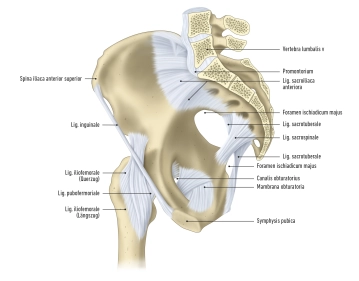
    The human pelvis is a complex ring structure that fulfills two main functions. On one hand, it forms the lower closure of the trunk and thus carries the weight of the upper body. On the other hand, it transfers this weight to the lower limbs, which is crucial for the upright posture and locomotion of humans.

    The pelvis is composed of several bony elements. The foundation is formed by the two hip bones, also known as the pelvic girdle or cingulum membri inferioris. Between them is the sacrum. The os coxae consists of three main components:

    1. The ilium (Os ilium), consisting of the corpus ossis ilii and the ala ossis ilii.
    2. The ischium (Os ischii), consisting of the corpus ossis ischii and the ramus ossis ischii.
    3. The pubis (Os pubis), consisting of the corpus ossis pubis, the ramus superior, and the ramus inferior ossis pubis.

    These bones and the sacrum are connected by various types of connections, including ligamentous connections, cartilaginous connections, and joints:

    1. Ligamentous connections include the membrana obturatoria, the ligamenta sacroiliaca, sacrotuberale, and sacrospinale.
    2. Fibrocartilaginous connections are established by the symphysis pubica.
    3. Joint connections include the articulation sacroiliaca and the articulatio sacrococcygea.

    There are various ligaments involved in the joints:

    • The ligg. sacroiliaca anteriora and posteriora are ligaments that connect the upper and lower ends of the ilium to the sacrum.
    • The ligg. sacroiliaca interossea extend between the sacrum and the tuberositas ossis sacri and tuberositas iliaca.
    • The lig. iliolumbale runs from the 4th and 5th lumbar vertebrae to the crista iliaca and the tuberositas iliaca.
    • The ligg. sacrotuberale et sacrospinale are additional ligaments that act on the articulatio sacroiliaca.
    • The lig. sacrococcygeum anterius, the lig. sacrococcygeum posterius profundum, and the lig. sacrococcygeum posterius superficiale are ligaments that connect the sacrum to the coccyx.

    The pelvis is divided into two main parts:

    • the greater pelvis (pelvis major) and
    • the lesser pelvis (pelvis minor).

    The linea terminalis is the dividing line between them. The greater pelvis, above the linea terminalis, contains the space between the two iliac wings, while the lesser pelvis includes the pelvic inlet, the pelvic outlet, and the pelvic walls.

    The pelvic walls are covered by connective tissue, known as fasciae. These fasciae are important for the stability and delineation of the pelvic organs. Furthermore, there are openings in the pelvic walls that allow the passage of blood vessels, nerves, and muscles that run between the pelvis and the buttocks. The pelvic region is rich in neurovascular structures that play an important role in supplying the pelvis and lower extremities.
  2. Pelvic diaphragm

    Pelvic diaphragm 1
    Pelvic diaphragm 2

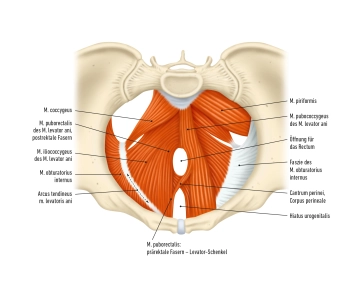
    The pelvic diaphragm is a term that describes the muscular structure forming the pelvic floor. It consists of three main muscles:

    M. levator ani: The muscle forms a funnel-like structure with an open tip downward. On its front side, the urogenital hiatus opens, a gap extending from the posterior side of the pubic bone to the perineal center. The M. levator ani frames this hiatus with its two limbs, which unite in front of the rectum at the perineal center. This center forms the muscular and connective tissue foundation of the perineum. The urogenital hiatus itself is covered and closed by the urogenital diaphragm. The levator ani is composed of the following muscles:

    • M. puborectalis,
    • M. pubococcygeus
    • M. iliococcygeus.

    M. coccygeus: This muscle extends from the ischial spine to the coccyx and runs like the M. levator ani in the pelvic floor.

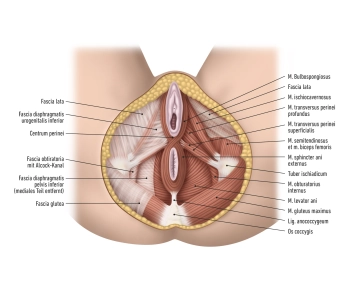
    M. sphincter ani externus: This is the external anal sphincter and consists of striated muscle tissue. It has three parts: Pars subcutanea, Pars superficialis, and Pars profunda. The Pars subcutanea consists of superficial fibers running in front of and behind the anus. The Pars superficialis forms muscle plates on the sides of the rectum and acts like a clamp. The Pars profunda consists of circularly arranged muscle fibers surrounding the rectum, enabling voluntary closure of the bowel.

    The pelvic floor also contains the urogenital diaphragm, which closes the urogenital hiatus. It consists of various muscles located in the superficial perineal space (superficial pelvic floor space) and the deep perineal space (deep pelvic floor space):

    M. transversus perinei superficialis: a flat, transverse muscle of the pelvic floor. It belongs to the superficial perineal muscles and extends from the pubic bone (Ramus inferior ossis pubis) to the center of the perineum, where it merges with the muscle of the opposite side or connects with the fibers of the external anal sphincter.

    M. transversus perinei profundus: It lies below the M. transversus perinei superficialis and is stronger and more deeply embedded in the structure of the pelvic floor compared to it. The muscle also runs transversely from the inner edge of the ischium (Ramus inferior ossis ischii) to the midline of the body, where it meets the muscle of the opposite side or connects with the fibers of the external sphincter of the urethra and partially the M. sphincter ani externus.

    M. sphincter urethrae externus: This is the external sphincter of the urethra and is formed by the M. transversus perinei profundus.

    Additionally, there are two muscles adjacent to the internal genital organs:

    M. ischiocavernosus: This muscle attaches to the ischial rami and covers the clitoral body. It is involved in erection.

    M. bulbospongiosus (M. bulbocavernosus): This muscle runs from the perineal center and covers the vestibular gland. In women, it can narrow the vestibule of the vagina.

    The pelvic fascia, also known as the pelvic fascia, plays a crucial role in the structure and function of the pelvis. It encompasses a series of connective tissue layers that support the pelvic organs, envelop the musculature, and contribute to the overall stability of the pelvic floor. This fascial structure is divided into two main parts: the parietal pelvic fascia and the visceral pelvic fascia.

    1. Parietal pelvic fascia (Fascia endopelvina) This fascial layer lines the inner walls of the pelvis. It covers the muscles forming the pelvis, including the M. piriformis and the M. obturator internus. The parietal pelvic fascia contributes to the demarcation of pelvic spaces and forms important anatomical structures such as the retropubic space and the ischioanal space. It also provides an attachment surface for other fasciae and ligaments that hold the pelvic organs in position.
    2. Visceral pelvic fascia (Fascia propria organi): The visceral pelvic fascia encloses the pelvic organs and adapts to their shape changes. Each organ is surrounded by a specific partial fascia, giving it a unique name. Additionally, this fascia forms various septa that separate the organs, including the vesicovaginal septum between the bladder and vagina and the rectovaginal septum between the rectum and vagina. The accompanying connective tissue, which carries blood vessels and nerves to the respective organs, is specifically named: as Paraproctium, supporting the rectum, as Paracystium, supporting the bladder, as Parametrium, surrounding the uterus, and as Paracolpium, structuring the vagina.

    There are also openings in the wall of the lesser pelvis that allow the passage of nerves and blood vessels:

    Obturator canal: A canal for the obturator nerve and vessels, running from the lesser pelvis to the inner thigh.

    Ischiadic foramina: These allow the passage of vessels, nerves, and muscles from the lesser pelvis into the gluteal region. There is the greater sciatic foramen and the lesser sciatic foramen.

    Finally, the lesser pelvis houses internal genital organs, the bladder, part of the ureter, and the rectum. These organs are surrounded by fat and connective tissue, and vessels and nerves run in the pelvic wall and connective tissue to supply and innervate them.

  3. Rectum

    • Origin of the Rectum: Extension of the sigmoid colon, beginning at the upper edge of the third sacral vertebra.
    • Shape and Curvatures:
      • Sacral flexure: Follows the contour of the sacrum downward.
      • Anorectal (perineal) flexure: Bends backward in the perineal region, bulging forward.
      • Lateral flexures: Occasionally variable curvatures in the frontal plane.
    • Structural Features:
      • Length of approximately 15 cm.
      • Three semilunar transverse folds; the most prominent is the Kohlrausch fold about 6 cm above the anus on the right side.
    • Continuation into the Anal Canal: Ampulla recti above the anal canal, which expands when filled.
    • Boundaries and Position:
      • Upper section: Covered by peritoneum in front and laterally, retroperitoneal (Rectum fixum).
      • Peritoneal contact: In women, the peritoneum meets the posterior vaginal fornix and the back of the uterus (rectouterine excavation) at the middle transverse fold.
      • Below the Kohlrausch fold: Completely extraperitoneal.
    • Anatomical Neighborhood:
      • Adjacent to the sacrum, coccyx, and the posterior parts of the levator ani muscle.
      • Bordering the vagina in front.
    • Vasculature and Innervation:
      • Median sacral artery, superior rectal artery.
      • Sympathetic trunks, lateral sacral arteries, sacral plexus in retrorectal connective tissue.
  4. Ureter

    Pelvic and intramural part of the ureter: Section extending from the crossing of the linea terminalis with the sacroiliac joint to the entrance into the bladder wall.

    • Course of the ureter: On the right, the ureter runs above the initial segment of the external iliac artery and on the left over the bifurcation of the common iliac artery.
    • Peritoneal coverage: Initially covered by peritoneum, the ureter follows the lateral wall of the small pelvis, positioning itself ventral to the internal iliac artery.
    • Change in direction of the ureter: Near the ischial spine, the ureter turns frontal and medial towards the bladder, separating from the peritoneum.
    • Crossing with the broad ligament of the uterus: The ureter crosses this ligament, running below the uterine artery and near the lateral vaginal fornix.
    • Intramural part: This part of the ureter obliquely penetrates the bladder wall and opens into the bladder at the ureteral orifice.
  5. Urinary bladder

    The urinary bladder is a muscular hollow organ that serves to store urine and later expel it through the urethra. The bladder's capacity is normally 300-500 ml. The bladder can be divided into different parts,

    • the bladder apex (Apex vesicae), 
    • the bladder body (Corpus vesicae), 
    • bladder base (Fundus vesicae), 
    • bladder neck (Collum or Cervix vesicae), transition to the urethra 

    The apex is connected to the median umbilical ligament (Chorda urachi), the obliterated allantoic duct leading to the navel. 

    The peritoneum extends from the bladder to the uterus (Excavatio vesicouterina).

    The trigone of the bladder is a roughly triangular, smooth mucosal area located at the base of the urinary bladder. This triangle is formed by the two openings of the ureters (Ostia ureterum) and the internal opening of the urethra (Ostium urethrae internum). The interureteric fold bounds the trigone posteriorly, and anteriorly it forms an angle that extends into the urethra. In this area, the tunica mucosa is closely fused with the tunica muscularis. In other areas of the bladder, there exists a tunica submucosa, which forms a slightly movable buffer zone between the mucosa and muscle layer, allowing the bladder to fill and empty without difficulty.  

  6. Urethra

    The female urethra is approximately 3-5 centimeters long. It is anteriorly connected to the connective tissue of the septum urethrovaginale. Its course begins in the bladder at the ostium urethrae internum and ends in the vestibulum vaginae, after passing through the urogenital diaphragm at the ostium urethrae externum.

    The wall of the female urethra consists of different layers:

    • the outer tunica adventitia,
    • the middle tunica muscularis,
    • the tunica spongiosa, and
    • the tunica mucosa.

    The outer circular muscle layer near the bladder forms the M. sphincter urethrae internus (M. sphincter vesicae internus), which belongs to the bladder. The actual M. sphincter urethrae (formerly M. urethrae externus) is located in the urogenital diaphragm.

  7. Internal genital organs

    Internal genital organs 1
    Internal genital organs 2
    Internal genital organs 3
    Internal genital organs 4

    Ovary (Ovarium)

    The ovary (Ovarium) is located laterally in the pelvic region and is oriented vertically. It has an inner surface facing the pelvic interior (Facies medialis/intestinalis) and an outer surface directed towards the lateral pelvic wall (Facies lateralis). The rounded free edge is called the Margo liber, and at the anterior edge, the Margo mesovaricus, the mesovarium is attached, which is a structure of the broad ligament of the uterus (Lig. latum uteri).

    There are two poles: 

    • Extremitas uterina
    • Extremitas tubaria

    The hilum ovarii, where vessels and nerves enter, is located at the attachment of the connective tissue of the ovary, known as the mesovarium, at the Margo mesovaricus.

    The ovary is connected to the pelvic wall at the extremitas tubaria by the suspensory ligament of the ovary. The ovarian vessels (Vasa ovarica), lymph vessels, and nerves run along this suspensory ligament.

    The proper ovarian ligament lies between the ovary (extremitas uterina). This is located directly behind the tubal angle. The artery R. ovaricus of the a. uterinae runs here. 

    The ovary is supplied by: 

    • A. ovarica 
    • Ramus ovaricus from the A. uterina.

    These arteries form anastomoses at the Margo mesovaricus and supply the ovary with blood. 

    Veins transport the venous blood via the V. ovarica dextra to the inferior vena cava and via the V. ovarica sinistra to the left renal vein. Part of the blood flows through the uterine plexus to the internal iliac vein.

    The ovary is located in the abdominal cavity (intraperitoneal) in the ovarian fossa. Here, in the retroperitoneum, run the N. obturatorius, Vasa obturatoria, and the Vasa iliaca externa. Medially, the A. umbilicalis and the A. uterina also run.


    The Fallopian Tube (Tuba uterina, Salpinx)

    The fallopian tube, also known as the tuba uterina, is about 10-15 centimeters long and 2-5 millimeters thick. It runs intraperitoneally along the upper free edge of the broad ligament of the uterus (Ligamentum latum uteri), from the corner of the uterus to the ovary. In the mesosalpinx, the blood vessels and nerves to the fallopian tube run, additionally securing the fallopian tube to the ligamentum latum.

    The fallopian tube itself can be divided into different sections:

    • Infundibulum tubae uterinae (+ Ostium abdominale tubae uterinae )
    • Fimbriae tubae uterinae, 
    • Ampulla tubae uterinae
    • Isthmus tubae uterinae
    • Pars uterina. 

    The blood supply of the tuba uterina is provided by small branches (Rr. tubarii) from the arteries A. ovarica and A. uterina, which run in the mesosalpinx and anastomose with each other. Veins accompany the arteries and drain into the V. ovarica and the uterine/uterovaginal plexus. 

    The Uterus

    The uterus, also known as the womb, is a hollow, muscular organ in the female body that plays an important role during pregnancy and childbirth.

    The uterus consists of:

    • the body (Corpus uteri), 
    • the isthmus uteri
    • the cervix (Cervix uteri) 

    The average length of the uterus is about 7.5 cm, the width 4 cm, and the thickness 2.5 cm. 

    The fundus: uteri represents the upper section of the uterus, located above the entry points of the fallopian tubes. Its lateral walls are connected to the broad ligament (Ligamentum latum uteri). At the lateral edges of the uterus, where the fallopian tubes enter the uterus, the tubal angle is formed. From the tubal angle, the proper ovarian ligament extends to the ovary, while the round ligament of the uterus extends to the inguinal canal.

    Cervix uteri: The cervix extends with its conical lower third into the vagina. It is divided into the supravaginal portion of the cervix (Endocervix) and the vaginal portion of the cervix (Ectocervix or simply Portio). In the upper area of the vagina, the cervix uteri forms the anterior and posterior vaginal fornices (Fornix vaginae) between the portio and the vaginal wall.

    Vaginal portion: At the end of the vaginal portion is the external os, also known as the ostium uteri (Orificium externum uteri).

    The vaginal portion usually has a reddish color and is covered with stratified, non-keratinized squamous epithelium, similar to the vagina. At the transition to the ostium uteri, this epithelium changes to the single-layered, columnar epithelium of the cervical canal (Canalis cervicis). Between puberty and menopause, the cylindrical epithelium of the cervical canal can migrate outward onto the portio (ectropion), leading to more intense redness. With a colposcopy, precancerous lesions and cancer can be detected in this area.

    Ligaments of the Uterus:

    Cardinal ligament: This ligament runs laterally to the uterus and extends to the vagina. It divides into:

    • Bladder pillar (Paracystium) in front 
    • Rectum pillar (Paraproctium) behind
    • Towards cervix (Paracervix) laterally
    • Towards vagina (Paracolpium) laterally

    Parametria: 

    • anterior = Paracystium, 
    • lateral = uterovaginal pillar, cardinal ligament,
    • posterior = Paraproctium

    Pubovesical ligament: This ligament runs from the symphysis (pubic symphysis) to the bladder and supports the anterior wall of the vagina.

    Vesicocervical ligament: This ligament extends from the cervix uteri to the bladder and provides support.

    Vesicovaginal ligament: This ligament runs from the vagina to the bladder and supports the bladder.

    Lateral vesical ligament: It runs from the arcus tendineus fasciae pelvis to the bladder and contributes to the stability of the bladder. The inferior vesical artery also runs here.

    Sacrouterine ligament: This ligament connects the cervix uteri with the rectum and the sacrum. It forms a peritoneal fold and is an important part of the posterior support of the uterus.

    Round ligament of the uterus (Lig. rotundum): This ligament runs from both sides of the tubal angle to the internal inguinal ring through the inguinal canal into the connective tissue of the mons pubis and the labia majora.

    The peritoneum, also known as the peritoneal membrane, forms a kind of double layer in the pelvic area of the woman, covering and protecting the internal organs.

    The peritoneum lies like a cloth on the uterus. In front, it covers the bladder and the anterior wall of the uterus, forming a depression at the level of the cervix uteri, called the vesicouterine excavation. It further extends over the fundus and onto the posterior wall up to the posterior fornix of the vagina. Here, another depression is formed, called the rectouterine excavation or Douglas pouch. The peritoneum then covers the anterior wall of the rectum. The Douglas pouch is the deepest point in the female pelvis. 

    Broad Ligament of the Uterus (Ligamentum latum uteri): From the lateral edges of the uterus, broad peritoneal tissue, the Lig. latum uteri, extends to the lateral pelvic wall. Between the two layers of the peritoneum (peritoneal duplication) is connective tissue, known as the parametrium or paracervix. Structure of the Ligamentum latum uteri: 

    • Connective tissue
    • Blood vessels
    • Nerves

    The ureter runs near the posterior side of the Lig. latum and bends inward and forward above the pelvic floor. It crosses under the uterine artery.

    The Lig. latum uteri consists of three parts: 

    • the mesometrium, lateral to the uterus including the uterine artery and veins from the uterovaginal plexus
    • the mesosalpinx, in the area of the tube
    • the mesovarium, in the area of the ovary including the proper ovarian ligament, suspensory ligament of the ovary 

    Vagina

    Length and Structure: The vagina is a muscular and connective tissue organ with a length of about 8-11 cm. In its non-distended state, it shows a characteristic H-shaped structure in cross-section.

    Anatomical Orientation: Naturally, the vagina runs from below anteriorly to above posteriorly, adapted to the shape of the female pelvis.

    Vaginal Walls:

    • Anterior wall (Paries anterior): This wall is shorter due to the presence of the vaginal portion of the cervix, a part of the cervix that protrudes into the vagina.
    • Posterior wall (Paries posterior): Longer than the anterior wall, it forms the larger posterior vaginal fornix (Fornix posterior).

    Vaginal Fornices (Fornix vaginae):

    • There are a total of four fornices: the posterior fornix, anterior fornix, and two lateral fornices, which form around the vaginal portion of the uterus.

    Opening and Entrance:

    • Ostium vaginae: The opening of the vagina opens into the vestibule of the vagina, directly below the urogenital diaphragm.
    • Introitus vaginae: The entrance to the vagina, where the hymen or its remnants, the hymenal caruncles, are located.

    Vaginal Wall Features:

    • The wall of the vagina is soft in younger years and shows characteristic transverse folds, known as vaginal rugae, which contribute to flexibility and distensibility.

    Position in the Pelvis:

    • The vagina runs between the rectum and the bladder or urethra. Between these structures are the rectovaginal septum and the vesicovaginal or urethrovaginal septum, which serve as separating membranes.

    Features of the Posterior Vaginal Fornix:

    • The posterior fornix of the vagina forms the lower boundary of the rectouterine excavation, also known as the Douglas pouch, and is covered by peritoneum.

    Vascular Supply:

    • The uterine artery reaches the cervix uteri near the lateral fornices of the vagina. At this anatomical site, the ureter crosses under the uterine artery, which is significant during surgical procedures.
  8. External genital organs

    External genital organs

    Mons pubis

    The mons pubis is a triangular elevation of connective tissue located above the symphysis. This elevation bears pubic hair in adult women.

    Labia majora and minora

    Labia majora:

    • The outer labia, also known as labia majora, contain subcutaneous fat tissue that forms them into raised skin folds.
    • They form a protective barrier for the vagina and enclose the labia minora.
    • The anterior and posterior connection of the labia majora is referred to as the commissura labiorum anterior et posterior.

    Labia minora:

    • The labia minora, also called labia minora, are thin, without fat tissue, but rich in sebaceous glands.
    • They surround the vestibule of the vagina.
    • Anteriorly, the labia minora form the frenulum clitoridis and the prepuce of the clitoris, posteriorly the frenulum labiorum.

    Vestibule of the vagina

    The vestibule of the vagina is laterally bounded by the labia minora, anteriorly by the frenulum clitoridis, and posteriorly by the frenulum labiorum. Within the vestibule are:

    • The vaginal opening (ostium vaginae)
    • The external urethral opening (ostium urethrae externum)
    • The ducts of the greater and lesser vestibular glands (glandulae vestibulares majores et minores)

    Glands of the vestibule

    Bartholin's glands (glandulae vestibulares majores):

    • These paired, pea-sized glands are located in the urogenital diaphragm.
    • Their ducts open on the inner side of the labia minora, near the ostium vaginae.
    • They produce a secretion to moisten the vaginal entrance.
    • If the ducts become blocked, Bartholin's cysts can form, and if these become inflamed, it is referred to as a Bartholin's abscess.

    Lesser vestibular glands:

    • These are collections of small glands that open into the vestibule of the vagina.

    Paraurethral glands (Skene's glands):

    • These glands open beside the urethra and are also called ductus paraurethrales.

    Hymen

    The hymen is a membrane that separates the external from the internal genital area.

    Vulva and erectile tissues

    Clitoris:

    • The clitoris consists of the crura clitoridis, the corpus clitoridis, and the glans clitoridis. It corresponds to the corpora cavernosa penis in males.

    Bulbus vestibuli:

    • The two bulbi vestibuli are located laterally to the vestibule of the vagina and correspond to the corpus spongiosum penis in males.
  9. Lymphatic drainage pathways of the cervix uteri

    The cervix uteri has a complex lymphatic drainage system that drains through several pathways into different lymph node stations. These lymphatic pathways are particularly relevant for tumor spread in malignant diseases.

    Primary Lymphatic Pathways

    Parametrial Lymph Nodes (Nodi lymphoidei parametriales)

    • Located in the broad ligament and are the first lymph stations for the cervix.
    • They drain directly into the iliac lymph nodes.

    Internal Iliac Lymph Nodes (Nodi lymphoidei iliaci interni)

    • Collect lymph from the cervix and the parametrial lymph nodes.
    • Are particularly relevant for pelvic lymphadenectomy.

    External Iliac Lymph Nodes (Nodi lymphoidei iliaci externi)

    • Drain lymph from the cervix and parts of the uterus.
    • Connected with the obturator lymph nodes.

    Obturator Lymph Nodes (Nodi lymphoidei obturatorii)

    • Located deep in the obturator fossa along the obturator nerve.
    • Important lymph node station in cervical carcinomas.

    Presacral Lymph Nodes (Nodi lymphoidei sacrales)

    • Located in front of the sacrum, receive lymph from the posterior cervical wall.

    Secondary Lymphatic Pathways

    • Para-aortic Lymph Nodes (Nodi lymphoidei lumbales)
      • Important secondary lymph node station if the tumor spreads further.
      • Drain via the pelvic lymphatic pathways or directly from the uterine fundus.
  10. Obturator Nerve

    The obturator nerve is an important motor and sensory nerve that originates from the lumbar plexus (L2-L4).

    Course:

    • It emerges medially to the psoas major muscle and runs along the pelvic wall.
    • Passes through the obturator fossa and traverses the obturator foramen into the thigh.
    • There, it divides into an anterior and posterior branch, supplying the adductors of the thigh.

    Function:

    Motor: Innervation of the adductor muscles of the thigh:

    • Adductor longus muscle
    • Adductor brevis muscle
    • Adductor magnus muscle (partially)
    • Gracilis muscle
    • Obturator externus muscle

    Sensory: Sensory supply to the medial thigh skin.

    Relevance in Lymphadenectomy:

    • The nerve lies deep in the obturator fossa, close to the obturator lymph nodes.
    • It must be preserved during dissection, as damage can lead to adduction weakness and sensory deficits.
  11. Genitofemoral nerve

    The genitofemoral nerve originates from the lumbar plexus (L1-L2) and is a sensory and motor nerve with two main branches.

    Course:

    • It passes through the psoas major muscle and divides early into two branches:
      • Genital branch: Passes through the inguinal canal to the scrotum or labia.
      • Femoral branch: Runs under the inguinal ligament to the anterior thigh skin.

    Function:

    • Genital branch: Passes through the inguinal canal and innervates the cremaster muscle and the skin of the scrotum in males; in females, it supplies the skin of the labia majora.
    • Femoral branch: Runs under the inguinal ligament and provides sensory innervation to the skin in the area of the femoral triangle.

    Relevance in lymphadenectomy:

    • The genitofemoral nerve runs on the psoas major muscle and can be affected during lymphadenectomy lateral to the iliac vessels.
    • Damage leads to hypoesthesia in the groin area and anterior thigh.
  12. Arterial and venous system of the pelvis

    The arterial and venous system of the pelvis is responsible for the supply and venous return of the pelvic organs, pelvic wall, and lower extremities. These structures are particularly important in pelvic lymphadenectomies as they are closely related to the lymph node stations.

    Arterial System of the Pelvis:

    Abdominal Aorta and its Division

    The abdominal aorta is the largest artery in the body and runs along the spine to its bifurcation.

    Course:

    • Begins at the level of Th12 after passing through the diaphragm (aortic hiatus).
    • Runs retroperitoneally along the spine.
    • Divides at the level of L4 into the two common iliac arteries.

    Important branches of the abdominal aorta in the pelvic area:

    • Ovarian artery: Arises from the aorta and forms anastomoses with the uterine artery.
    • Inferior mesenteric artery: Supplies the left colon and gives branches to the pelvic region.
    • Lumbar arteries: Supply the lumbar muscles and the posterior peritoneum.
    • Median sacral artery: Runs along the sacrum and participates in the supply of the pelvic floor.

    Common Iliac Artery

    The common iliac artery is the first major vascular branch after the division of the aorta and runs to the level of the sacroiliac joint, where it divides into the internal iliac artery and external iliac artery.

    Course:

    • Begins at the aortic bifurcation at the level of L4–5.
    • Runs laterally and slightly caudally along the psoas major muscle.
    • Divides at the level of the sacroiliac joint into:
      • Internal iliac artery (supplies the pelvic organs and pelvic wall).
      • External iliac artery (supplies the lower extremity).

    Important clinical relations:

    • Ureter crosses the artery ventrally, CAVE: Risk of ureteral injury during dissections!
    • The common iliac vein runs dorsally to the artery.

    Internal Iliac Artery

    The internal iliac artery is the main supplier of the pelvic organs, pelvic wall, gluteal region, and pelvic floor.

    • Course:
      • Arises from the common iliac artery at the level of the sacroiliac joint.
      • Runs medially into the lesser pelvis.
      • Divides at the level of the greater sciatic foramen into an anterior and posterior trunk.

    Branches of the Internal Iliac Artery:

    Parietal branches (supply the pelvic wall and muscles):

    • Iliolumbar artery: Supplies the lumbar muscles and the iliacus muscle.
    • Lateral sacral arteries: Supply the sacrum and sacral nerves.
    • Obturator artery: Passes through the obturator foramen and supplies the adductors of the thigh.
    • Superior/inferior gluteal arteries: Supply the gluteal muscles.

    Visceral branches (supply the pelvic organs):

    • Umbilical artery: Forms the medial umbilical ligament postnatally.
    • Uterine artery: Main supplier of the uterus, tubes, and vagina.
    • Vaginal artery: Supplies the vagina.
    • Internal pudendal artery: Supplies the pelvic floor and external genitalia.
    • Clinical significance:
      • Close proximity to the internal iliac vein and the inferior hypogastric plexus, CAVE: Risk of autonomic dysfunction after damage.
      • Must be carefully exposed during pelvic lymphadenectomy.

    External Iliac Artery

    The external iliac artery is the main supplier of the lower extremity.

    Course:

    • Arises from the common iliac artery at the level of the sacroiliac joint.
    • Runs along the psoas major muscle caudally.
    • Passes under the inguinal ligament, where it becomes the femoral artery.

    Important branches:

    • Deep circumflex iliac artery: Supplies the lateral abdominal wall.
    • Inferior epigastric artery: Anastomoses with the superior epigastric artery.

    Clinical significance:

    • The external iliac vein runs dorsally to the artery, CAVE: Risk of venous bleeding during dissection.
    • The ureter crosses medially to the artery, especially important during lymphadenectomy!

    The Venous System of the Pelvis

    The venous system in the pelvis largely corresponds to the arterial structures but has some important peculiarities.

    External Iliac Vein

    • Course:
      • Formed by the confluence of the femoral vein with the deep circumflex iliac vein.
      • Runs dorsally to the external iliac artery and drains into the common iliac vein.

    Internal Iliac Vein

    Course:

    • Corresponds to the course of the internal iliac artery.
    • Drains the venous blood of the pelvic organs via a dense venous plexus system.

    Clinical significance:

    • The venous plexuses (e.g., uterine, vaginal, sacral venous plexus) have no venous valves → Increased risk of retrograde tumor cell spread.

    Common Iliac Vein

    Course:

    • Formed by the confluence of the external and internal iliac veins.
    • Both common iliac veins unite to form the inferior vena cava.

    Clinical significance:

    • Lies dorsally to the common iliac artery, CAVE: High risk of bleeding during deep dissection!