
In general, it applies that the surgical access should be chosen sufficiently large for a good overview to avoid injury to the median nerve and the superficial palmar arch.
The access for simple carpal roof splitting (red line) runs longitudinally starting approximately 5 mm distal to the rascetta, towards the third interdigital space and ends before the so-called Kaplan line.
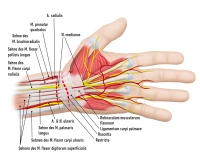
The access is chosen such that the median nerve lies far on the radial side and is thus securely protected.

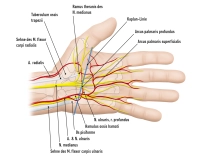
The Kaplan line serves as a topographic orientation line and for the protection of the superficial palmar arch, which is regularly found about 10 mm distal to the Kaplan line in depth. It runs parallel to the proximal transverse palmar crease, from the ulnar pole of the flexion crease over the thumb metacarpophalangeal joint to the ulnar edge of the hand.
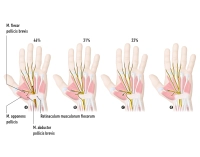
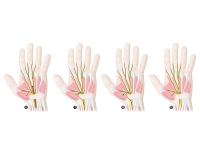
To avoid iatrogenic injury, the numerous variants of the origin of the motor branch must be considered.
a most common variant, extraligamentous origin of the motor branch,
b subligamentous course of the motor branch,
c transligamentous course of the motor branch,
d ulnar origin of the motor branch.
e high division of the median nerve with median artery,
f accessory motor branch with origin proximal to the carpal tunnel from the ulnar margin of the median nerve,
g accessory motor branch with origin proximal to the carpal tunnel, perforating the retinaculum,
h high division of the median nerve.
| 
|