Start your free 3-day trial β€” no credit card required, full access included

Anatomy - Myotomy and Dor fundoplication, robotically assisted

  1. Surgical Anatomy of the Esophagus and Stomach

    Surgical Anatomy of the Esophagus and Stomach 1
    Surgical Anatomy of the Esophagus and Stomach 2

    Esophagus

    General Characteristics

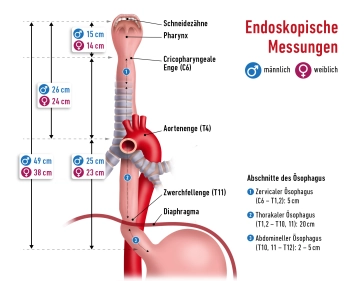
    • Muscular hollow organ, approximately 25–30 cm long
    • Connects Pharynx (C6) with the Stomach (Th11)
    • Three constrictions:
      1. Upper constrictionCricopharyngeal constriction (transition Pharynx/Esophagus, at the level of C6)
      2. Middle constrictionAortic constriction (crossing with aortic arch + left main bronchus)
      3. Lower constrictionDiaphragmatic constriction (hiatus oesophageus, Th10)

    Topographical Sections

    Cervical Esophagus (C6–Th1)

    • Behind the trachea
    • Accompanying structure: N. laryngeus recurrens
    • Access: transcervical, ventral-lateral

    Thoracic Esophagus (Th1–Th10)

    • Upper mediastinum: behind trachea, in front of the spine
    • Middle mediastinum: behind heart and pericardium
    • Crossing by aortic arch, V. azygos, left main bronchus
    • Access: right-thoracic (better overview)

    Abdominal Esophagus (short, 1-3 cm)

    • Passes through hiatus oesophageus (Th10) into the abdomen
    • Empties into the cardia region of the stomach
    • Accompanying structures: anterior vagal trunk (left), posterior (right)


    Stomach

    General & Location

    • Muscular hollow organ between esophagus and duodenum
    • Located in the left/middle upper abdomen, directly under the diaphragm
    • Can vary greatly in size and shape depending on age, filling state, and body position
    • Large interindividual differences in location, size, and shape
    • Located intraperitoneally; mostly covered with serosa (except dorsal cardia)

    Size & Capacity

    • Average length: 25–30 cm (with moderate filling)
    • Storage capacity: approximately 1.5 liters, in extreme cases up to 2.5 liters

    Attachment

    • Embryonic mesogastria rotate into a frontal position:
      • Lesser omentum: from the lesser curvature to the liver hilum
      • Greater omentum: from the greater curvature to the transverse colon, spleen, and diaphragm
    • Attachment and stabilization by ligaments, which also extend to the liver and spleen

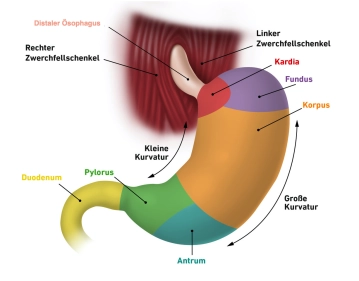
    Sections of the Stomach

    • Cardia (stomach entrance, upper stomach mouth, ostium cardiacum)
      • Area of 1–2 cm where the esophagus empties into the stomach
      • Distinct transition from esophageal mucosa to gastric mucosa (clearly visible during endoscopy)
    • Fundus gastricus (stomach fundus)
      • Located above the stomach entrance, arches upwards
      • Also known as stomach dome or fornix gastricus
      • Typically filled with air; in an upright position, the highest point, recognizable as a “stomach bubble” on X-ray
      • Demarcated from the stomach entrance by the incisura cardialis
    • Corpus gastricum (stomach body)
      • Main part of the stomach
      • Characterized by deep longitudinal mucosal folds (plicae gastricae) running from the stomach entrance to the pylorus (“stomach street”)
    • Pylorus (pars pylorica, stomach gatekeeper)
      • Beginning with the expanded antrum pyloricum, followed by the pyloric canal (canalis pyloricus)
      • Ends with the actual pylorus, where the pyloric sphincter muscle (M. sphincter pylori) is located
      • Closes the stomach exit (ostium pyloricum) and regulates the passage of chyme into the duodenum

    Other Anatomical Features

    • Greater curvature (convex side)
    • Lesser curvature (concave side)
    • Anterior wall: paries anterior; posterior wall: paries posterior
  2. Layers and Structure of the Esophagus and Stomach Wall/Microscopy

    Layer Structure of the Esophagus (from inside to outside)

    1. Tunica mucosa (Mucosa)

    • Lamina epithelialis mucosae: stratified, non-keratinized squamous epithelium – provides mechanical protection against food and gastric acid, with a clear Z-line to the gastric epithelium
    • Lamina propria mucosae: loose connective tissue with small vessels, lymphatic tissue, and nerves
    • Lamina muscularis mucosae: thin smooth muscle layer – contracts independently of the muscularis propria

    2. Tela submucosa

    • Connective tissue layer with Glandulae oesophageales (mucous glands), producing mucus for lubrication during swallowing
    • Meissner's plexus: enteric nerve plexus for controlling mucosal activity
    • Longitudinal folds in the tissue allow expansion during swallowing; in cross-section, the lumen appears star-shaped

    3. Tunica muscularis (Muscle Layer)

    • Consists of two layers:
      • Stratum circulare (Circular muscle)
      • Stratum longitudinale (Longitudinal muscle)
    • Muscle distribution:
      • upper third: striated muscle
      • middle third: mixed muscle
      • lower third: exclusively smooth muscle
    • Auerbach's plexus (Myenteric plexus) between the muscle layers: coordination of peristalsis

    4. Tunica adventitia / Tunica serosa

    • Pars thoracica: Adventitia – loose connective, collagenous tissue, fixes the esophagus in its surroundings
    • Pars abdominalis (after passing through the diaphragm): covered by Serosa – intraperitoneal segment with simple squamous epithelium


    Layers of the Stomach Wall from Inside to Outside
    The stomach wall shows a characteristic layer structure under the microscope from inside to outside:

    1. The Tunica mucosa is the mucosal layer lining the inside of the stomach. The gastric mucosa is divided into three sublayers: The Lamina epithelialis mucosae forms a tough neutral mucus that protects the gastric mucosa from mechanical, thermal, and enzymatic damage. Below it follows the Lamina propria mucosae, a shifting layer into which the gastric glands (Glandulae gastricae) are embedded. Finally, there is a narrow Lamina muscularis mucosae, a thin initial muscle layer that can change the relief of the mucosa.
    2. The Tela submucosa follows in the view from inside to outside of the gastric mucosa. It represents a loose shifting layer consisting of connective tissue. In the Tela submucosa runs a dense network of blood and lymph vessels, as well as a nerve fiber network, the submucosal plexus (Meissner's plexus), which controls gastric secretion. This plexus operates independently of the central nervous system (CNS) and is influenced by the autonomic nervous system.
    3. Next is a strong Tunica muscularis, divided into three sublayers with fibers running in different directions: an inner layer of small obliquely running muscle fibers (Fibrae obliquae), then a circular muscle layer (Stratum circulare), and finally an outer longitudinal muscle layer (Stratum longitudinale). This musculature ensures the peristalsis of the stomach, responsible for the constant mixing of the chyme with gastric juice. Between the circular and longitudinal muscle layers runs a nerve fiber network, the myenteric plexus (Auerbach's plexus), which controls the function of the musculature. Like the submucosal plexus, this plexus also operates largely autonomously but is influenced by the autonomic nervous system.
    4. Again follows a connective tissue shifting layer (Tela subserosa).
    5. The final layer is the Tunica serosa. The serosa is also divided into several layers. Following the Tela subserosa is the Lamina propria serosae. In this layer run the blood and lymph vessels as well as nerves. Additionally, cells of the immune defense, known as milk spots (Macula lactea), are found in the Lamina propria. The Lamina epithelialis serosae is finally directed towards the body cavity and consists of a single-layered squamous epithelium, the serosal epithelium. This layer is shiny, transparent, and ensures good mobility of the stomach against adjacent organs through a thin film of fluid.

    Gastric Glands
    The gastric glands (Glandulae gastricae) are located in the Lamina propria mucosae and can be found in the fundus and body of the stomach. Up to 100 glands are located on 1mm² of the mucosal surface. Different cells are located in the wall of the gland tube:

    • Mucous cells: They produce the same neutral mucus as the epithelial cells.
    • Neck cells: These cells are located quite superficially in the gland and secrete alkaline mucus, meaning the pH is high due to the bicarbonate ions (OH- ions) contained. This property is important to control and, if necessary, regulate the pH of the stomach. The mucus coats the gastric mucosa and thus protects against self-digestion by the aggressive hydrochloric acid (HCl) and enzymes as self-digesting proteins. This cell type is found predominantly in the cardia and fundus of the stomach.
    • Chief cells: These cells produce the inactive precursor enzyme pepsinogen, which is converted into the active enzyme pepsin by hydrochloric acid (HCl) after release and is responsible for the digestion of food proteins. Since the enzyme only comes into contact with hydrochloric acid at the surface of the gland, self-digestion of the glands by the enzyme is prevented. This cell form is mainly located in the body of the stomach.
    • Parietal cells: These cells, found predominantly in the gastric body, produce abundant hydrogen ions (H+ ions) needed for the formation of hydrochloric acid (HCl). Hydrochloric acid has a very low pH of 0.9-1.5. Additionally, parietal cells produce the so-called intrinsic factor. This substance forms a complex with vitamin B12 from food in the intestine, which can then pass through the intestinal wall. This vitamin is of particular importance in erythropoiesis (removal of the stomach can lead to anemia).
    • G cells: These cells, preferably located in the antrum of the stomach, produce gastrin to increase HCl production in the parietal cells.
  3. Functions of the Esophagus and Stomach

    Esophageal Function

    • Transport of Food and Liquid
      Peristaltic waves of the longitudinal and circular muscles propel the bolus from the hypopharynx to the stomach. The swallowing process is initially voluntary, then reflexive.
    • Protection Against Reflux
      Functional closure by the lower esophageal sphincter (UES = upper, LES = lower sphincter) as well as diaphragmatic crura.
    • Controlled Passage Through the Diaphragm
      Coordination of swallowing and breathing movements.

    Stomach Function

    • The stomach serves as a reservoir for ingested food. Its task is to store and mix the food. 
    • In the stomach, acidic gastric juice (mucus and HCl) and enzymes are produced, which partially digest some components of the food. Subsequently, the chyme is graduallytransferred to the duodenum through the pylorus. 
    • It can store food for hours, ensuring that we can meet our daily nutritional needs with a few larger meals. 
  4. Arterial Supply

    Arterial Supply 1
    517_AN_02_Oesophagus.jpg

    Arterial Vascular Supply of the Esophagus

    The blood supply of the esophagus is segmental. It receives arterial blood from three main sections, corresponding to its topographical division:

    Section

    Main Arteries

    Origin

    Cervical

    Rr. oesophagei from the inferior thyroid artery

    Thyrocervical trunk (subclavian artery)

    Thoracic

    Rr. oesophagei from the thoracic aorta

    + small branches from the bronchial arteries

    Direct aortic branches, bronchial arteries

    Abdominal

    Rr. oesophagei from the left gastric artery (main supply) 

    + possibly from the left inferior phrenic artery

    Celiac trunk, inferior phrenic artery


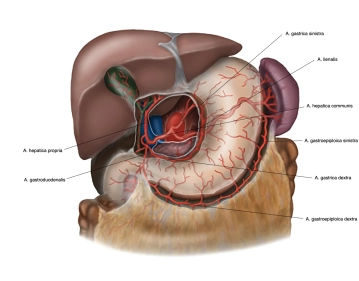
    The arterial supply of the stomach is provided by several blood vessels, all originating from the unpaired celiac trunk. These run along the gastric curvatures as vascular arcades to supply the organ and form numerous anastomoses among themselves:

    • Right gastric artery from the proper hepatic artery to the lower part of the lesser curvature,
    • Left gastric artery to the upper part of the lesser curvature,
    • Short gastric arteries from the splenic artery to the fundus,
    • Right gastroepiploic (omental) artery from the gastroduodenal artery to the lower (right) part of the greater curvature,
    • Left gastroepiploic (omental) artery from the splenic artery to the left side of the greater curvature,
    • Posterior gastric artery from the splenic artery to the posterior wall.

    Thus, the stomach is supplied by two vascular arcades between the left and right gastric arteries at the lesser curvature, as well as the left and right gastroepiploic arteries at the greater curvature.

  5. Venous and Nervous Supply

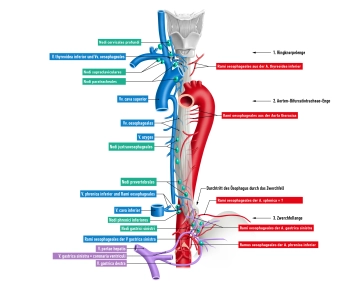
    517_Anatomie_venen besch.jpg
    517_AN_02_Oesophagus.jpg

    Venous Drainage of the Esophagus

    The venous outflow of the esophagus occurs segmentally in three directions and forms an important portocaval anastomosis through its connections between the portal and caval venous systems.

    Note: This portocaval anastomosis is clinically significant, especially in portal hypertension.

    • Cervical: Inferior thyroid vein → Brachiocephalic vein
    • Thoracic: Esophageal veins → Azygos / hemiazygos vein
    • Abdominal: Left gastric vein → Portal vein
      ➡ Anastomoses between azygos vein and portal vein = portocaval connection (esophageal varices in portal hypertension).


    Nervous Supply of the Esophagus

    The nervous supply of the esophagus is divided into somatomotor/sensory components for the upper (striated) muscle portion and visceromotor/sensory components for the smooth muscle portion.

    • Motor Function
      • Upper Third (striated muscle)
        • Somatomotor: Vagus nerve (pharyngeal branches, recurrent branch) → voluntary initiation of swallowing
      • Middle and Lower Third (smooth muscle)
        • Visceromotor: Vagus nerve via the esophageal plexus → controlled by parasympathetic reflexes
    • Parasympathetic Innervation
      • Source: Vagus nerves (right and left vagus)
      • Course: Form the esophageal plexus in the thorax → pass as vagal trunks (anterior/posterior) through the diaphragm to the stomach
      • Function: Peristalsis, secretion, sphincter tone
    • Sympathetic Innervation
      • Source: Sympathetic trunk (segments Th1–Th6) → Greater/lesser splanchnic nerves → Esophageal plexus
      • Function: Inhibition of peristalsis, increase in sphincter tone
    • Sensory Innervation
      • Somatosensory (pain, touch in the upper third): Vagus nerve, recurrent laryngeal nerve
      • Viscerosensory (distension, chemical stimuli in the lower third): Vagus and sympathetic pathways → dorsal horns of the spinal cord
    • Surgical Relevance:
      • Injury to the recurrent laryngeal nerve (e.g., during cervical esophagus mobilization) → hoarseness, risk of aspiration
      • Denervation of the lower esophagus during fundoplication or esophagectomy can lead to motility disorders


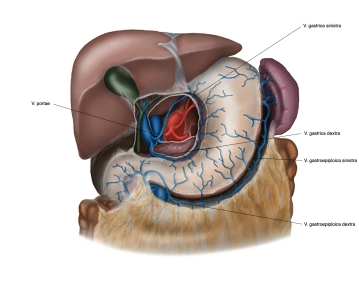
    Venous Supply of the Stomach

     Parallel to the arterial supply, the 4 major veins of the stomach run along the two curvatures. Collectively, they form collecting veins (left and right gastric veins directly into the portal vein, left gastroepiploic vein and short gastric veins to the splenic vein, and right gastroepiploic vein to the superior mesenteric vein), which all eventually drain into the portal vein.


    Nervous Supply of the Stomach 

    The nervous supply of the stomach is predominantly under the control of the autonomic nervous system. Sensory fibers are also present: The sympathetic innervates the pyloric musculature, while the parasympathetic (vagus nerve X) innervates the rest of the gastric musculature and the glands of the stomach. The vagus nerve runs right and left parallel to the esophagus, passes through the diaphragm via the esophageal hiatus, and reaches the anterior surface of the stomach on the left side (anterior vagal trunk), and the posterior surface on the right side (posterior vagal trunk). Sensory fibers from the stomach, on the other hand, run afferently via the greater splanchnic nerve to the thoracic spinal ganglia.

Lymphatic Drainage Pathways

Lymphatic Drainage Pathways of the EsophagusCervical → paratracheal, deep cervical lymph nod

Activate now and continue learning straight away.

Single Access

Activation of this course for 3 days.

US$9.30  inclusive VAT

Most popular offer

webop - Savings Flex

Combine our learning modules flexibly and save up to 50%.

from US$4.32 / module

US$51.88/ yearly payment

price overview

robotics

Unlock all courses in this module.

US$8.64 / month

US$103.80 / yearly payment

to top