Start your free 3-day trial β€” no credit card required, full access included

Perioperative management - Aortoiliac TEA in bilateral peripheral arterial occlusive disease stage IIb

  1. Indication

    According to the TASC criteria, therapeutic treatment options can be derived depending on the length of the local occlusion/stenosis. The length of the stenosis and the regions of its localisation determine the choice of therapy: endovascular or open vascular surgery.

    TASC criteria for aortoiliac vascular occlusions

    Types

    Morphology

    Therapeutic principle

    A

    Focal stenoses of the common iliac artery or the external iliac artery <3 cm, uni- or bilateral

    endovascular

    B

    Focal stenoses 3–10 cm long and/or unilateral occlusion of the common iliac artery

    endovascular

    C

    Bilateral stenoses of the common iliac artery, 5–10 cm, or unilateral complete occlusion of the external iliac artery, or bilateral occlusions of the common iliac artery

    open reconstruction

    D

    Diffuse stenotic changes of the entire iliac axis, or unilateral occlusion of the common and external iliac artery, or bilateral occlusions of the external iliac artery

    open reconstruction

    Film example:

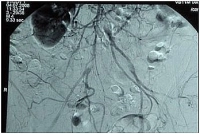
    High aortic occlusion with subtotal stenosis of the iliac bifurcation, occlusion of the right common iliac artery and thrombosis in the region of the left external iliac artery (clinically PAOD IIb bilateral)

    -> TASC D, hence a recommendation for open reconstruction

    Preoperative i.a. DSA
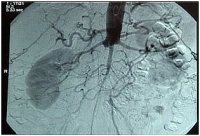
    PM 303-1
    High aortic occlusion in bifurcation stenosis
    PM 303-2
    Bilateral CIA occlusion; embolism in left EIA

    Classification of PAOD according to the Fontaine stages and Rutherford categories

    Fontaine stage

    Clinical presentation

    Rutherford category

    Grade

    Clinical presentation

    I

    asymptomatic

    0

    0

    asymptomatic

    IIa

    walking distance > 200 m

    1

    I

    mild intermittent claudication

    IIb

    walking distance < 200 m

    2

    I

    moderate intermittent claudication


    3

    I

    severe intermittent claudication

    III

    ischaemic rest pain

    4

    II

    ischaemic rest pain

    IV

    ulcer, gangrene

    5

    III

    small-area necrosis

    6

    III

    large-area necrosis

  2. Contraindication

    • serious cardiopulmonary risks (e.g. NYHA IV, COPD Gold stage IV)
    • Acute or chronic inflammatory abdominal processes (e.g. florid ulcerative colitis, recurrent sigmoid diverticulitis)
    • History of multiple extensive abdominal procedures ("hostile abdomen")
    • Liver cirrhosis
    • Advanced malignancy
    • Transmural calcification of the aorta and pelvic vessels (so-called "pretzel-stick vessels")*
    • Abdominal aortic aneurysm*

    * in such cases: Y-graft

  3. Preoperative diagnostic work-up

    History

    • Claudication
    • Walking distance
    • Risk factors -> nicotine, arterial hypertension, coronary heart disease, heart failure, diabetes mellitus, manifest renal insufficiency with/without dialysis dependence, coagulopathies

    Inspection

    • Skin changes
    • Muscular abnormalities
    • Orthopaedic malalignments
    • Skin colour
    • Hair growth
    • Trophic changes
    • Swelling, oedema, mycoses, phlegmons, ulcera cruris, etc.

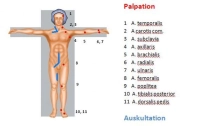
    Side-comparing palpation

    • Pulse status
    • Skin temperature

    Side-comparing auscultation of the extremity arteries

    PM 303-3

    Ankle-brachial index (ABI)

    • ABI = systolic BP posterior tibial artery/systolic BP brachial artery

    ABI value

    Severity of PAD

    > 1.3

    Falsely high values (suspected Mönckeberg medial sclerosis, e.g. in diabetes mellitus)

    > 0.9

    Normal finding

    0.75 - 0.9

    Mild PAD

    0.5 - 0.75

    Moderate PAD

    < 0.5

    Severe PAD

    • An ABI value of < 0.9 is considered proof of the presence of relevant PAD.
    • Determination of the ankle-brachial index (ABI) by non-invasive measurement of the Doppler occlusion pressure is a suitable test for detecting PAD.
    • For the diagnosis of PAD, the ABI value with the lowest ankle artery pressure is decisive.
    • A pathological ankle-brachial index is an independent risk indicator for increased cardiovascular morbidity and mortality.

    Colour-coded duplex sonography

    • Carotid, abdominal aorta, extremity arteries
    • Localisation of stenoses and occlusions in almost all vascular regions except the thoracic region
    • Quantification of the degree of stenosis and assessment of plaque morphology possible
    • Sensitivity and specificity approximately 90%
    • Well suited as a screening method

    CT angiography

    • Multislice computed tomography (MS-CT) using non-ionic contrast medium
    • Broad spectrum of indications: traumatic vascular lesion (especially trunk), vascular dissection/rupture, aneurysm, arterial thrombosis/embolism, portal/mesenteric vein thrombosis, pulmonary artery embolism, PAD, vascular tumours
    • Advantages: quickly performed, detection of relevant concomitant diseases, visualisation of peripheral arteries, sensitivity and specificity each approximately 90%
    • Disadvantages: radiation and contrast medium exposure, allergies (approximately 3%), no functional assessment

    Angiography (i.a. DSA)

    • Usually as digital subtraction angiography (DSA)
    • Contraindications: hyperthyroidism, manifest renal disease, creatinine elevation relative to the indication, metformin-containing antidiabetics (risk of lactic acidosis), prothrombin time (Quick) < 30%
    • Advantages: highest level of detail recognition, superselective visualisation possible, immediate intervention possible, sensitivity 100%, specificity 100%
    • Radiation exposure, contrast medium exposure, only the patent vascular lumen can be visualised, i.e. non-visualisation of thrombosed areas and extravascular processes, puncture and catheter complications
    • Necessity of determining TSH and creatinine before DSA
    • Caution in patients with multiple myeloma -> renal failure

    Cardiac check

    • Resting ECG
    • Exercise ECG
    • Echocardiography

    Chest X-ray examination

    If necessary, spirometry

    Laboratory

    • Full blood count
    • Electrolytes
    • Coagulation
    • Retention values
    • Liver enzymes
    • Blood lipids
    • Blood group

  4. Special preparation

    • Enema the evening before
    • Clipping of hair in the operative field
    • Order blood units to be available
    • Indwelling bladder catheter
    • Perioperative antibiotic prophylaxis 30 min before the start of surgery (see KRINKO recommendation, Robert Koch Institute)
  5. Informed consent

    General surgical risks

    • Major bleeding, blood transfusions, transmission of hepatitis/HIV through allogeneic blood transfusions
    • Allergy/intolerance
    • Wound infection
    • Thrombosis/embolism
    • Skin, vascular and nerve damage, e.g. due to patient positioning
    • Keloids
    • Incisional hernia

    Specific procedural risks

    • Thrombosis, possibly leg ischaemia, amputation
    • Infection with bleeding from suture lines; sepsis, leg ischaemia, amputation
    • Damage to adjacent organs, e.g. ureter, bladder, spleen, liver; intestinal ischaemia -> resection, ostomy formation
    • Paraplegia in the presence of a low origin of the artery of Adamkiewicz (arteria radicularis magna)
    • Nerve lesions -> dysaesthesia, pain, paralysis of the abdominal wall and thigh muscles
    • Peritoneal adhesions -> chronic pain, mechanical ileus
    • Lymph fistula
    • Secondary bleeding
    • Impotence
    • Compromise of renal function due to intraoperative angiography
Anaesthesia

General anaesthesia (endotracheal intubation) ... - Operations in general, visceral and transplant

Activate now and continue learning straight away.

Single Access

Activation of this course for 3 days.

US$9.30  inclusive VAT

Most popular offer

webop - Savings Flex

Combine our learning modules flexibly and save up to 50%.

from US$4.30 / module

US$51.61/ yearly payment

price overview

vascular surgery

Unlock all courses in this module.

US$8.60 / month

US$103.20 / yearly payment

to top