Start your free 3-day trial — no credit card required, full access included

Left lateral alloplastic anterior tibial bypass according to Stockmann for PAOD stage IV

Reading time readingtime 18:38 min.
Activate now
  1. Lateral access to the left anterior tibial artery

    Video
    Lateral access to the left anterior tibial artery
    Soundsettings

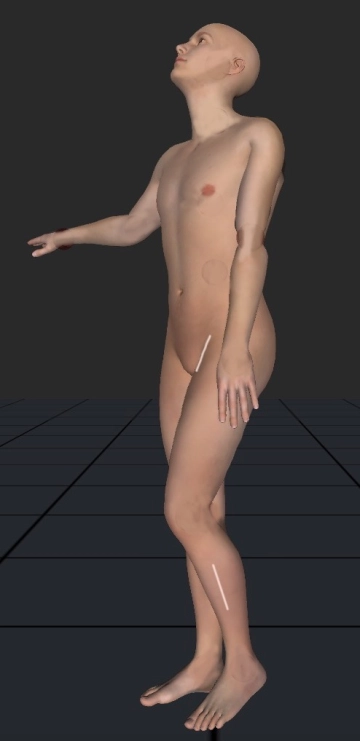
    The skin incision is made with slight internal rotation of the leg approximately two fingerbreadths lateral to the anterior edge of the tibia. Hemostasis. Incision of the anterior fascia initially with a scalpel, then with half-open dissecting scissors. The tibialis anterior muscle and extensor digitorum longus muscle are bluntly separated.

    Tips:

    1. The length of the skin incision must be adapted to the depth of the surgical area. Since the crural skin-soft tissue mantle is very vulnerable, surgery should under no circumstances be performed under skin tension, which must also be observed during instrumental wound retraction.

    2. To avoid injuries to the peroneal nerve, the skin incision should not be made too close to the fibular head.

    3. The exposure of the lower leg arteries must be as atraumatic as possible. The use of magnifying glasses is recommended.

    4. Due to the arteriosclerotic remodeling of the vessel wall, a local inflammatory concomitant reaction is not uncommon, which can be particularly pronounced in diabetics (note the soft tissue edema in the film clip!).  The preparation of such vessel segments can quickly become unclear due to the occurrence of diffuse bleeding.
  2. Preparation and Clamping of the Anterior Tibial Artery

    Video
    Preparation and Clamping of the Anterior Tibial Artery
    Soundsettings

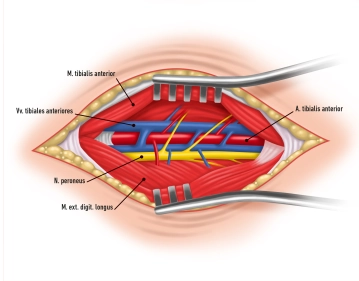
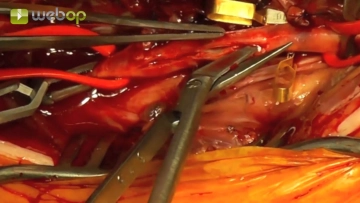
    Perforating veins and arterial muscle branches indicate the way to the anterior tibial vessels, which lie ventral to the interosseous membrane. The preparation of the anterior tibial artery is performed bluntly with instruments. Retract the artery using vessel loops. Crossing veins are divided between penetrating ligatures. Also blunt preparation of the arterial side branches. Clamping of the anterior tibial artery centrally and peripherally. The side branches are secured with micro-bulldog clamps.

    Tips:

    1. The anterior tibial artery is often palpable as a calcified hard strand in the depth.

    2. Dorsolateral to the anterior tibial vessels is the peroneal nerve, which is at risk of injury during preparation. Caution with coagulation!

    3. The crossing veins, which are congested in severe arteriosclerosis and especially in diabetics, must be prepared carefully. Venous bleedings can significantly impair the view in the site and complicate the progress of the procedure. The blood loss from venous bleedings, especially after release of a well-functioning bypass in combination with anticoagulation, can be considerable. In principle, penetrating ligatures that cannot slip off!

    4. The crural arteries are very vulnerable and quickly suffer dissections and clamp damages. Therefore, soft, fine bulldog clamps should be used for clamping.

    5. If the anterior tibial artery cannot be clamped due to its sclerotic changes, an intraluminal balloon occlusion can be performed. Mini-flush catheters (5F/6F) are also suitable for this, which close the lumen and can be flushed intraoperatively with heparin-saline solution.

  3. Incision of the anterior tibial artery

    Video
    Incision of the anterior tibial artery
    Soundsettings

    Stab incision of the anterior tibial artery and extension of the incision using Potts scissors. Instillation of 1000 IU heparin-saline solution with a fine button cannula peripherally and centrally. Checking of inflow and backflow.

    Tip:

    The arteriotomy can sometimes be difficult due to severe arteriosclerosis. Dissection of the vessel wall must be absolutely avoided. Local excisions are usually disadvantageous.

Preparation of the femoral bifurcation left groin

Access to the femoral bifurcation is achieved via a longitudinal incision in the left groin approx.

Activate now and continue learning straight away.

Single Access

Activation of this course for 3 days.

US$9.40  inclusive VAT

Most popular offer

webop - Savings Flex

Combine our learning modules flexibly and save up to 50%.

from US$4.35 / module

US$52.30/ yearly payment

price overview

vascular surgery

Unlock all courses in this module.

US$8.71 / month

US$104.60 / yearly payment

to top