Start your free 3-day trial — no credit card required, full access included

Anatomy - Left lateral alloplastic anterior tibial bypass according to Stockmann for PAOD stage IV

  1. Arterial Supply of the Lower Extremity

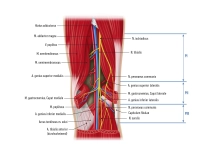
    1. A. femoralis


    A 324-1
    Zum Vergrößern bitte anklicken
    1.1. Overview

    Origin

    • A. iliaca externa, which becomes the A. femoralis after passing under the inguinal ligament

    Course

    • runs between M. iliopsoas and M. pectineus (= Fossa iliopectinea) covered by Fascia lata
    • is accompanied by M. sartorius up to the middle of the thigh
    • passes together with V. femoralis and N. saphenus through the adductor canal
    • transitions into the A. poplitea after passing through the Hiatus adductorius

    Branches

    • A. epigastrica superficialis
    • A. circumflexa ilium superficialis
    • A. profunda femoris (main artery for supplying the thigh!)
    • Aa. pudendae externae
    • A. descendens genus

    Supply Area

    • Thigh 
    • Skin of the abdominal wall
    • External genitalia
    • Knee joint and proximal/medial lower leg
    1.2. Important Branches of the A. femoralis

    Branches

    Supply Area

    A. epigastrica superficialis

    • Ø
    • Skin of the abdominal wall up to the umbilical region

    A. circumflexa ilium superficialis

    • Ø
    • Spina iliaca anterior superior

    A. profunda femoris

    • A. circumflexa femoris medialis runs between M. iliopsoas and M. pectineus dorsally → Fossa trochanterica; Anastomosis with  A. circumflexa femoris lateralis
    • A. circumflexa femoris lateralis runs between M. rectus femoris and Mm. vasti laterally; Anastomosis with A. circumflexa femoris medialis
    • Aa. perforantes pass through the adductors to the back of the thigh
    • Thigh

    Aa. pudendae externae

    • Ø
    • External genitalia
    • Scrotum or Labia majora pudendi

    A. descendens genus

    • Rr. articulares → Rete articulare genus
    • R. saphenus → runs medially together with V. saphena magna and N. saphenus to the calf
    • Knee
    • Medial calf proximal

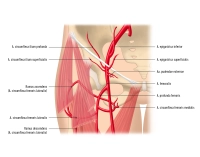
    2. A. poplitea

    A 324-2
    Zum Vergrößern bitte anklicken
    2.1. Overview

    Origin

    • Continuation of the A. femoralis after its passage through the Hiatus adductorius

    Course

    • passes through the popliteal fossa
    • runs between the heads of the M. gastrocnemius
    • transitions into the Truncus tibiofibularis after giving off the A. tibialis anterior

    Branches

    • A. tibialis anterior

    Supply Area

    • Popliteal fossa
    • Knee joint
    2.2. Important Branches of the A. poplitea

    Course

    Branches

    Supply Area

    A. tibialis anterior

    • Branch of the A. poplitea
    • is accompanied by 2 veins and in the lower part by the N. peronaeus profundus
    • passes through the Membrana interossea cruris and runs on its anterior side
    • runs behind the tendon of the M. extensor hallucis longus
    • transitions into the A. dorsalis pedis
    • A. recurrens tibialis posterior + anterior
    • A. malleolaris anterior lateralis + medialis
    • A. dorsalis pedis (terminal branch of the A. tibialis anterior)
    • Anterior lower leg
    • Dorsum of the foot

    From a surgical-technical perspective, the division of the A. poplitea into three segments is common (PI – PIII), which guide the operative access routes:

    Segment

    Characteristic

    Access

    PI

    Exit of the adductor canal to the gastrocnemius tunnel proximal to the knee joint

    Distal medial thigh

    PII

    Knee joint

    Posterior (popliteal fossa)

    PIII

    Exit of the gastrocnemius tunnel below the knee joint to the origin of the A. tibialis anterior/soleus arch

    Proximal medial lower leg

    The A. poplitea runs in a vascular-nerve bundle surrounded by fatty connective tissue (Corpus adiposum popliteum). In the PI and PII segments, the artery lies ventromedial to the V. poplitea; in the PIII segment, it is surrounded by the Vv. comitantes. Dorsolateral to the A. and V. poplitea lie the N. tibialis and N. peroneus communis. The nerves have a relatively superficial position in the popliteal fossa, which must be considered during dissection of the A. poplitea from dorsal.

    The superficial and deep lymphatic drainage is bundled in the popliteal fossa and is drained via three to five perivenous lymph nodes.

    Due to its location, the A. poplitea is exposed to significant mechanical stresses, which is why it has strong muscle and fiber layers as a muscular-type artery (Tunica media, Tunica elastica interna). Its wall properties are therefore similar to those of central elastic arteries.

    3. A. tibialis posterior
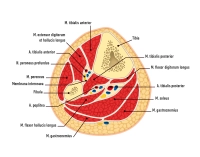
    A 324-3
    Zum Vergrößern bitte anklicken
    3.1. Overview

    Origin

    • Continuation of the A. poplitea after the origin of the A. tibialis anterior

    Course

    • passes together with the N. tibialis under the tendinous arch of the M. soleus → Sulcus malleolaris medialis → Malleolus medialis
    • Division into A. plantaris medialis + lateralis

    Branches

    • A. fibularis
    • A. plantaris medialis + lateralis

    Supply Area

    • Dorsal part of the lower leg
    • Sole of the foot
    3.2. Important Branches of the A. tibialis posterior

    Course

    Branches

    Supply Area

    A. fibularis

    • runs on the back of the fibula 
    • runs between M. tibialis posterior and M.flexor hallucis longus
    • R. communicans: Transverse connection to the A. tibialis posterior
    • Rr. malleolares laterales
    • Lateral-dorsal lower leg

    A. plantaris medialis

    • runs in the medial vascular-nerve bundle of the sole of the foot (A., V. and N. plantaris medialis) between M. abductor hallucis and M. flexor digitorum brevis
    • Ø
    • Medial sole of the foot

    A. plantaris lateralis

    • runs in the lateral vascular-nerve bundle of the sole of the foot (A., V. and N. plantaris lateralis) between M. flexor digitorum brevis and M. quadratus plantae
    • Arcus plantaris profundus: Anastomosis between A. plantaris lateralis and the R. plantaris profundus of the A. dorsalis pedis in the area of the metatarsal bones
    • Lateral sole of the foot
    • Toes
to top