Start your free 3-day trial — no credit card required, full access included

Anatomy - Total Parathyroidectomy with Autotransplantation

  1. Anterior Neck Triangle

    Anterior Neck Triangle

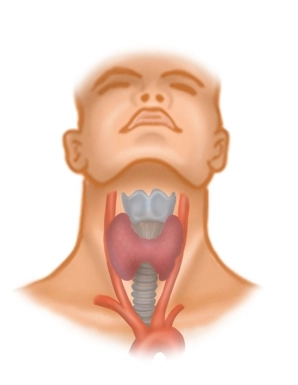
    Located between the anterior border of the M. sternocleidomastoideus, the mandible, and the jugular fossa, the anterior neck triangle in the vicinity of the hyoid bone includes the supra- and infrahyoid musculature, vessels, nerves, and the thyroid gland. For thyroidectomy, among the infrahyoid muscles, possibly the medially located

    • M. sternohyoideus (sternum → hyoid bone) and below it the
    • M. sternothyroideus (sternum → thyroid cartilage of the larynx) as well as further laterally the
    • M. omohyoidus (scapula → intermediate tendon → hyoid bone)

    are of importance, as they partially cover the thyroid gland and must be pushed aside intraoperatively.

    Blood Vessels
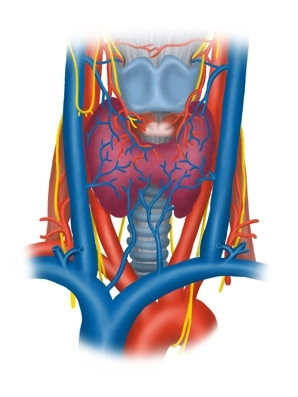
    The common carotid artery divides at the upper edge of the thyroid cartilage at the level of its carotid sinus (receptors for blood pressure and chemoreceptors for blood gases) into its internal and external branches and previously runs immediately laterally in the carotid sheath next to the trachea and esophagus cranially. Here, as a large vessel, it touches the right and left thyroid lobes. From the sigmoid sinus of the skull, the internal jugular vein emerges, which collects blood from the skull and neck, extending caudally first attaching to the internal carotid artery in the carotid sheath, then running further laterally and laterally enclosing the common carotid artery as well as the vagus nerve (X).

    Nerves
    In addition to the vagus nerve and its upper branch to the larynx (superior laryngeal nerve → anterior cricothyroid muscle, as well as mucosa of the upper half of the larynx), in the area of the thyroid gland laterally, descending from above, is the deep cervical ansa (superior and inferior roots, from C1-C3) for the innervation of the three mentioned muscles of the anterior neck triangle and the transverse cervical nerve (from C2/3, skin innervation, platysma).

    Fascial Layers
    In the anterior neck triangle, there are several fascial layers under the skin (all belonging to the cervical fascia), which exhibit certain peculiarities:

    • The superficial lamina superficialis surrounds all neck structures except for the platysma and separately envelops the M. sternocleidomastoideus and dorsally the M. trapezius (accessory nerve XI),
    • the middle lamina pretrachealis surrounds the infrahyoid musculature, and the
    • deep lamina prevertebralis runs between the esophagus and the spine outside the surgical area.

    The thyroid gland/parathyroid glands and the trachea possess, just like the lateral vascular-nerve bundle (carotid artery, internal jugular vein, and vagus nerve), in addition their own organ fascias. Due to the arrangement of the cervical fascias, compartments enclosed by them and spaces in between (spaces) arise, which extend into the mediastinum and represent potential infection pathways.
  2. Thyroid Region

    Thyroid Region

    The unpaired thyroid gland (Glandula thyroidea) belongs, like the 4 parathyroid glands (Gld. parathyroidea), to the endocrine organs. It is located in the anterior neck region caudal and lateral to the thyroid cartilage and is composed of a left and a right lobe as well as an isthmus connecting both lobes. The lobes cover the lateral upper rings of the trachea, as well as the cricoid and thyroid cartilage from the front, the isthmus is located centrally at the level of the 2nd/3rd tracheal ring. The organ has its own connective tissue sheath (Capsula fibrosa) and is covered ventrolaterally by the infrahyoid musculature (M. sternohyoideus, M. sternothyroideus and M. omohyoideus) as well as the lamina praetrachealis. Due to its embryonic development and its descent (via the ductus thyroglossus) from the base of the tongue (Foramen caecum) to its later, described location, cysts or ducts to the foramen caecum, as well as functional glandular parts (e.g., as lobus pyramidalis), can remain along this path.

    Blood Supply
    Arteries from the external carotid artery (→ A. thyroidea superior) and from the subclavian artery via the thyrocervical trunk (→ A. thyroidea inferior) supply the thyroid gland with anterior and lateral/posterior smaller branches. Inconsistently, but certainly to be noted, the A. thyroidea ima approaches the gland directly from the aortic arch or the brachiocephalic trunk from below. The blood drainage, which has systemic significance in this endocrine organ, occurs via similarly named vessels (V. thyroidea superior and media → V. jugularis interna, V. thyroidea inferior → V. brachiocephalica).

    Lymphatic Vessels and Nerves
    The lymphatic drainage from the thyroid gland occurs paratracheally, as well as to deep cervical lymph nodes. Particular attention should be paid intraoperatively to the recurrent laryngeal nerve (from the vagus nerve X, running on the right around the subclavian artery, on the left around the aortic arch). It ascends in the groove between the trachea and esophagus cranially to the larynx, where, in addition to the sensory innervation of the mucous membrane of the lower half of the larynx, it supplies all laryngeal muscles except for the anterior cricothyroid muscle (“Anticus”).
    The 4 parathyroid glands (Gld. parathyroidea) are small oval glands on the posterior surface of the thyroid lobes, which are supplied by the A. thyroidea inferior.

Topography

In thyroidectomy, due to the close spatial proximity, there is a risk of injuring structures such a

Activate now and continue learning straight away.

Single Access

Activation of this course for 3 days.

US$9.50  inclusive VAT

Most popular offer

webop - Savings Flex

Combine our learning modules flexibly and save up to 50%.

from US$7.38 / module

US$88.58/ yearly payment

price overview

general and visceral surgery

Unlock all courses in this module.

US$14.76 / month

US$177.20 / yearly payment

to top