Start your free 3-day trial — no credit card required, full access included

Anatomy - Endocystectomy for Echinococcus granulosus infection of the liver

  1. Functional liver anatomy

    Functional liver anatomy

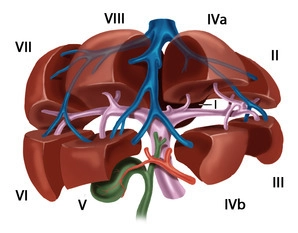
    Through the falciform ligament and the insertion of the round ligament of the liver on the diaphragmatic surface as well as the sagittal fissure on the visceral surface, the liver is macroscopically divided into a larger right and a smaller left lobe (volume ratio approximately 80:20), although this morphological division does not correspond to the functional structure of the liver. The functional segmentation of the liver is determined by the branching of the portal structures: portal vein, hepatic artery, and bile duct. These three anatomical structures branch not only at the hepatic hilum but also predominantly in a similar manner within the parenchyma. Each liver segment is completely independent in terms of blood supply and bile drainage from the other segments and can be surgically removed without endangering the function of the remaining liver.

    The term "functional anatomy" thus refers to a sub-structuring of the liver based on the delineation of hemodynamically independent parenchymal areas, and knowledge of this is essential for the surgical strategy in liver resection procedures.

  2. Portal vein and hepatic veins

    The functional division of the liver is based on the portal branching into individual, independent subunits, the segments.

    Typically, the portal vein divides in the hepatic hilum into a right and left main trunk. The boundary of these supply areas lies in the Cava-Gallbladder line ("Cantlie line"). By further bifurcation of the respective portal vein trunk, an anteromedial and a posterolateral trunk for liver segments V/VIII and VI/VII are formed on the right side. The left main trunk runs transversely to the left and then as the umbilical part anteriorly, ending at the insertion site of the Lig. teres hepatis in the so-called Recessus rex. The left portal main trunk gives branches for the two left-lateral segments II and III as well as for the median segments IVa and IVb. The caudate lobe holds a special position as it can receive strong inflows from both the left and right portal main trunks.

    According to Couinaud, eight portal venous liver segments are distinguished, numbered clockwise starting with the caudate lobe as segment I:

    Segment ICaudate lobe
    Segment I/II/IIILateral left liver lobe
    Segment IVLeft paramedian sector (quadrate lobe)
    Segment I/II/III/IVLeft lobe of the liver
    Segment V/VIIIRight paramedian sector
    Segment VI/VIIRight lateral sector
    Segment V/VI/VII/VIIIRight lobe of the liver 

    The liver is traversed in a caudocranial direction by three main venous trunks, namely the right, middle, and left hepatic veins, which divide the liver into a total of four hepatic sectors. The left hepatic vein drains almost exclusively the left-lateral liver lobe and usually joins the middle hepatic vein shortly before its entry into the vena cava, which runs along the Cava-Gallbladder line. The right hepatic vein runs between the posterolateral and anteromedial segments. The caudate lobe has an independent venous outflow consisting of multiple small veins that drain directly into the vena cava dorsally, known as the Spieghel veins.

    The portal hila of liver segments II, III, and IV are extrahepatic and can be relatively easily dissected in the anterior section of the left umbilical fissure. The hila of the right liver segments are intrahepatic. Exceptions occasionally occur, mostly involving segment VI. The anatomy of the hepatic veins is even more variable than that of the portal vein.

    Variants

    Portal vein system

    • Anomalies of the portal vein bifurcation almost always affect the right portal main trunk
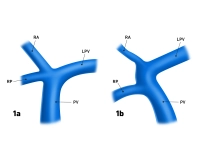
    • Portal vein trifurcation: right main trunk is absent, instead, there are two branches for the right double segments V/VIII and VI/VII (Fig. 1a); occasionally, one of the right branches may also originate from the left portal main trunk (Fig. 1b)
    • Variants of the left portal vein system rarely affect the main trunk, but almost always the division: several small portal vein branches instead of two segmental branches IVa/IVb, occasionally also an additional, intermediate branch between the segmental branches II and III
    44_LAV_01_a_b_Pfortader_Lebervenen

    Fig. 1a and 1b: PV = portal vein, LPV = left portal vein, RA = right anterior portal branch, RP = right posterior portal branch

    Hepatic veins

    • Variants of the hepatic veins are more common than those of the portal vein system
    • Deviations from the hepatic sectors described by Couinaud particularly affect the territories of the right and middle hepatic veins
  3. Hepatic artery

    The common hepatic artery originates from the celiac trunk, and in rare cases, it originates directly from the aorta or the superior mesenteric artery. After giving off the gastroduodenal artery, the proper hepatic artery divides into the right and left hepatic arteries at the hepatic hilum. It is not uncommon to find additional extrahepatic branches, such as the artery for segment IV, which usually arises from the left hepatic artery just before the umbilical fissure.

    Variants
    • Deviations from the normal distribution type are found in 30% of cases
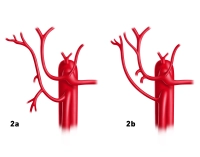
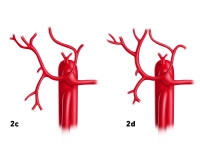
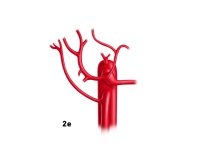
    • The most common anatomical variants are a proper or accessory hepatic artery from the superior mesenteric artery (Fig. 2a-b) or from the left gastric artery (Fig. 2c-d)
    • Occasionally, both variants are present together (Fig. 2e)
    44_LAV_02_a_b_Leberarterie
    44_LAV_02_c_d_Leberarterie
    44_LAV_02_e_Leberarterie
  4. Bile ducts

    The extrahepatic portion of the left hepatic duct is approximately 3-5 cm long and originates in the umbilical fissure from the union of the two ducts from segments II and III. Proximal to this junction, the bile duct from segment IV is usually incorporated.

    The right hepatic duct is very short, about 1 cm, and receives bile secretion via an anterior and posterior branch from segments V, VI, VII, and VIII. Occasionally, the right hepatic duct may be absent.

    Variants

    Left hepatic duct

    • The most common (approximately 25%) and clinically significant variant is a common opening of the segment IV bile duct with the segment II/III bile ducts (Fig. 3a)
    • In left-lateral resections, corresponding liver living donations, and liver splitting, there can easily be impairments of bile drainage from segment IV
    44_LAV_03_a_Gallenwege

    Right hepatic duct

    • Occasionally very short or absent, so that the anterior and posterior pedicle for the double segment V/VIII or VI/VII originates directly from the common hepatic duct (Fig. 3b); a typical hepatic bifurcation is then missing
    44_LAV_03_b_Gallenwege

    Fig. 3b to 3g: rp = right posterior bile duct, ra = right anterior bile duct, dhs = left hepatic duct

    Opening variants

    • Opening of the posterior bile duct directly into the cystic duct, common hepatic duct, or common bile duct (Fig. 3c-d)
    44_LAV_03_c_Gallenwege
    44_LAV_03_d_Gallenwege
    • Opening of the anterior and much more frequently the posterior right bile duct into the left hepatic duct (Fig. 3e-g)
    • Important in left hemihepatectomy: accidental transection can lead to significant bile leaks and segmental cholestasis in the right liver lobe
    44_LAV_03_e_Gallenwege
    44_LAV_03_f_Gallenwege
    44_LAV_03_g_Gallenwege
  5. Regional lymph nodes

    The liver has two lymphatic drainage pathways:

    1. Mostly (90%), the lymph from the liver flows to the lymph nodes at the porta hepatis and from there via the coeliac lymph nodes into the intestinal trunk.
    2. The second drainage pathway (10%) involves the superficial area of the diaphragmatic surface and the bare area. The lymph passes through the diaphragm into the superior phrenic lymph nodes and via mediastinal lymphatic vessels into the right venous angle.