Start your free 3-day trial — no credit card required, full access included

Perioperative management - Incisional hernia repair, open sublay

  1. Indication

    According to the guidelines of the EHS and AHS, the open sublay technique is an option for the treatment of primary and secondary abdominal wall hernias with defects between 4 and 10 cm.

    For retromuscular mesh positioning behind the M. rectus abdominis, this technique is particularly suitable for midline defects.

    In the incarceration situation, depending on the degree of contamination, treatment with a synthetic mesh is indicated only with great caution.

    Due to the evidence of the retromuscular layer as the optimal mesh placement, there has been a renaissance of the open sublay procedure in incisional hernia surgery in recent years.

    The sublay technique describes a retromuscular preperitoneal position of the mesh, which ideally includes a midline reconstruction with closure of the fascia over the mesh. This achieves a good mesh counterbearing, with the intra-abdominal pressure resting on the mesh as the strongest component of the closure and supporting its fixation.

    In principle, the indication for repair of an abdominal wall hernia is always given, as the hernia gap and extra-abdominal organ volume will usually continue to increase. In larger defects, ventral stabilizing elements of the trunk musculature are missing. Physically demanding activities and sports can be severely restricted to impossible.

    The exception is only the incidental finding in the context of cross-sectional imaging for other reasons. In the absence of symptoms, there is not necessarily an indication for surgery here.
  2. Contraindications

    For elective procedures, infection-free skin conditions are mandatory; pressure ulcers and superficial skin infections should first be treated primarily conservatively.
    The indication for hernia repair in patients with liver cirrhosis and ascites should be critically weighed; if necessary, preoperative optimization of liver function should be considered. In cases of severe coagulation disorders (Quick < 50 %, PTT > 60 s, platelets < 50 /nl) and pronounced portal hypertension with caput medusae, surgery should be avoided, especially due to the risk of uncontrollable bleeding from abdominal wall vessels.
    It is also important to have a good respiratory situation that is not compromised by acute infections. In case of respiratory infections, an elective procedure must be postponed.

  3. Preoperative Diagnostics

    Abdominal wall hernia is a clinical diagnosis and can usually be easily recognized in a standing patient. It is advisable to additionally examine the patient in a relaxed, lying position. If the patient is asked to lift the upper body, the fascial edge, the extent of the fascial defect, and the surrounding muscles can usually be assessed in reducible incisional hernias.

    For smaller primary hernias, abdominal sonography is an informative imaging procedure.

    To determine the defect location, the defect size, especially in incisional hernias, and to depict the abdominal wall anatomy, CT is the best diagnostic procedure, alternatively an MRI.

    In cases of previous incisional hernia repairs, a corresponding surgical report is often helpful, especially if a mesh repair has already been performed. In addition to the exact surgical technique (extra- or intraperitoneal mesh placement, augmentation or bridging of the fascial defect), the type of mesh material is particularly important.

    In extensive findings, a thorough cardiopulmonary function diagnostics is recommended due to the pressure increase after repositioning of the protruded viscera.

    To better characterize the present hernia, the EHS classification should be used.

    Classification of primary ventral hernias


    Small (S)

    Medium (M)

    Large (L)


    < 2 cm 

    ≥ 2 - < 4 cm

    ≥ 4 cm 

    Midline

    Epigastric


    Umbilical


    Lateral

    Spigelian


    Lumbar


    Classification of secondary ventral hernias (incisional hernias)

    70-PM-3

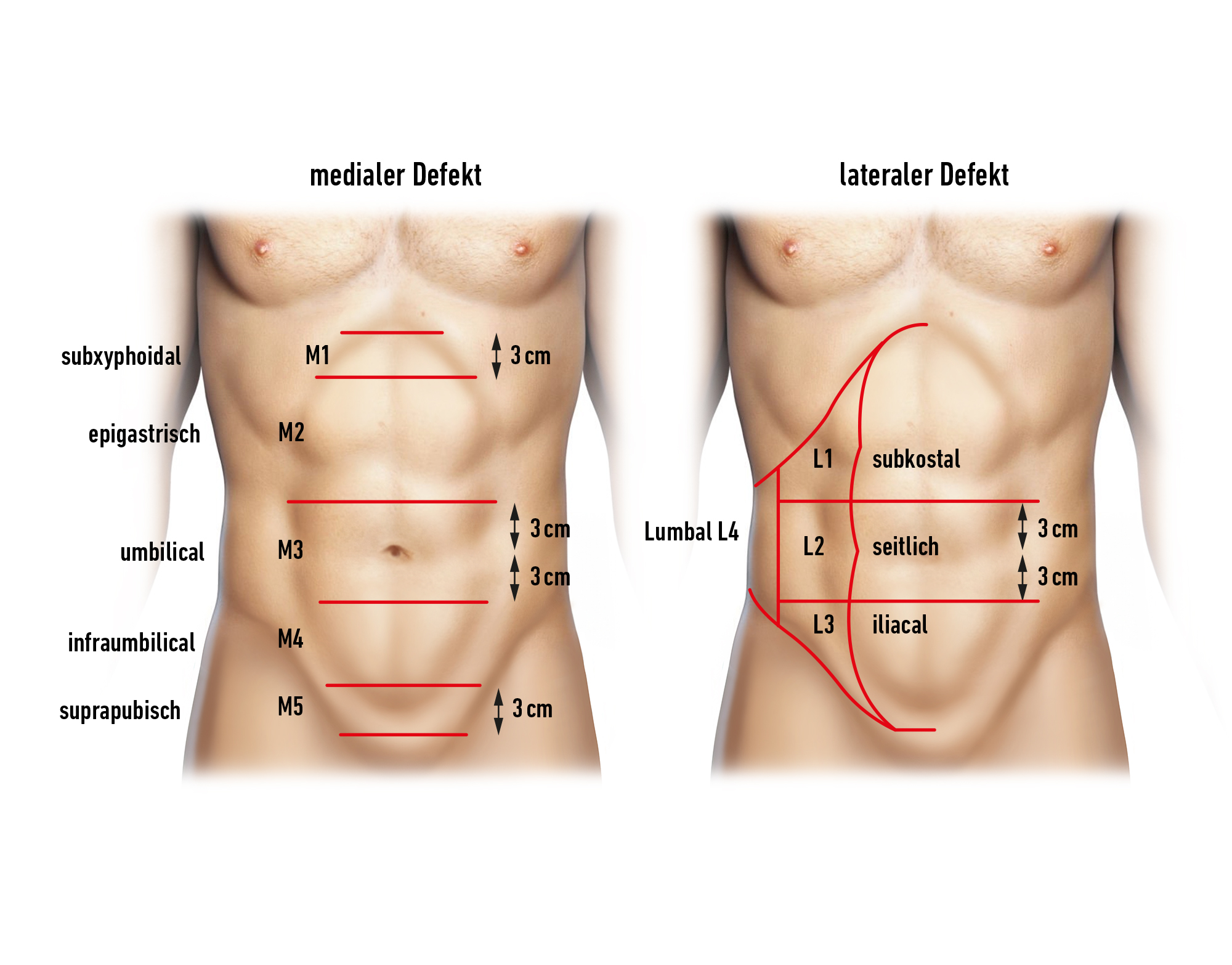
    The classification of secondary abdominal wall hernias is initially based on a medial or lateral defect location in the abdominal wall.

    The defect location of medial hernias is then more precisely delimited into subxiphoid, epigastric, umbilical, infraumbilical, and suprapubic. Laterally, the defects are divided into subcostal, lateral, iliac, and lumbar.

    Further consideration is given to the defect width of the incisional hernias: W1 (< 4 cm), W2 (4 - 10 cm) and W3 (> 10 cm).

    If there are multiple hernia defects (grid hernia, Swiss-cheese hernia), their size is determined by the total length and width.

  4. Special Preparation

    • Control of infection situations
    • Medication management in immunosuppression or anticoagulation
    • Control of cardiac and pulmonary risk factors
    • In advanced eventration of the viscera, conditioning of the abdominal wall in the example shown by a preoperative progressive pneumoperitoneum.
    • For this purpose, at least 10 days before the planned operation, a 1-lumen central venous catheter is placed laparoscopically via a trocar into the intraperitoneal space. Over 10 days, one liter of room air per day is insufflated into the peritoneal cavity using a filter, thereby achieving abdominal wall distension.
    • Meanwhile, botulinum toxin is more frequently used, which is injected ultrasound-guided into the lateral abdominal muscles 4 weeks before the operation and leads to a length gain of 4-5 cm per side through abdominal wall relaxation (transient paralysis).
    • Bowel emptying is advisable, preoperative bowel lavage is not required.
    • Single-shot antibiotic i.v. perioperatively (due to use of foreign material/mesh), possibly continuation of therapy in case of intraoperative signs of inflammation or bacterial contamination.
  5. Informed Consent

     General:

    • Pneumonia
    • Bleeding, secondary bleeding, hematoma
    • Wound infection/wound healing disorder
    • Thrombosis/Embolism
    • Excessive scar formation

    Specific:

    • Implantation of plastic material
    • Nerve injury/chronic pain
    • Seroma (regularly present, usually without therapeutic consequence)
    • Infection of the implant with the consequence of having to remove it again.
    • Intestinal passage disorder (Atony/Ileus)
    • Recurrent hernia
    • Intestinal perforation
    • Follow-up interventions
    • Mortality
  6. Anesthesia

    • Anesthesia is generally performed under general anesthesia ITN.
    • Intra- and postoperative analgesia by means of PDK.
  7. Positioning

    • Positioning of the patient in supine position, if necessary one arm adducted.
    • Depending on the size of the findings:
      Slight hyperextension of the patient during the preparation or
      neutral position during the fascia closure.
  8. OR-Setup

    • The surgeon stands to the right of the patient.
    • 1st assistant opposite the surgeon, 2nd assistant to the left next to the surgeon
    • The instrumenting nurse stands to the left of the patient next to the assistant.
  9. Special Instrumentation and Holding Systems

    • basic abdominal surgical instrumentation
    • bipolar scissors
    • in the film example: resorbable biomesh for augmentation of the abdominal wall
  10. Postoperative Treatment

    postoperative analgesia: Non-steroidal anti-inflammatory drugs are generally sufficient; if necessary, escalation with opioid-containing analgesics can occur.
    Follow the link here to PROSPECT (Procedures Specific Postoperative Pain Management).
    Follow the link here to the current guideline: Treatment of acute perioperative and posttraumatic pain.

    medical follow-up treatment: After umbilical, incisional, or epigastric hernias with mesh insertion, consistent wearing of an abdominal binder for 4 - 6 weeks is recommended. This is intended to prevent seroma and promote better and faster incorporation of the mesh. There is no clear data on this.

    Redon drains are removed when the drainage volume is < 10 - 20 ml/day. Inform the patient about reduced load-bearing capacity, especially during the first 3 months!

    Maintenance of basic mobility and light physical activity. Avoidance of sports and lifting loads up to 3 months. Inpatient rehabilitation depending on age, mobility, and home care

    Thrombosis prophylaxis: In the absence of contraindications, due to the moderate thromboembolism risk (surgical procedure > 30 min duration), in addition to physical measures, low-molecular-weight heparin should be administered in prophylactic, possibly weight- or disposition risk-adapted dosage until full mobilization is achieved.
    Note: Renal function, HIT II (history, platelet monitoring)
    Follow the link here to the current guideline: Prophylaxis of venous thromboembolism (VTE).

    Mobilization: Immediate

    Physiotherapy: For large hernias or elderly patients, intensive respiratory therapy

    Diet buildup: Immediate

    Bowel regulation: If necessary, oral laxatives from day 3/4 to avoid postoperative bowel atony; constipation should also be avoided in the long term.

    Inability to work: Depending on the extent of the findings, 3 - 4 weeks. For occupations with heavy strain on the abdominal wall → Avoid carrying/lifting heavy loads, possibly up to 6 - 12 weeks.