Start your free 3-day trial — no credit card required, full access included

Anatomy - Inguinal hernia repair using TEP technique with ENDOLAP 3D

  1. Inguinal Region

    Inguinal Region

    Inguinal region from the inside: (1) Inferior epigastric artery and vein, (2) medial = direct inguinal hernia orifice, (3) femoral hernia orifice, (4) pectineal ligament (Cooper), (5) ductus deferens, (6) external iliac artery and vein, (7) testicular artery and vein, (8) iliopubic tract, (9) lateral = indirect inguinal hernia orifice

    The inguinal region (transition between the anterior abdominal wall and lower extremity) has several weak points through which a hernial sac with or without contents can protrude through the abdominal wall (women are more prone to femoral hernias, men to inguinal hernias). Below the inguinal ligament, the inguinal canal is divided into two compartments by a separation of the inguinal ligament (iliopectineal arch): the vascular lacuna and the muscular lacuna.

    • Vascular Lacuna
      Located next to the pubic bone, it serves as the passageway for the external iliac artery and vein (→ femoral artery and vein, arrangement: artery lateral to the vein). Additionally, the femoral branch of the genitofemoral nerve passes through it laterally, and the deep inguinal lymph nodes (Rosenmüller) are found caudally medial within it. The vascular lacuna represents the internal hernia gap for femoral hernias (through the femoral septum next to the femoral vein).
    • Muscular Lacuna
      Located lateral to the vascular lacuna, it serves as the passageway for the psoas major muscle and iliacus muscle (together = iliopsoas muscle) as well as the femoral nerve and lateral cutaneous femoral nerve (cranially).
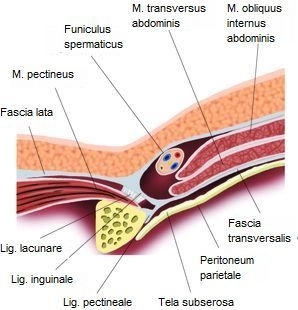
  2. Anterior Abdominal Wall

    Anterior Abdominal Wall
    • The inguinal canal forms during gonadal development in the male embryo through the descent of the testes, which are drawn into the scrotum by the gubernaculum testis, as a tubular structure. The peritoneum carried along during this descent remains as an outpouching in the inguinal canal (Proc. vaginalis testis) and extends to the epididymis. The layers of the abdominal wall thus become comparable coverings in this pouch: Fascia transversalis → Fascia spermatica interna, M. obliquus internus abdominis → M. cremaster, Fascia of M. obliquus externus abdominis → Fascia spermatica externa, no covering by M. transversus abdominis, as it ends more cranially.
    • Blood vessels (A. and V. testicularis) as well as the vas deferens (Ductus deferens) and nerves (N. ilioinguinalis from Pl. lumbalis) are also drawn into the scrotum and form the spermatic cord. Through obliteration of the Proc. vaginalis, the connection to the abdominal cavity closes, typically leaving only its entrance (Vestigium proc. vaginalis). In the female embryo, there is no complete descent of the ovaries due to the pull of the gubernaculum; instead, they remain beside the uterus, and only the Lig. teres uteri, as the former gubernaculum, persists in the inguinal canal. Inadequate obliteration of the Proc. vaginalis represents a weakness in the abdominal wall and the starting point for inguinal hernias.
    • The inguinal canal runs approximately 4 cm in a medio-caudal direction just above the inguinal ligament parallel to it and lies between the Anulus inguinalis profundus, as its cranial end, and the Anulus inguinalis superficialis, as its opening to the outer abdominal wall.

    Anulus inguinalis profundus

    • Centrally located between the symphysis and the anterior superior iliac spine in the inner abdominal wall, lateral to the A./V. epigastrica inferior (in the Plica umbilicalis lateralis).

    Anulus inguinalis superficialis

    • Above the pubic tubercle in the fascia of M. obliquus externus abdominis, upper edge pointing cranially, lower edge formed by the inguinal ligament, sides = Crus mediale and laterale with intercrural fibers for stabilization.
  3. Walls of the Inguinal Canal

    Anterior Wall

    • Fascia of the external oblique muscle, laterally reinforced by fibers of the internal oblique muscle → inguinal ligament and → cremaster muscle

    Posterior Wall

    • Transversalis fascia, medially reinforced by the conjoint tendon (= tendon of the transversus abdominis and internal oblique muscles

    Superior Wall

    • Transversus abdominis and internal oblique muscles (fiber direction from the inguinal ligament to the medial conjoint tendon

    Inferior Wall

    • Medial inguinal ligament (= reflected ligament) as well as a groove formed by the external oblique muscle for the spermatic cord.
  4. Contents of the Inguinal Canal

    In men: the spermatic cord (Funiculus spermaticus) with the ductus deferens, A. ductus deferentis (from A. vesicalis inferior) and A. testicularis (from the aorta), venous pampiniform plexus, A./V. cremasterica, R. genitalis of the N. genitofemoralis as well as sympathetic nerve fibers and lymphatic vessels, surrounded by the internal spermatic fascia, cremasteric fascia, and external spermatic fascia.

    In women: the round ligament of the uterus (Lig. teres uteri), which extends from the uterus to the deep inguinal ring through the inguinal canal to the superficial inguinal ring and finally to the labia majora, lymphatic vessels, and in both partially the N. ilioinguinalis.

  5. Types of Hernias

    • Hernial openings represent for indirect inguinal hernias the deep inguinal ring, for direct inguinal hernias the medial inguinal fossa (medial to the deep inguinal ring and the inferior epigastric artery/vein).
    • Indirect inguinal hernias
      more common, men > women, congenital (open processus vaginalis testis) or acquired (also through the internal inguinal ring in the lateral inguinal fossa, mostly adults), hernial sac runs lateral to the epigastric vessels and extends into the scrotum or labia majora
    • Direct inguinal hernias
      Mostly acquired, in adults men > women, protrusion of the peritoneum and the transversalis fascia in the medial inguinal fossa (= Hesselbach's triangle/inguinal triangle, medial to the epigastric artery/vein), medially bounded by the transversus abdominis muscle, caudally by the inguinal ligament, usually exiting through the external inguinal ring → scrotum/labia majora.
    • Femoral hernias
      Mostly acquired, in adults women > men, through the femoral canal in the medial thigh (medial to the vascular lacuna) together with the femoral artery/vein, femoral branch of the genitofemoral nerve, and lymphatic vessels.