Start your free 3-day trial — no credit card required, full access included

Anatomy - Open surgical gastrectomy

  1. Surgical Anatomy of the Stomach

    Surgical Anatomy of the Stomach

    The stomach is, formally speaking, a dilation of the digestive tract located between the esophagus and the intestine, tasked with storing and mixing food. This muscular hollow organ produces acidic gastric juice (mucus and HCl) and enzymes that pre-digest some components of food, then gradually pass the chyme into the small intestine.
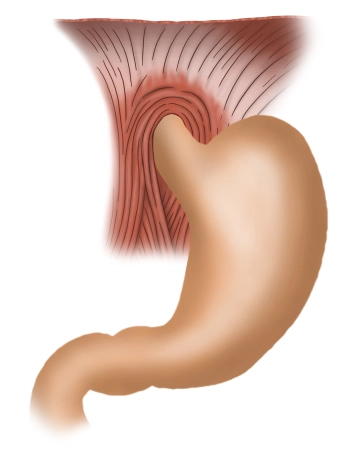
    The stomach is usually located in the left and middle upper abdomen directly beneath the diaphragm. The position, size, and shape of the stomach vary greatly from person to person and depending on age, state of fullness, and body position. When moderately filled, the stomach is on average 25-30 cm long and has a storage capacity of 1.5 liters, and in extreme cases, up to 2.5 liters.
    The stomach is anchored and stabilized in the abdominal cavity by ligaments that extend to the liver and spleen, among others. It forms the greater curvature (Curvatura major) with its convex side and the lesser curvature (Curvatura minor) with its concave side. Its anterior wall is referred to as Paries anterior, and its posterior wall as Paries posterior.
    The stomach is intraperitoneal and thus covered by serosa, except for the dorsal cardia, which is free of serosa. The embryonic mesogastria rotate from their original sagittal position to a frontal one through gastric rotation: The lesser omentum extends from the lesser curvature to the liver hilum, while the greater omentum spreads from the greater curvature to the transverse colon, spleen, and diaphragm.

    The stomach can be divided into different sections:

    • Cardia / Ostium cardiacum:
      The upper stomach entrance is an area of 1-2 cm where the esophagus opens into the stomach. Here, the sharp transition from esophageal mucosa to gastric mucosa is usually well visible with an endoscope.
    • Fundus gastricus:
      Above the stomach entrance, the fundus arches upward, also called the "gastric dome" or Fornix gastricus. The fundus is typically filled with air that is involuntarily swallowed during eating. In an upright person, the fundus forms the highest point of the stomach, so in an X-ray, the collected air appears as a "gastric bubble." Opposite the stomach entrance, the fundus is demarcated by a sharp fold (Incisura cardialis).
    • Corpus gastricum:
      The main part of the stomach is formed by the body of the stomach. Here, deep longitudinal mucosal folds (Plicae gastricae) extend from the stomach entrance to the pylorus and are also referred to as the "gastric street."
    • Pars pylorica:
      This section begins with the expanded Antrum pyloricum, followed by the pyloric canal (Canalis pyloricus), and ends with the actual pylorus. Here lies the pyloric sphincter muscle (M. sphincter pylori), formed by a strong circular muscle layer, which closes the lower stomach opening (Ostium pyloricum). The pylorus closes the stomach exit and periodically allows some chyme to pass into the subsequent duodenum.
  2. Layers and Structure of the Stomach Wall

    Stomach Wall
    Under the microscope, the stomach wall exhibits a characteristic layered structure from inside to outside:

    • Internally, the stomach wall is lined by mucosa (Tunica mucosa). The gastric mucosa is divided into three sublayers: The lamina epithelialis mucosae produces a viscous neutral mucus that protects the gastric mucosa from mechanical, thermal, and enzymatic damage. Below this is the lamina propria mucosae, which contains the gastric glands (Glandulae gastricae). Finally, there is a narrow lamina muscularis mucosae that can alter the relief of the mucosa.
    • The gastric mucosa is followed by a loose connective tissue layer (Tela submucosa), consisting of connective tissue with a dense network of blood and lymphatic vessels, as well as a nerve fiber network, the submucosal plexus (Meissner's plexus), which controls gastric secretion. This plexus operates independently of the central nervous system (CNS) but can be influenced by it through the autonomic nervous system.
    • Next is a robust tunica muscularis, divided into three sublayers with fibers running in different directions: an inner layer of small oblique muscle fibers (Fibrae obliquae), then a circular muscle layer (Stratum circulare), and an outer longitudinal muscle layer (Stratum longitudinale). This muscle is responsible for the stomach's peristalsis, which ensures the continuous mixing of chyme with gastric juice. Between the circular and longitudinal muscle layers runs a nerve fiber network, the myenteric plexus (Auerbach's plexus), which controls the function of the muscle. Like the submucosal plexus, this plexus operates largely autonomously but is influenced by the autonomic nervous system.
    • This is followed by another connective tissue layer (Tela subserosa).
    • The final layer is the peritoneum as the serous membrane (Tunica serosa).

    Gastric Glands
    The gastric glands (Glandulae gastricae) are located in the lamina propria mucosae and can be found in the fundus and corpus of the stomach. Up to 100 glands are located on 1 mm² of the mucosal surface. Various cells are located in the wall of the glandular tube:

    • Mucous cells: They produce the same neutral mucus as the epithelial cells.
    • Neck cells: These cells are located quite superficially in the gland and secrete alkaline mucus, meaning the pH is high due to the bicarbonate ions (OH- ions) it contains. This property is important for controlling and, if necessary, regulating the stomach's pH. The mucus coats the gastric mucosa, protecting it from self-digestion by the aggressive hydrochloric acid (HCl) and enzymes as self-digesting proteins. This cell type is found predominantly in the cardia and fundus of the stomach.
    • Chief cells: These cells produce the inactive precursor enzyme pepsinogen, which is converted into the active enzyme pepsin by hydrochloric acid (HCl) and is responsible for the digestion of dietary proteins. Since the enzyme only comes into contact with hydrochloric acid at the surface of the gland, self-digestion of the glands by the enzyme is prevented. This cell form is mainly located in the corpus of the stomach.
    • Parietal cells: These cells, found predominantly in the gastric corpus, produce abundant hydrogen ions (H+ ions) necessary for the formation of hydrochloric acid (HCl). Hydrochloric acid has a very low pH of 0.9-1.5. Additionally, parietal cells produce the so-called intrinsic factor. This substance forms a complex with vitamin B12 from food in the intestine, which can then pass through the intestinal wall. This vitamin is particularly important in erythropoiesis (removal of the stomach can lead to anemia).
    • G cells: These cells, preferably located in the antrum of the stomach, produce gastrin to increase HCl production in the parietal cells.
  3. Function

    The stomach serves as a reservoir for ingested food. It can store food for hours, allowing us to meet our daily nutritional needs with a few larger meals. Through peristalsis, the food bolus (chyme) is mixed with gastric juice, chemically broken down, partially digested, and then gradually passed into the duodenum.

  4. Arterial, Venous, and Nervous Supply

    Arterial, Venous, and Nervous Supply

    The arterial supply of the stomach is provided by several blood vessels, all originating from the unpaired celiac trunk, forming numerous anastomoses among themselves, and running along the gastric curvatures as vascular arcades to supply the organ:

    • Right gastric artery from the proper hepatic artery to the lower part of the lesser curvature,
    • Left gastric artery to the upper part of the lesser curvature,
    • Short gastric arteries from the splenic artery to the fundus,
    • Right gastroepiploic (omental) artery from the gastroduodenal artery to the lower (right) part of the greater curvature,
    • Left gastroepiploic (omental) artery from the splenic artery to the left side of the greater curvature,
    • Posterior gastric artery from the splenic artery to the posterior wall.

    Thus, the stomach is supplied by two vascular arcades between the left and right gastric arteries at the lesser curvature, as well as the left and right gastroepiploic arteries at the greater curvature.

    Parallel to the arterial supply, the four major veins of the stomach run along the two curvatures. Collecting veins (left and right gastric veins directly into the portal vein, left gastroomental vein and short gastric veins to the splenic vein, and right gastroomental vein to the superior mesenteric vein) form from them, all draining into the portal vein.

    The nervous supply of the stomach is predominantly governed by the autonomic nervous system, but sensory fibers are also present: The sympathetic system supplies the pyloric muscle, while the parasympathetic system (vagus nerve X) supplies the rest of the gastric muscle and the gastric glands. The vagus nerve runs parallel to the esophagus on the right and left, passes through the diaphragm via the esophageal hiatus, reaching the anterior surface of the stomach on the left side (anterior vagal trunk) and the posterior surface on the right side (posterior vagal trunk). Sensory fibers from the stomach, on the other hand, run afferently via the greater splanchnic nerve to thoracic spinal ganglia.

  5. Lymphatic Drainage Pathways

    Lymphatic Drainage Pathways

    The efferent lymphatic vessels of the stomach run parallel to the arterio-venous supply of the organ:

    • The lymph from the lesser curvature runs parallel to the left/right gastric arteries into the left/right gastric lymph nodes,
    • from the gastric fundus parallel to the splenic artery into the splenic lymph nodes,
    • the lymph from the greater curvature runs parallel along the attachment of the greater omentum to the right/left gastro-omental lymph nodes,
    • from the pyloric region into the pyloric lymph nodes.
      From the aforementioned regional lymph nodes, the lymph subsequently flows into the celiac lymph nodes, the upper mesenteric lymph nodes, and the thoracic duct.
      Another drainage pathway for the lymph is represented by the pancreatic lymph nodes, so that tumors of the stomach can indeed metastasize into the pancreas. A peculiarity of gastric carcinoma is the recurrent presence of a noticeable lymph node in the left lateral neck region (Virchow's node), which indicates advanced metastasis.
      For surgical reasons, the lymph node stations are divided into 3 compartments:
    • Compartment I (LN group 1-6): all LNs directly at the stomach: paracardial (Group 1+2), at the lesser and greater curvature (Group 3+4), supra- and infrapyloric (Group 5+6).
    • Compartment II (LN group 7-11): LNs along the major vessels: left gastric artery (Group 7), common hepatic artery (Group 8), celiac trunk (Group 9), splenic hilum (Group 10), splenic artery (Group 11).
    • Compartment III (LN group 12-16): LNs at the hepatoduodenal ligament (Group 12), behind the pancreatic head (Group 13), at the mesenteric root and mesentery (Group 14+15), and along the abdominal aorta (Group 16).