Start your free 3-day trial — no credit card required, full access included

Abdominal wall closure - Techniques: loop suture and "small tissue bites"

Reading time readingtime 00:01 min.
Activate now
  1. Continuous Fascial Closure with the Loop; Cranial Suture

    Video
    Continuous Fascial Closure with the Loop; Cranial Suture
    Soundsettings

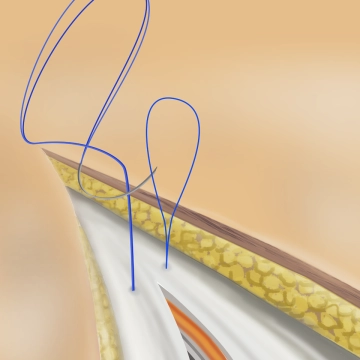
    The surgeon grasps the fascia with the surgical forceps and pierces through the fascia 1 cm from the edge with a twisting motion. Both the anterior and posterior fascial layers are grasped together.
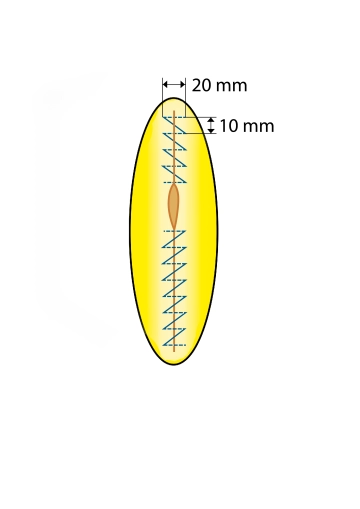
    The first stitch is placed approximately 1 cm cranial to the end of the wound to anchor the loop in the non-incised fascial area. The insertion is V-shaped from the healthy tissue into the incision and from the incision into the healthy tissue. The needle is pulled through the loop and the suture is then performed in a continuous technique. The loop is sutured from the wound edge to the wound center. The distance between the stitches is about 1 cm, achieving a thread-to-wound length ratio of at least 4:1. The cranial suture line is continued to the middle of the incision.

    Note: In fascial suturing, only the aponeurosis should be grasped, as muscle in the stitch area can become necrotic and lead to loosening of the fascial closure.
    The peritoneum is not closed separately but can be included.
    Peritoneal bulges in the suture line should be avoided.
  2. Continuous Fascial Closure with the Loop; Caudal Suture

    Video
    Continuous Fascial Closure with the Loop; Caudal Suture
    Soundsettings

    Due to the length of the wound, a second loop is started from the other end of the wound in the same manner. The suture should neither be pulled too tight, to avoid strangulation of the tissue, nor too loosely adapted, as this can lead to suture leakage with delayed wound healing, which similarly increases the risk of fascial dehiscence.

    Note: Due to its elasticity, the thread does not need to be tensioned to the maximum. This, in turn, reduces the cutting of the stitch channels to the fascial edges and preserves the tissue. Overstretching must be avoided as this could cause the two threads of the loop to become unequal in length. Such a thread must be discarded.

Continuous Fascial Closure with the Loop; Knotting

The caudal suture is advanced so that both loops overlap in the middle by one to two stitches to av

Activate now and continue learning straight away.

Single Access

Activation of this course for 3 days.

US$9.30  inclusive VAT

Most popular offer

webop - Savings Flex

Combine our learning modules flexibly and save up to 50%.

from US$4.32 / module

US$51.88/ yearly payment

price overview

gynecology

Unlock all courses in this module.

US$8.64 / month

US$103.80 / yearly payment

to top