Start your free 3-day trial — no credit card required, full access included

Perioperative management - Abdominal Aortic Aneurysm - Endovascular Therapy

  1. Indications

    Indications

    Asymptomatic: a rapid increase in size (> 4mm per year) or a transverse diameter of > 5 cm are clinical decision criteria for surgery; in women, smaller diameters are already at risk of rupture.

    Symptomatic: every aneurysm rupture is a life-threatening situation and represents the absolute indication for surgery in all patients.

    Note: Mortality for emergency interventions: > 40 %, for elective interventions: approx. 3 – 5 %

  2. Contraindications

    Contrast agent intolerance in

    • Allergy
    • Renal insufficiency or
    • Hyperthyroidism
  3. Preoperative Diagnostics

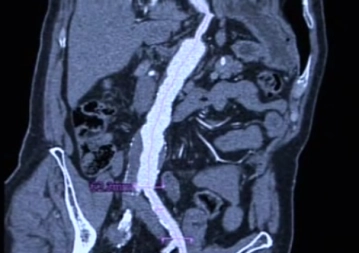
    • Contrast-enhanced abdominal CT (Angio-CT) for visualization of aneurysm size and morphology
    • additional intra-arterial angiography in case of clinical suspicion of AVK in the course of the pelvic or renal arteries
    • internal medicine evaluation to assess operability (ECG, chest X-ray, carotid duplex, if necessary stress ECG, echocardiography, myocardial scintigraphy, coronary angiography to exclude CAD)
  4. Special Preparation

    • Orthograde bowel irrigation the day before to improve image quality in the context of fluoroscopy
    • Provision of red blood cell concentrates depending on GC and initial Hb
  5. Informed Consent

    • Conversion (“open” aneurysm exclusion by laparotomy)
    • Circulatory disturbances of the legs (amputation),
    • of the bowel (artificial bowel outlet) and
    • of the kidneys (dialysis requirement)
    • Stroke
    • Heart attack
    • Death
  6. Anesthesia

  7. Positioning

    Positioning
    • Supine position on an X-ray-transparent (carbon) table
    • Arms positioned on both sides
  8. OR Setup

    OR Setup
    • Operator on the right side
    • Assistant on the left side, likewise C-arm and DL monitor
    • Instrumenting OR nurse at the foot end (with a long table for placing the intervention materials)
  9. Special Instrumentation and Holding Systems

    • C-arm
    • Angiography high-pressure pump
    • Endograft: Manufacturer and size according to preoperative planning with additional proximal and distal extension options
  10. Postoperative Treatment

    Postoperative Analgesia:
    intensive care monitoring depending on comorbidities; laboratory checks (Hb, coagulation, creatinine); CT check before discharge; repeated CT check after 6 and 12 months, if findings are unremarkable then annually; angiographic clarification in case of endoleaks, migration and dislocation of the endoprosthesis, increase in aneurysm size.
    Follow the link here to PROSPECT (Procedures Specific Postoperative Pain Management)
    Follow the link here to the current guideline Treatment of acute perioperative and posttraumatic pain.

    Medical Follow-up Care:
    Focuses of postoperative treatment in the first 1–2 days are recognizing complications such as rebleeding, respiratory insufficiency, cardiac decompensation.
    Thrombosis Prophylaxis:
    Weight-adapted low-molecular-weight heparin; or follow the link here to the current guideline Prophylaxis of Venous Thromboembolism (VTE).

    Mobilization:
    from the 1st postoperative day
    Physiotherapy:
    if necessary due to comorbidities
    Diet Build-up:
    immediately desired diet
    Stool Regulation:
    generally not required
    Inability to Work:
    for 2 weeks, follow-up treatment possible