Start your free 3-day trial โ€” no credit card required, full access included

Perioperative management - Resection of an infrarenal abdominal aortic aneurysm and tube graft interposition

  1. Indications

    The indication for invasive treatment of an abdominal aortic aneurysm (AAA) is fundamentally based on weighing the individual risk of rupture in the spontaneous course against the operative risk. If the risk of rupture in the spontaneous course exceeds the individual operative risk, invasive treatment is generally indicated.

    Classification of rupture risk

    Factors

    Low risk

    Moderate risk

    High risk

    Aneurysm diameter

    < 5 cm

    5–6 cm

    > 6 cm

    Growth rate per year

    < 0.3 cm

    0.3–0.5 cm

    > 0.5 cm

    Smoking/COPD

    low

    moderate

    heavy

    Family history

    none

    isolated

    frequent

    Arterial hypertension

    none

    well controlled

    unstable despite treatment

    Morphology

    fusiform

    saccular

    protrusions

    Sex

    male

    female

    Surgical indication

    Classification

    Size

    Wall

    Clinical presentation

    Surgical indication

    asymptomatic infrarenal

    > 5 cm ♂

    > 4.5 cm ♀

    intact

    none

    elective

    asymptomatic supra-aortic

    > 6 cm

    intact

    none

    elective

    symptomatic

    independent

    intact

    spontaneous pain, tenderness in the abdomen, back or flank

    urgent, within 24 hrs

    ruptured

    independent

    contained or free rupture

    diffuse severe spontaneous/touch pain of the tense abdomen, with/without haemorrhagic shock

    emergency

    aortoduodenal fistula

    intermittent vomiting, melaena

    emergency

    aortocaval fistula

    right heart failure, fistula murmurs, central cyanosis, simultaneous contrast enhancement of the aorta and inferior vena cava

    emergency

    Two procedures are available for the surgical treatment of AAA:

    • open replacement of the abdominal aorta with a tube or bifurcated graft (OAR, open aortic repair)
    • endovascular implantation of a stent graft (EVAR, endovascular aortic repair)

    Laparoscopic aneurysm surgery, usually combined with a mini-laparotomy, is of rather minor importance.

    The following recommendations exist for the selection of the procedure – OAR or EVAR:

    OAR (trans-, retroperitoneal)

    • normal life expectancy
    • low operative risk ('fitness')
    • anatomy unsuitable for EVAR: landing zone, aneurysm neck (angle, length), iliac vessels (stenoses, elongation, kinking), thrombi, calcification
    • Marfan and other connective tissue disorders

    EVAR (standard graft, custom-made)

    • previous abdominal surgery
    • limited life expectancy
    • high operative risk
    • anatomy suitable for EVAR (see above)

    EVAR requires adequate iliac vessels for access, as the stent graft systems are often of large calibre. Atherosclerotically narrowed, tortuous and kinked, as well as aneurysmatically dilated iliac vessels are problematic.

    In the long-term course, the endovascular aortic graft is associated with a higher complication rate than open aortic surgery.

    The mortality risk for EVAR or OAR of an individual patient can be quickly calculated using the so-called BAR Score Calculator -> www.britishaneurysmrepairscore.com, which can be usefully employed to counsel patients about the risk of an elective procedure with EVAR or OAR.

    Video example
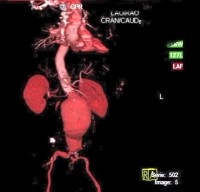
    PM 304-1
    Three-dimensional spiral CT image of an infrarenal AAA.

    Asymptomatic, infrarenal AAA over 5 cm in diameter, unsuitable for EVAR due to angulation of the aneurysm neck over 60°.
  2. Contraindications

    Contraindications for open aneurysm repair:

    • serious cardiopulmonary risks (e.g. NYHA IV, COPD Gold stage IV)
    • acute or chronic inflammatory abdominal conditions (e.g. florid ulcerative colitis, recurrent sigmoid diverticulitis)
    • history of multiple extensive abdominal procedures ('hostile abdomen')
    • cirrhosis of the liver
    • advanced tumour disease
    • compensated renal failure (relative contraindication)

  3. Preoperative diagnostic work-up

    History

    • cardiac history
    • medication history
    • risk factors: nicotine, arterial hypertension, coronary artery disease, heart failure, diabetes mellitus, manifest renal failure with/without dialysis dependency, coagulopathies
    • walking distance/claudication
    • back or flank pain?
    • mid- to upper abdominal complaints?

    Inspection

    • skin changes
    • muscular abnormalities
    • orthopaedic malalignments
    • skin colour
    • hair growth
    • trophic changes
    • swelling, oedema, mycoses, phlegmons, ulcera cruris, etc.

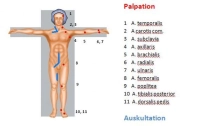
    Palpation

    • bilateral pulse status (side-to-side comparison)
    • side-to-side comparison of skin temperature
    • possibly an expansile pulsating mass in the mid-abdomen
    • doughy, extensively pulsating, painful abdomen: suspicion of contained perforation

    side-to-side comparative auscultation of the extremity arteries

    PM 304-2

    Ankle-brachial index (ABI)

    • ABI = systolic BP posterior tibial artery/systolic BP brachial artery

    ABI value

    Severity of PAD

    > 1.3

    falsely high values (suspicion of Mönckeberg's medial sclerosis, e.g. in diabetes mellitus)

    > 0.9

    normal finding

    0.75–0.9

    mild PAD

    0.5–0.75

    moderate PAD

    < 0.5

    severe PAD

    • An ABI value of < 0.9 is considered diagnostic of the presence of relevant PAD.
    • Determination of the ankle-brachial index (ABI) by non-invasive measurement of the Doppler occlusion pressure is a suitable test for detecting PAD.
    • For the diagnosis of PAD, the ABI value with the lowest ankle artery pressure is decisive.
    • A pathological ankle-brachial index is an independent risk indicator for increased cardiovascular morbidity and mortality.

    Colour-coded duplex ultrasonography

    • carotid, abdominal aorta, extremity arteries
    • localisation of stenoses and occlusions in almost all vascular regions except the thoracic region
    • quantification of the degree of stenosis and assessment of plaque morphology possible
    • Sensitivity and specificity approximately 90%
    • well suited as a screening method

    Contrast-enhanced spiral computed tomography (SCTA)

    • broad range of indications: traumatic vascular lesion (especially of the trunk), vascular dissection/rupture, aneurysm, arterial thrombosis/embolism, portal/mesenteric vein thrombosis, pulmonary embolism, PAOD, vascular tumours
    • Advantages: quickly performed, detection of relevant concomitant diseases, visualisation of peripheral arteries, sensitivity and specificity each approximately 90%
    • Disadvantages: radiation and contrast agent exposure, allergies (approximately 3%), no functional assessment
    • Aneurysm: three-dimensional visualisation of the entire aorta and its morphology, sufficiently precise measurement for EVAR, demonstrates wall characteristics with thrombosis and calcification

    Angiography (intra-arterial DSA)

    • visualisation of the aortic branches (stenoses, renal polar arteries, visceral and iliofemoral arteries)
    • dynamic imaging
    • Disadvantages: limited visualisation of aneurysm morphology (only perfused lumen), ionising radiation, nephrotoxic contrast agent, invasive

    Cardiac check

    • resting ECG
    • exercise ECG
    • echocardiography

    Chest radiograph

    spirometry if required

    Laboratory

    • full blood count
    • electrolytes
    • coagulation
    • renal retention parameters (urea/creatinine)
    • liver enzymes
    • blood lipids
    • blood group
  4. Special preparation

    • Enema the evening before
    • Trimming of the hair in the surgical field
    • Order packed red blood cells
    • Indwelling urinary catheter
    • Administer prophylactic perioperative antibiotics 30 min. before the start of surgery (see KRINKO recommendation, Robert Koch Institute)
  5. Informed consent

    General surgical risks

    • Allergy/intolerance (e.g. latex, medication)
    • Wound infection, sepsis
    • Thromboembolism
    • Skin/tissue/nerve damage due to positioning on the operating table or procedure-related measures
    • Keloids

    Specific procedural risks

    • Bleeding, blood transfusion, risk of infection through allogeneic blood transfusion (hepatitis, HIV)
    • Secondary bleeding, possibly requiring revision surgery
    • Thrombosis of the vascular graft and possibly adjacent vascular segments, hypoperfusion of the legs, gangrene, limb loss/amputation, revision surgery
    • Injury to adjacent organs (e.g. ureter, urinary bladder, bowel, kidneys, etc.), further procedures
    • Kidney failure secondary to preexisting renal insufficiency or additional interventions on the renal arteries, possibly permanent dialysis
    • Nerve injury with dysaesthesia or pain, weakness of the abdominal wall musculature, weakness or partial paralysis of the thigh musculature, each of which may be temporary or permanent
    • In men: sexual dysfunction, infertility in the case of injury to the vas deferens with a non-functional contralateral vas deferens
    • Impaired perfusion of the bowel/ischaemic colitis, possibly resection, temporary or permanent stoma
    • Spinal ischaemia/paraplegia
    • Abdominal compartment syndrome: multi-organ failure, intensive care management, relaparotomy
    • Lymphoedema, temporary or permanent
    • Infection-induced suture line breakdown of the graft: bleeding, sepsis, relaparotomy
    • Side effects of iodine-containing contrast media
    • Anastomotic aneurysm, surgical revision, possibly endovascular
    • Incisional hernia
    • Intra-abdominal adhesions
Anaesthesia

General endotracheal anaesthesia ... - Operations in general, visceral and transplant surgery, vasc

Activate now and continue learning straight away.

Single Access

Activation of this course for 3 days.

US$9.30  inclusive VAT

Most popular offer

webop - Savings Flex

Combine our learning modules flexibly and save up to 50%.

from US$4.30 / module

US$51.61/ yearly payment

price overview

vascular surgery

Unlock all courses in this module.

US$8.60 / month

US$103.20 / yearly payment

to top