Start your free 3-day trial โ€” no credit card required, full access included

Perioperative management - Popliteal artery aneurysm: resection and revascularization with a great saphenous vein interposition graft (posterior approach)

  1. Indications

    The aim of treating popliteal artery aneurysms (PAA) is to prevent major amputations caused by microemboli entering the arteries of the lower leg from the aneurysm. In critical ischaemia caused by PAA, the rate of major amputation is between 25% and 50%.

    Asymptomatic PAA

    Surgery is generally recommended for aneurysms measuring 2 cm in diameter or more, since even small aneurysms can frequently become symptomatic. In the absence of pedal pulses and in aneurysms smaller than 2 cm with partial mural thrombosis, "silent" embolisation may occur, which is why in this constellation the indication for surgery must be determined on a case-by-case basis.

    Symptomatic PAA

    Acute and chronic critical ischaemia, local pressure sequelae, venous thrombosis due to compression, septic aneurysm and rupture constitute an indication for surgery regardless of extent or diameter.
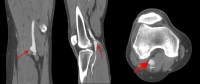
    PM 302-1
    Video example Preoperative CT-angiogram
  2. Contraindications

    A thrombotically occluded PAA with good collateralisation and without intermittent claudication does not necessarily require surgery. The indication for surgery in these cases depends on the perfusion situation of the extremity (e.g. PAOD stage III/IV). An autologous distal crural bypass may be indicated where appropriate. If the patient is in poor general condition or is already unable to walk, amputation may be considered as an alternative.

  3. Preoperative diagnostic work-up

    History/Symptoms

    At the time of diagnosis, 80% of PAA are clinically silent, and around 14% become symptomatic each year. The symptoms resemble the picture of peripheral arterial occlusive disease:

    • Arterial stenoses
    • Microemboli
    • Intermittent claudication
    • Rest pain
    • Trophic disorders

    PAA may also manifest as swelling of the leg and secondary deep vein thrombosis.

    Contralateral pulse status comparison

    Occlusion pressure/ankle-brachial index

    Colour-coded duplex sonography

    Modality of choice:

    • PAA screening and sizing
    • Extent of mural thrombosis
    • Runoff situation
    • Anatomical variants
    • also: preoperative mapping of the greater saphenous vein (= graft material)

    CT angiography

    • complements ultrasonography for planning the surgical management of the PAA

    Cardiac workup

    • in suspected myocardial ischaemia

    Clinical chemistry

    • FBC, electrolytes, coagulation panel

    Chest radiograph

    Screening for

    • aortic aneurysm (in about 20% of patients)
    • contralateral PAA (in about 50% of patients)
    • stenoses of the supra-aortic branches requiring treatment
  4. Special preparation

    • If necessary, temporary discontinuation of oral anticoagulation with transition to low molecular weight heparin
    • Preoperative mapping of the greater saphenous vein (= graft material)
  5. Informed consent

    General risks of surgery

    • Allergy/intolerance
    • Wound infection
    • Thrombosis/embolism
    • Skin/tissue/nerve damage
    • Keloids

    Specific surgical risks

    • Bleeding/secondary bleeding
    • Hepatitis/HIV transmission by blood transfusion
    • Arterial/venous thrombosis/embolism, microembolisation
    • Nerve injury
    • Occlusion of the graft/bypass with critical ischaemia, loss of limb
    • Massive infection of the graft/bypass
    • Lymphoedema of the leg, lymph fistula
    • Compartment syndrome
Anaesthesia

General anaesthesia ... - Operations in general, visceral and transplant surgery, vascular surgery

Activate now and continue learning straight away.

Single Access

Activation of this course for 3 days.

US$9.30  inclusive VAT

Most popular offer

webop - Savings Flex

Combine our learning modules flexibly and save up to 50%.

from US$4.30 / module

US$51.61/ yearly payment

price overview

vascular surgery

Unlock all courses in this module.

US$8.60 / month

US$103.20 / yearly payment

to top