Start your free 3-day trial — no credit card required, full access included

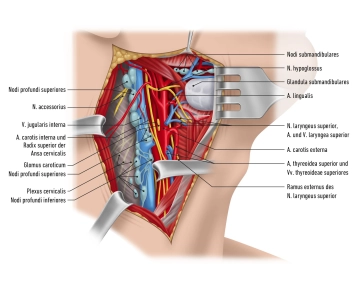
Anatomy - Open TEA of the left carotid bifurcation with patch angioplasty and temporary intraluminal shunt

  1. Common carotid artery

    Common carotid artery
    Zum Vergrößern bitte anklicken

    Origin

    • left: aortic arch
    • right: brachiocephalic trunk

    Course

    • ascending behind the sternocleidomastoid muscle
    • within the carotid sheath

    Division

    • Carotid bifurcation (Bifurcatio carotidis): Division into internal carotid artery and external carotid artery

    Vascular territory

    1. Internal carotid artery

    • Brain
    • Eye
    • Forehead
    • Anterior nasal cavity

    2. External carotid artery

    • Extracranial structures of the head and neck
  2. Internal carotid artery

    Origin

    • Branch of the common carotid artery (carotid bifurcation)

    Course from caudal to cranial

    1. Cervical part

    • Section between origin of the common carotid artery to the skull base
    • entry into the cranial cavity via the carotid canal
    • gives off no branches

    2. Petrous part

    • runs in the petrous bone
    • small branches to the tympanic cavity and pterygoid canal

    3. Cerebral part

    • runs in the subarachnoid space
    • passes through the dura mater
    • Branching into anterior cerebral artery and middle cerebral artery
    • Anterior cerebral artery communicates via the anterior communicating artery with the contralateral anterior cerebral artery

    The circle of Willis is an arterial vascular ring at the base of the brain, which serves the blood supply of the brain. It is composed – from anterior to posterior - of the following vessels:

    • Anterior communicating artery (unpaired)
    • Anterior cerebral artery (left and right)
    • Internal carotid artery (left and right) or its direct continuation, the middle cerebral artery
    • Posterior communicating artery (left and right)
    • Posterior cerebral artery (left and right, both from the basilar artery).

    However, there are numerous variants in the formation of the circle regarding the caliber of the branches and the connections (hypoplasias of individual branches or even agenesis of partial sections). This is clinically relevant for collateral supply in stenoses.

  3. External carotid artery

    The supply areas of the external carotid artery can be divided into four groups depending on location: anterior, middle and posterior group as well as terminal branches.

    1. Anterior Group

    Branches (cranial → caudal)

    Branches

    Supply

    Superior thyroid artery

    • Infrahyoid branch
    • Cricothyroid branch
    • Sternocleidomastoid branch
    • corresponding muscles
    • Superior laryngeal artery
    • Inner side of larynx
    • Glandular branches
    • Thyroid gland

    Lingual artery

    • Suprahyoid branch
    • Hyoid bone
    • Dorsal lingual branches
    • Dorsum of tongue
    • Sublingual artery
    • Sublingual gland
    • Deep lingual artery
    • Tip of tongue

    Facial artery

    • Ascending palatine artery
    • soft palate
    • tonsils
    • pharynx
    • Submental artery
    • Submandibular gland
    • suprahyoid muscles
    • Inferior labial artery
    • Lower lip
    • Superior labial artery
    • Upper lip
    • Angular artery
    • medial canthus
    2. Middle Group

    Branches (cranial → caudal)

    Branches

    Supply

    Ascending pharyngeal artery

    • Pharyngeal branches
    • Pharynx
    • Inferior tympanic artery
    • Tympanic cavity
    • Posterior meningeal artery
    • Dura mater
    3. Posterior Group

    Branches (cranial → caudal)

    Branches

    Supply

    Occipital artery

    • Mastoid branch
    • Mastoid cells
    • Occipital branches
    • Occipital region
    • Meningeal branch
    • Dura mater

    Posterior auricular artery

    • Auricular branch
    • external ear
    • Occipital branch
    • Occipital region
    • Stylomastoid artery
    • Facial nerve
    • Tympanic cavity
    • Mastoid cells
    • Posterior tympanic arteries
    • Tympanic cavity
    • Mastoid cells
    • Pharyngeal branches
    • Pharynx
    • Parotid branch
    • Parotid gland
    4. Terminal branches

    Branches (cranial → caudal)

    Supply

    Superficial temporal artery

    • Transverse facial artery
    • Face
    • Zygomatico-orbital artery
    • lateral canthus
    • Middle temporal artery
    • Temporal muscle
    • Frontal branch
    • Scalp

    Maxillary artery

    Mandibular part

    • Deep auricular artery
    • Temporomandibular joint
    • external auditory canal
    • Anterior tympanic artery
    • Tympanic cavity
    • Inferior alveolar artery
    • Teeth
    • Mandible
    • Mylohyoid branch: floor of mouth
    • Mental branch: chin
    • Middle meningeal artery
    • Meninges

    Pterygoid part

    • Masseteric artery
    • Masseter muscle
    • Pterygoid branches
    • Pterygoid muscles
    • Deep temporal arteries
    • Temporal muscle
    • Buccal artery
    • Buccinator muscle

    Pterygopalatine part

    • Posterior superior alveolar artery
    • Teeth
    • Maxilla
    • Infraorbital artery
    • Maxilla
    • Descending palatine artery
    • Tonsils
    • soft palate
    • Sphenopalatine artery
    • Nasal cavity
    • Nasal septum
    • Artery of pterygoid canal
    • Pharynx
    • Tympanic cavity
  4. Venous Systems

    Superficial and deep venous systems unite in the venous angle ("venous angle") to form the V. brachiocephalica and empty into the V. cava superior.

    1. Superficial Veins

    V. jugularis externa

    • runs in the lateral neck area covered by the platysma
    • penetrates the superficial lamina of the cervical fascia
    • empties into the venous angle, possibly even earlier, into the V. jugularis interna, then into the V. cava superior

    V. jugularis anterior

    • usually runs over the M. sternocleidomastoideus
    • Vv. jugulares anteriores of both sides usually unite in the suprasternal space to form the jugular venous arch
    • empties into the venous angle or into the V. jugularis externa
    2. Deep Veins

    V. jugularis interna

    • see below

    V. subclavia

    • Continuation of the V. axillaris
    • runs in front of the M. scalenus anterior
    • empties together with the V. jugularis interna in the venous angle and forms the V. brachiocephalica → V. cava superior
    V. jugularis interna

    Origin

    • arises extracranially through the confluence of the sigmoid sinus and inferior petrosal sinus
    • begins as the superior bulb of the jugular vein
    • passes through the skull base in the jugular foramen

    Course

    • runs parallel to the A. carotis communis within the carotid sheath
    • meets with the A. subclavia in the venous angle → V. brachiocephalica

    Tributaries (cranial → caudal)

    • V. ophtalmica superior
    • V. facialis
    • V. retromandibularis
    • Plexus pterygoideus
    • Vv. pharyngeales
    • V. lingualis
    • V. thyreoidea superior et mediae
    • V. sternocleidomastoidea

    Drainage Area

    • entire brain
    • face
    • thyroid gland
  5. Lymphatic vessels

    The lymphatic drainage of the head and neck drains into the paired jugular trunks.

    Left jugular trunk

    • Drainage area: left half of the head and neck
    • Empties into: Thoracic duct

    Right jugular trunk

    • Drainage area: right half of the head and neck
    • Empties into: Right lymphatic duct
  6. Nervous System

    1. Cervical Plexus - predominantly motor innervation

    Nerve

    Segments

    Course/Special Features

    motor innervation

    sensory innervation

    Cervical Ansa

    • Superior Root: C1, C2
    • Inferior Root: C2, C3
    • Superior root parallel with hypoglossal nerve
    • Geniohyoid muscle
    • infrahyoid musculature

    Ø

    Phrenic Nerve

    • C3 - C5
    • runs on anterior scalene muscle
    • in the mediastinum between mediastinal pleura and pericardium to the diaphragm
    • Diaphragm

    Pericardial branch:

    • Pericardium
    • Mediastinal pleura
    • Diaphragmatic pleura

    Phrenicoabdominal branch:

    • Peritoneum on the underside of the diaphragm
    • Peritoneum of the gallbladder

    Sternocleidomastoid branch

    • C1 - C3
    • forms plexus with branches of the accessory nerve (XI)
    • Sternocleidomastoid muscle (together with XI)

    Ø

    Trapezius branch

    • C2 - C4
    • Trapezius muscle (together with XI)

    Ø

    2. Cervical Plexus - purely sensory innervation

    Nerve

    Segments

    Course, Special Features

    Innervation

    Lesser Occipital Nerve

    • C2, C3
    • runs dorsal to the sternocleidomastoid muscle
    • lateral occiput

    Great Auricular Nerve

    • C2, C3
    • crosses over the sternocleidomastoid muscle
    • Skin below the auricle

    Transverse Cervical Nerve

    • C2, C3
    • crosses over the sternocleidomastoid muscle
    • Superior branch: forms anastomosis with cervical branch of facial nerve
    • anterior neck region

    Supraclavicular Nerves

    • C3, C4
    • fan-shaped course towards clavicle
    • Clavicle
    • upper chest region
    • Shoulder
    3. Sympathetic Nervous System

    Sympathetic Ganglion

    Special Features

    Nerve Branches, Innervation

    Superior Cervical Ganglion

    • Level of C2/3
    • Branches run predominantly periarterially
    • Jugular nerve → glossopharyngeal nerve and vagus nerve
    • Internal carotid nerve → deep petrosal nerve
    • External carotid nerves → salivary glands
    • Laryngopharyngeal branches → pharyngeal plexus
    • Superior cervical cardiac nerve → cardiac plexus
    • Fibers to the pineal gland

    Middle Cervical Ganglion

    • variable location, not always present
    • Middle cervical cardiac nerve → cardiac plexus

    Inferior Cervical Ganglion

    • often united with the first ganglion of the thoracic sympathetic trunk to form the stellate ganglion
    • Inferior cervical cardiac nerve → cardiac plexus
    • Vertebral nerve → sympathetic fibers to the cranial nerves
    • Subclavian ansa → connection between inferior cervical ganglion and middle cervical ganglion
    • in fusion to stellate ganglion → sympathetic fibers to sweat glands and skin vessels of the upper extremity