Start your free 3-day trial — no credit card required, full access included

Perioperative management - PTA of a left subclavian artery stenosis (balloon angioplasty)

  1. Indications

    Indications
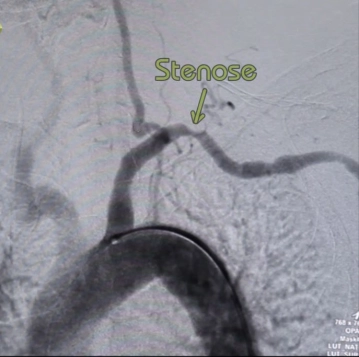
    Subtotale Stenose der A. subclavia links

    Stenosis or occlusion of the subclavian artery only in cases of clearly attributable symptoms/hypoperfusion of the arm:

    • claudication-like arm complaints (load-dependent ischemia)
    • acral lesions in the finger area
    • Subclavian Steal Syndrome

    Classification of arterial occlusive disease of the upper extremity based on the Fontaine classification of the lower extremity

    Stage I

    asymptomatic stenosis/occlusion

    Stage II

    load-dependent fatigue, weakness or pain in the affected arm

    Stage III

    constant pain symptoms, nocturnal rest pain

    Stage IV

    trophic disorders, necrosis formation in the acral area

  2. Contraindications

    • asymptomatic stenosis of the subclavian artery
    • systemic diseases, e.g. Takayasu arteritis
  3. Preoperative Diagnostics

    Medical History

    Ischemia-related complaints

    • rapid fatigue of the arm, claudication-like complaints during overhead work

    Inspection/Palpation

    • Pallor and coldness of the hand
    • weakened pulse (brachial, radial, ulnar arteries)
    • acral cyanosis, also necroses due to embolic digital artery occlusions (e.g., due to thrombi in a post-stenotically dilated subclavian artery)

    Blood Pressure Measurement

    • on the affected side, blood pressure usually > 30 mm Hg lower

    Doppler Duplex Sonography

    • The brachiocephalic trunk and the origin area of the left subclavian artery are usually not directly accessible due to anatomical reasons
    • from the flow spectrum of the more cranial arterial segments, however, stenoses in the inflow can be inferred

    Imaging

    • MR or CT Angiography
  4. Special Preparation

    • Marking of the side to be operated on
    • if necessary, shaving of the puncture site
  5. Informed Consent

    • Change of access route, e.g. transfemoral -> cubital
    • Allogeneic blood transfusion, Hepatitis, HIV
    • Allergic reaction, e.g. contrast medium
    • Contrast-induced nephropathy, possibly lifelong dialysis
    • Hematoma/secondary bleeding groin
    • Vessel dissection in the groin or pelvic arteries necessitating possibly open surgical correction
    • AV fistula formation, pseudoaneurysm in the groin necessitating surgical correction
    • Groin infection, deep infection, sepsis
    • Lesion of the femoral nerve
    • Thromboembolism (myocardial infarction, renal infarction, intestinal necrosis) -> local lysis, fibrinolysis
    • Re-stenosis
    • Conversion to open surgery
  6. Anesthesia

    • Local anesthesia
    • ITN (patient's request)
  7. Positioning

    Positioning
    • Supine position, arm of the affected side adducted (due to C-arm), opposite side abducted
  8. OP-Setup

    OP-Setup

    The surgeon stands at the level of the puncture site (video example: right groin), to his left the assistant. The surgical nurse stands to the right of the surgeon or opposite. The C-arm for intraoperative fluoroscopy comes from the side to be operated on (video example: left), next to it at the patient's head level, the monitor is placed clearly visible for the surgeon.

  9. Special Instrumentation and Holding Systems

    • long 6-F sheath
    • flexible guidewire (Terumo® 0,035)
    • if nec. rigid wire (Back-up Meier®, Amplatz®)
    • guide catheter (pigtail, vertebral catheter)
    • dilation balloon 6-9 mm
    • DEB balloon 6-9 mm („drug eluting balloon“)
    • if nec. flexible stents in various sizes
    • DSA system, contrast medium high-pressure pump
    • for conversion in emergency: vascular filter
  10. Postoperative Treatment

    Postoperative Analgesia

    Follow the link here to PROSPECT (Procedure Specific Postoperative Pain Management) and to the current guideline Treatment of acute perioperative and posttraumatic pain.

    Medical Follow-up Care

    • Circulation control of the affected arm
    • Control of the puncture site
    • dual platelet aggregation inhibitor therapy (Clopidogrel & ASA); in case of monotherapy, possibly heparinization of the patient over 24 hours

    Mobilization

    • in case of closure of the puncture site with a closure system (Proglide®, StarClose®, Angioseal®, Exoseal® etc.) absolute bed rest 2-6 hours, otherwise 12-24 hours

    Physiotherapy

    • not applicable

    Diet Buildup

    • immediately

    Stool Regulation

    • usually unnecessary

    Incapacity for Work

    • 1-3 days