Start your free 3-day trial — no credit card required, full access included

Anatomy - Restthyroidectomy with partial central lymph node dissection on the left

  1. Anterior Triangle of the Neck

    Anterior Triangle of the Neck

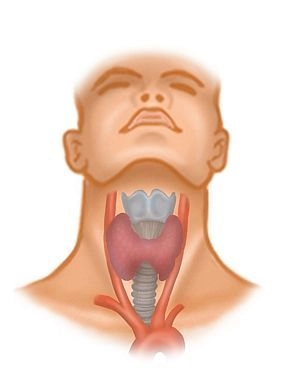
    Located between the anterior border of the sternocleidomastoid muscle, the mandible, and the jugular fossa, the anterior triangle of the neck includes the supra- and infrahyoid muscles, vessels, nerves, and the thyroid gland in the vicinity of the hyoid bone. For thyroidectomy, among the infrahyoid muscles, only the medially located

    • sternohyoid muscle (sternum → hyoid bone) and beneath it the
    • sternothyroid muscle (sternum → thyroid cartilage of the larynx) as well as more laterally the
    • omohyoid muscle (scapula → intermediate tendon → hyoid bone)

    are of significance, as they partially cover the thyroid gland and must be retracted intraoperatively.

    Blood Vessels
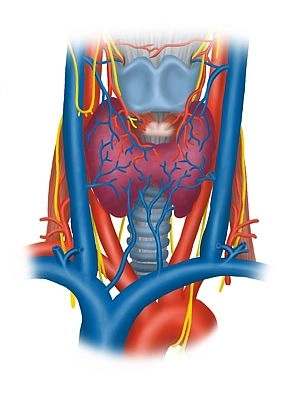
    The common carotid artery divides at the upper edge of the thyroid cartilage at the level of its carotid sinus (receptors for blood pressure and chemoreceptors for blood gases) into its internal and external branches and runs previously immediately lateral in the carotid sheath next to the trachea and esophagus cranially. Here it touches as a large vessel the right and left thyroid lobes. The internal jugular vein arises from the sigmoid sinus of the skull, collecting blood from the skull and neck, initially aligning with the internal carotid artery in the carotid sheath, then running further laterally and encircling the common carotid artery and the vagus nerve (N. X) laterally.

    Nerves
    In addition to the vagus nerve and its superior branch to the larynx (superior laryngeal nerve → anterior cricothyroid muscle, as well as mucosa of the upper half of the larynx), the ansa cervicalis profunda (superior and inferior roots, from C1-C3) descends laterally in the area of the thyroid gland to innervate the three mentioned muscles of the anterior triangle of the neck and the transverse cervical nerve (from C2/3, skin innervation, platysma).

    Fascial Layers
    In the anterior triangle of the neck, there are several fascial layers under the skin (all belonging to the cervical fascia), which have certain specific features:

    • the superficial lamina superficialis surrounds all neck structures except the platysma and separately encloses the sternocleidomastoid muscle and dorsally the trapezius muscle (accessory nerve XI),
    • the middle lamina pretrachealis surrounds the infrahyoid muscles and the
    • deep lamina prevertebralis runs between the esophagus and the spine outside the surgical area.

    The thyroid/parathyroid gland and the trachea, as well as the lateral vascular-nerve bundle (carotid artery, internal jugular vein, and vagus nerve), also have their own organ fascias. The arrangement of the cervical fascias results in compartments enclosed by them and spaces between them that extend into the mediastinum and represent potential pathways for infection.
  2. Thyroid Region

    Thyroid Region

    The unpaired thyroid gland (Glandula thyreoidea), along with the 4 parathyroid glands (Glandula parathyreoidea), belongs to the endocrine organs. It is located in the anterior neck region caudal and lateral to the thyroid cartilage and is composed of a left and a right lobe, as well as an isthmus connecting both lobes. The lobes cover the lateral upper rings of the trachea, as well as the cricoid and thyroid cartilage from the front, with the isthmus located centrally at the level of the 2nd/3rd tracheal ring. The organ has its own fibrous capsule (Capsula fibrosa) and is covered ventrolaterally by the infrahyoid muscles (M. sternohyoideus, M. sternothyroideus, and M. omohyoideus) as well as the lamina pretrachealis. Due to its embryonic development and descent (via the thyroglossal duct) from the base of the tongue (Foramen caecum) to its later described location, cysts or ducts to the Foramen caecum, as well as functional glandular parts (e.g., as Lobus pyramidalis), can remain along this path.

    Blood Supply
    Arteries from the external carotid artery (→ superior thyroid artery) and from the subclavian artery via the thyrocervical trunk (→ inferior thyroid artery) supply the thyroid gland with anterior and lateral/posterior smaller branches. Inconsistently, but notably, the thyroid ima artery may approach the gland directly from the aortic arch or the brachiocephalic trunk from below. The venous drainage, which has systemic significance for this endocrine organ, occurs through similarly named vessels (superior and middle thyroid veins → internal jugular vein, inferior thyroid vein → brachiocephalic vein).

    Lymphatic Vessels and Nerves
    The lymphatic drainage from the thyroid gland occurs paratracheally, as well as to deep cervical lymph nodes. Special attention should be paid intraoperatively to the recurrent laryngeal nerve (from the vagus nerve X, running on the right around the subclavian artery, on the left around the aortic arch). It ascends in the groove between the trachea and esophagus to the larynx, where it innervates all laryngeal muscles except the cricothyroid muscle anteriorly ("Anticus"), in addition to providing sensory innervation to the mucosa of the lower half of the larynx.

  3. Topography

    Topography

    During thyroidectomy, there is a risk of injuring structures such as the recurrent laryngeal nerve and the parathyroid glands at the posterior aspect of the organ, as well as parts of the sympathetic trunk or vessels and nerves near the common carotid artery due to the close spatial proximity.

  4. Anatomy and Function of the Parathyroid Glands

    The paired, just lens-sized parathyroid glands are located between the fibrous capsule and the external capsule on the posterior surface of both thyroid lobes, occasionally they are also embedded in the thyroid tissue. The upper parathyroid glands are usually located at the level of the lower edge of the cricoid cartilage, the lower ones at the level of the 3rd – 4th tracheal cartilage.

    The number and location of the parathyroid glands vary significantly, in 95% of cases there are 4 or more. They can be found above and below the thyroid in the cervical connective tissue. Displacements cranially up to the level of the hyoid bone and caudally into the upper mediastinum occur.

    The inferior thyroid artery supplies over 80% of the blood to the parathyroid glands. The rest is supplied by the superior thyroid artery and from branches arising from the anastomoses between the two thyroid arteries.

    The function of the parathyroid gland mainly lies in the formation and secretion of parathyroid hormone (PTH), a polypeptide consisting of 76 amino acids.

    Parathyroid hormone regulates calcium metabolism by increasing renal reabsorption in the distal tubule. The release of PTH is mainly determined by the level of serum calcium. The hydroxylation of 25-cholecalciferol in the kidney to 1,25-dihydroxycholecalciferol, the active vitamin D3 metabolite, is controlled by PTH and regulates the intestinal absorption of calcium and phosphate.

    The largest portion of serum calcium is bound to albumin (80%), but only the free portion, the ionized calcium, is of physiological significance. The binding of calcium to albumin is pH-dependent and is enhanced by alkalosis.

    PTH also has a direct influence on the serum levels of phosphate and magnesium through the regulation of bone calcium metabolism.