Start your free 3-day trial — no credit card required, full access included

Suturing and Knotting Technique

  1. Principles of the surgical knot

    A distinction is made between one-handed and two-handed knots. In the one-handed technique, one hand keeps the thread constantly under tension or pull, while the other hand ties a knot or a loop. In the two-handed technique, both hands tie equally and thus create a secure knot seat more directly (see film on surgical knot). Disadvantages of the two-handed technique are the lack of tension on both thread ends and the more difficult learnability.
    The one-handed technique alternately combines the index finger and middle finger knots. A secure knot seat is achieved by changing the pulling hand/pulling thread.
    The advantages of this technique are the higher tying speed, continuous maintenance of thread tension (which is particularly helpful in depth, for example in the small pelvis), and easier learnability. In general, only two superimposed loops (i.e., two knots) ensure a secure seat. The two first loops are finally fixed by changing the pulling hand/pulling thread. The first loop determines the tension on the tissue, the second fixes the first on it.

    In the following video sequences, the basic techniques for the one-handed knot technique are presented from the perspective of the right-hander. The “pulling thread” is always in the left hand and the “tying thread” in the right hand.
     

  2. Middle finger knot

    Video
    Middle finger knot
    Soundsettings

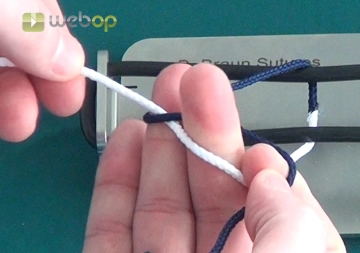
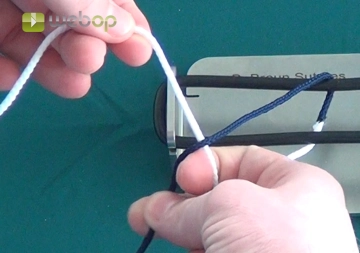
    The thread ends are held between thumb and index finger. The thread with which the knot is to be tied must first undercross the tension thread to avoid an overthrow that would endanger the secure knot seating. Middle and ring fingers are placed on the tying thread and the right hand is opened (externally rotated) so that the palm is facing. Simultaneously, the tension thread is placed on the middle and ring fingers of the right hand. Now, the bent right middle finger pulls the tying thread under the tension thread. While the thumb and index finger of the right hand release the tying thread, it is fixed between the again extended middle and ring finger and pulled away to the right rear to create the knot. Finally, the right index finger guides the knot down along the tension thread.
    In the example, a basic knot and two subsequent knots are shown, where counter-directionality is achieved in the last knot by switching the tension hand. For braided threads, a total of 4 knots are recommended. The last two loops should be knotted with a switch of the tension hand/ tension thread. For monofilament threads, 6-8 knots are recommended. After the first two loops, all further knots should also be knotted here with a switch of the tension hand/ tension thread to achieve counter-directionality and thus a secure knot seating.

    Note: To avoid an overthrow of the knot, alternatively (not shown in the film) the hands can be crossed after tying.

  3. Index Finger Knot

    Video
    Index Finger Knot
    Soundsettings

    The pulling hand holds the thread end with thumb and index finger, the knotting hand holds its own between thumb and middle finger. The thread with which the knot is tied crosses the pulling thread first to avoid an overthrow. The knotting thread is loaded onto the index finger to then guide this finger over the pulling thread. This creates an “opening” between the two threads. Then, the index finger of the knotting hand is bent so far that its tip can be brought behind the knotting thread. If the index finger is now straightened again, it pulls the knotting thread forward through the opening. Subsequently, the knotting thread is fixed between index and middle finger, and the knot is formed by a sideways movement of the right hand. Finally, the knot (not shown in the film sequence) is to be guided downward along the pulling thread again.
    In the example, a basic knot and two subsequent knots are shown, whereby counter-directionality is achieved in the last knot by switching the pulling hand.

    Note: The overthrown knot is not guided downward in the film sequence; it would not allow a secure hold. Alternatively, the hands can be crossed here as well to avoid an overthrow.

  4. Surgeon's Knot

    Video
    Surgeon's Knot
    Soundsettings

    The surgeon's knot is the most reliable knot of the surgeon. It is formed here by a combination of the two knots shown above, performed with the middle or index finger in one-hand technique. The opposite direction of the two superimposed loops/knots ensures a secure hold.
    The first loop determines the tension on the tissue, the second fixes the knot.
    To further improve the knot hold, additional surgeon's knots can be added.

    Note: A higher number of knots (approx. 6 to 8) can compensate for the poorer knot hold of a monofilament thread.

Sliding Knot

The sliding knot is a one-hand technique that combines the two knots shown above, guided by the mid

Activate now and continue learning straight away.

Single Access

Activation of this course for 3 days.

US$9.40  inclusive VAT

Most popular offer

webop - Savings Flex

Combine our learning modules flexibly and save up to 50%.

from US$7.33 / module

US$87.98/ yearly payment

price overview

general and visceral surgery

Unlock all courses in this module.

US$14.66 / month

US$176.00 / yearly payment

to top