
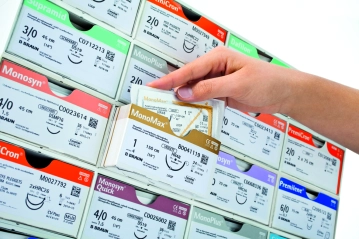
All suture materials available on the market are standardized and defined in the European Pharmacopoeia. Commonly used are two strength designations, those of the European Pharmacopoeia (EP) and the United States Pharmacopeia (USP).
The suture strengths according to the United States Pharmacopeia (American Pharmacopoeia, USP) were initially chosen arbitrarily. Significantly simpler and clearer is the strength designation according to the European Pharmacopoeia. Here, the decimal system was used as the basis. The strength sorting is called “metric.” The strength sorting indicates the thread strengths in 1/10mm and really says something about the thread diameter in relation to the conventional sorting (e.g.: metric 1 = 1/10 mm = 0.1 mm thread diameter). To facilitate the transition and avoid confusion, manufacturers in the Federal Republic of Germany indicate the thread strengths in metric and in the conventional designation USP on all packages (Harmsen W. S. 1994) (Thiede A. Geiger D. 1998).
The strength classification of the European Pharmacopoeia in metric has meanwhile also been adopted by the 19th Pharmacopoeia of the USA. Thus, a worldwide uniform strength specification is practically legally prescribed.
There is a variety of different surgical needles, which are adapted to the respective operative area of use. They are distinguished here according to certain specifications:
Bend shapes and arc length: the bend shape describes portions of the circle circumference, from a 1/4-circle up to a 5/8-circle. The more curved the needle is, the closer the entry and exit points are to each other. In confined surgical fields such as the anal canal, it can be useful to use a strongly curved needle. For skin sutures, 1/2-circle needles are usually used. The arc length is approximately equivalent to the width of the needle, or represents the distance between the needle tip and the arming zone.
Needle tip: Among others, cutting needles with a triangular cross-section for resistant tissues (for example, for skin sutures) are distinguished from round-bodied needles with slender and round tips with a small puncture channel for all soft tissues.
Needles already armed with thread allow atraumatic suturing in contrast to suturing with a thread to be inserted into the eyed needle; the thread lying double in the needle eye creates greater trauma during tissue puncture.
There is no optimal, universally applicable thread. For a layer- and tissue-appropriate wound closure, different materials are necessary. Important requirements for surgical suture material are
*high sterility
*high tensile strength
*secure knot hold
*tissue compatibility
*no capillarity
*adequate price.
Monofilament sutures are characterized by excellent tissue passage. The smooth surface and stiffness, however, worsen the knot hold, which must be compensated by a higher number of knots (approx. 6 to 8). Furthermore, monofilament threads have significantly lower tensile strength than braided suture material.
Multifilament, braided sutures made of several filaments are characterized by higher flexibility and thus lead to a more secure knot hold. In contrast, the disadvantage is the capillarity or wick effect. Due to its rough surface, the thread glides poorly through the tissue (sawing effect) and can thus lead to cutting. To minimize this undesirable effect and optimize the tissue passage behavior, some braided sutures are coated (pseudomonofilament).
Absorbable suture material is used in places that need to be adapted for a certain period of time (intestinal anastomoses, muscle sutures, subcutaneous sutures, vessel ligations).
Non-absorbable suture material is used where permanent or longer support of tissue strength is required. This particularly concerns sites with high mechanical stress (for example, the Shouldice suture in hernia repair, the fixation of the mesh in a Lichtenstein operation, or also vessel wall sutures).
Where, on the other hand, the removal of the suture material is planned, a non-absorbable thread should always be used (skin). An exception here is the intracutaneous skin suture, which can also be performed with absorbable monofilament threads.
Depending on the location, different suture strengths are used. On hands and face, for example, finer sutures of strength 4/0 or 5/0 are used. Tissues near joints, which are exposed to higher tension, should be treated with stronger threads (2/0 or 3/0). For skin sutures, no braided threads are used due to the capillary effect (possible contamination of the wound).
Hand-sewn gastrointestinal anastomoses are usually performed continuously in a single row seromuscularly and should be carried out with an absorbable monofilament thread.
Vessel walls should be sutured continuously everting in small intervals. Non-absorbable monofilament suture material is suitable for this.
Free ligatures as well as transfixion ligatures, for example on vessel stumps, should be performed with braided threads due to the better knot hold; however, monofilament suture material is also used for transfixion ligatures.
The peritoneal suture is intended to ensure a watertight closure of the peritoneum. Especially after interventions in inflammatory processes, the peritoneal exudate is often contaminated with germs despite extensive lavage. This is better tolerated by the peritoneum than by the musculature and subcutaneous tissue. Thus, abdominal wall abscesses usually arise from a subfascial process and not from unsterile dressing changes. The peritoneal suture is created with absorbable material and can be performed with monofilament, but also with braided, antibacterially coated threads.
Fasciae are bradytrophic tissues that are usually sutured continuously. They should therefore be treated with strong, monofilament absorbable threads that have a long half-life or a long resorption time.
Subcutaneous sutures are usually performed with absorbable, braided threads and are intended to prevent pocket formation.