Start your free 3-day trial — no credit card required, full access included

Anatomy - Chimney Technique for Juxtarenal Aortic Aneurysm (Ch-EVAR)

  1. Abdominal Aorta

    Abdominal Aorta
    Zum Vergrößern bitte anklicken

    Origin

    • from the thoracic aorta after its passage through the aortic hiatus of the diaphragm at the level of T12

    Course

    • retroperitoneal
    • left of the median plane ventral to the vertebral column
    • at the level of the umbilicus/L4 division (aortic bifurcation) into the common iliac arteries

    Branches from cranial to caudal

    • Inferior phrenic arteries
    • Celiac trunk
    • Middle suprarenal artery, right and left
    • Superior mesenteric artery
    • Right or left renal artery
    • Ovarian artery - or testicular artery right and left
    • Lumbar arteries
    • Inferior mesenteric artery
    • Median sacral artery

    Supply area

    • paired branches: abdominal wall, paired retroperitoneal organs, gonads
    • unpaired branches: spleen, unpaired digestive organs
  2. Paired branches of the abdominal aorta

    Main branches

    Course

    Branches and their   supply areas

    A. phrenica inferior

    • runs cranially on the underside of the diaphragm towards the diaphragmatic domes
    • network-like division into several terminal branches

    A. suprarenalis superior: Adrenal gland

    Terminal branches: Underside of the diaphragm

    A.suprarenalis media

    • runs laterally to the adrenal glands

    Terminal branches: Adrenal glands

    A. renalis

    • Origin approx. level L1 - 2
    • A. renalis dextra: runs dorsal to V. cava inferior and pancreatic head to the right kidney
    • A. renalis sinistra: runs dorsal to pancreatic body to the left kidney

    A. suprarenalis inferior: Adrenal gland

    A. ovarica, 

    A. testicularis

    • Origin below Aa. renales/L2 from the anterior side of the aorta
    • run over psoas muscle, ureter and Aa. iliacae externae to the suspensory ligament of the ovary or to the deep inguinal ring of the inguinal canal and the testis

    Aa. ovaricae: Ovaries, parts of the uterine tube,

    Aa. testiculares: Testes, epididymis

    Aa. lumbales (both sides 4)

    • run laterally behind the psoas muscle over L1 – 4
    • Anastomoses with the arteries of the anterior abdominal wall (Aa. epigastricae superior and inferior,  A. iliolumbalis, A. circumflexa ilium profunda)

    Rr. spinales: Spinal canal

    Terminal branches: Abdominal wall, back musculature

  3. Unpaired Branches of the Abdominal Aorta

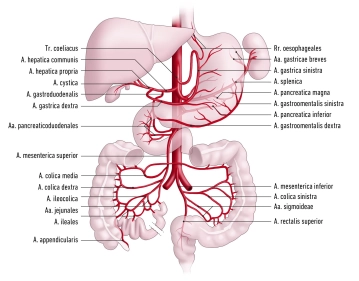
    • All unpaired branches of the abdominal aorta form anastomoses that maintain organ perfusion via collateral supply:
      • Celiac Trunk -> A. gastroduodenalis -> A. mesenterica superior
      • A. mesenterica superior -> A. colica media und sinistra -> A. mesenterica inferior (“Riolan Anastomosis”)
      • A. mesenterica inferior -> A. rectalis superior und media -> A. iliaca interna
    1. Celiac Trunk
    • Origin at level of T12
    • divides into A. splenica, A. gastrica sinistra, and A. hepatica communis (largest caliber branch of the trunk)

    Main Branches

    Course

    Branches and Their Course 

    Supply Area

    A. splenica

    • along upper border of pancreas
    • Entry into splenorenal ligament and spleen

    Rr. pancreatici:

    • dorsal to pancreas

    A. pancreatica dorsalis:

    • dorsal to pancreas
    • anastomoses with A. pancreatica magna to form A. pancreatica inferior

    A. pancreatica magna:

    • dorsal pancreatic tail caudally
    • anastomoses with A. pancreatica dorsalis to form A. pancreatica inferior

    Pancreas

    A. gastrica posterior:

    • courses in phrenicosplenic ligament cranially to gastric fundus

    Stomach (posterior surface fundus)

    Aa. gastricae breves:

    • course in gastrosplenic ligament to gastric fundus

    Stomach (fundus and greater curvature)

    A. gastroomentalis sinistra:

    • courses in gastrocolic ligament to greater curvature
    • anastomoses with A. gastroomentalis dextra

    Stomach (fundus and greater curvature)

    A. gastrica sinistra

    • extends to lesser gastric curvature
    • anastomoses with A. gastrica dextra

    direct branches

    Stomach (lesser curvature)

    Rr. oesophageales

    Esophagus

    A. hepatica communis

    • courses rightward to hepatic portal
    • Division into A. hepatica propria and A. gastroduodenalis

    A. hepatica propria

    • Main branch of A. hepatica communis
    • originates behind pylorus
    • extends in hepatoduodenal ligament together with V. portae hepatis and common bile duct to hepatic portal
    • gives off 3 branches:

    1. A. gastrica dextra:

    • courses in lesser omentum to lesser gastric curvature
    • anastomoses with A. gastrica sinistra

    Stomach (lesser curvature right)

    2. A. hepatica dextra

    Liver (right part)

    Gallbladder (A. cystica)

    partial caudate lobe

    3. A. hepatica sinistra

    Liver (left part)

    partial caudate lobe

    A. gastroduodenalis

    • courses dorsal to lesser omentum to pancreas
    • divides into 2 branches:

    1. A. gastroomentalis dextra:

    • extends to greater curvature
    • anastomoses with A. gastroomentalis sinistra

    Pancreas, duodenum, stomach

    2. A. pancreaticoduodenalis superior anterior und - posterior:

    • form with branches of A. pancreaticoduodenalis inferior a vascular plexus around pancreatic head
    2. Superior Mesenteric Artery
    • originates from aorta at level of L1-2
    • extends anterior-inferior
    • Branches: A. pancreaticoduodenalis inferior, Aa. jejunales and Aa. ileales, A. ileocolica, A. colica dextra, A. colica media

    Main Branches

    Course

    Branches

    Supply Area

    A. pancreaticoduodenalis inferior

    • courses in area of horizontal part of duodenum cranially to pancreatic head

    R. anterior und posterior:

    • anastomose with A. pancreaticoduodenalis anterior und posterior

    Pancreatic head

    Aa. jejunales and Aa. ileales

    • course in mesenteric root to jejunum and ileum
    • form a vascular arcade among themselves

    Aa. rectae

    Jejunum, ileum

    A. ileocolica

    • courses in mesentery to ileocecal region

    A. caecalis anterior und posterior

    Cecum

    A. appendicularis (Variant: Origin from A. caecalis posterior)

    Appendix vermiformis

    A. colica dextra

    • courses in ascending mesocolon to ascending colon

    divides into 2 branches, which anastomose with A. colica media or A. ileocolica

    Ascending colon

    A. colica media

    • courses in transverse mesocolon to transverse colon

    divides into 2 branches: right branch anastomoses with A. colica dextra (right flexure), left branch anastomoses with A. colica sinistra (left flexure)

    Transverse colon

    3. Inferior Mesenteric Artery
    • originates at level of L3 from aorta
    • supplies colon beyond left flexure with A. colica sinistra, Aa. sigmoideae, and A. rectalis superior

    Main Branches

    Course

    Branches

    Supply Area

    A. colica sinistra

    • courses in descending mesocolon to descending colon

    divides into 2 branches, which anastomose with A. colica media or A. sigmoideae

    Descending colon

    Aa. sigmoideae

    • 2-4 arteries that form a vascular arcade in sigmoid mesocolon
    • anastomose with A. colica sinistra and A. rectalis superior

    several small branches to sigmoid

    Sigmoid colon

    A. rectalis superior

    • approaches rectum from dorsal
    • anastomoses with A. rectalis media

    several small branches to rectum

    Upper rectum

  4. Arterial Supply of the Pelvis

    Arterial Supply of the Pelvis
    Zum Vergrößern bitte anklicken
    • Abdominal aorta divides at the aortic bifurcation (approx. level L4) into the two common iliac arteries
    • each common iliac artery in turn divides into an internal and external iliac artery
    • Internal iliac artery supplies mainly the pelvic viscera with visceral branches; with its parietal branches, it is involved in supplying the lower extremities
    • External iliac artery contributes to the supply of the pelvis and becomes the femoral artery after passing through the vascular lacuna
    1. Internal Iliac Artery

    Origin

    • arises immediately caudal to the aortic bifurcation from the common iliac artery

    Course

    • passes over the upper margin of the greater sciatic foramen caudally

    Positional Relationships

    • dorsal: internal iliac vein, piriformis muscle, lumbosacral plexus
    • ventral: ureter
    • lateral: external iliac vein, psoas major muscle
    • caudal: obturator nerve

    Branches

    visceral branches:

    • Umbilical artery
    • Inferior vesical artery
    • Middle rectal artery
    • in women: uterine artery

    parietal branches:

    • Iliolumbar artery
    • Lateral sacral arteries
    • Superior gluteal artery
    • Inferior gluteal artery
    • Obturator artery
    • Internal pudendal artery

    Supply Area

    • Pelvic organs, gluteal muscles
    1.1 Visceral Branches of the Internal Iliac Artery

    Main Branches

    Course and Branches

    Supply Area

    Umbilical artery

    • postnatal obliteration to the medial umbilical ligament
    • remaining branches: superior vesical arteries, in men: artery of the ductus deferens
    • Urinary bladder body
    • in men: ductus deferens

    Inferior vesical artery

    • branching in the urinary bladder fundus into small branches
    • Urinary bladder
    • in men: prostate, seminal vesicles

    Middle rectal artery

    • branching in the middle rectal section
    • anastomoses with superior and inferior rectal arteries
    • Rectal ampulla
    • in women: vagina
    • in men: prostate

    Uterine artery (women)

    • passes over the ureter
    • tortuous course in the broad ligament of the uterus
    • gives off numerous small branches
    • Ovary
    • Uterine tube
    • proximal vagina
    • Uterus
    1.2 Parietal Branches of the Internal Iliac Artery

    Main Branches

    Course and Branches

    Supply Area

    Iliolumbar artery

    • runs obliquely upward to the iliopsoas muscle
    • Psoas major muscle
    • Iliacus muscle

    Lateral sacral arteries

    • Superior branch: runs medially through the 1st or 2nd anterior sacral foramen and exits again through the posterior sacral foramen
    • Inferior branch: passes over the piriformis muscle and medial to the sacral foramina on the sacrum caudally
    • Sacral canal
    • Piriformis muscle
    • Muscles/skin dorsal to the sacrum

    Superior gluteal artery

    • passes with the superior gluteal nerve through the suprapiriform foramen and with branches to the gluteus maximus muscle (superficial branch) and gluteus medius muscle (deep branch)
    • Gluteus maximus, medius, and minimus muscles
    • Piriformis muscle
    • Tensor fasciae latae muscle
    • Skin over the sacrum

    Inferior gluteal artery

    • passes on the piriformis muscle caudally through the infrapiriform foramen
    • then runs together with the posterior femoral cutaneous nerve and sciatic nerve through the gluteus maximus muscle
    • Gluteus maximus, medius, and minimus muscles
    • Piriformis muscle
    • Quadriceps femoris muscle
    • Skin of the lower buttock and proximal thigh

    Obturator artery

    • runs along the lateral pelvic wall forward and downward
    • branches to the ilium and iliacus muscle
    • after passing through the obturator canal, gives off further branches, including pubic branch (anastomoses with the inferior epigastric artery to form the corona mortis) and posterior branch (branch: acetabular artery -> artery of the femoral head)
    • Ilium
    • Iliacus muscle
    • Thigh adductors
    • Pubis
    • External hip muscles
    • Femoral head

    Internal pudendal artery

    • runs ventral to the sacral plexus to the infrapiriform foramen
    • re-enters the lesser pelvis via the lesser sciatic foramen, through the pudendal canal, and branches in the ischiorectal fossa
    • Distal third of the rectum
    • Anal canal
    • Urethra
    • Scrotal skin/labia
    • Bulb of penis/vestibule
    • Dorsum of penis/clitoral prepuce
    2. External Iliac Artery

    Origin

    • arises caudal to the internal iliac artery from the common iliac artery

    Course

    • runs along the psoas major muscle to the inguinal ligament, through the vascular lacuna, and becomes the femoral artery here

    Positional Relationships

    • Right external iliac artery runs under the ureter

    Branches

    • Deep circumflex iliac artery runs to the anterior superior iliac spine and anastomoses with the iliolumbar artery and superior gluteal artery
    • Inferior epigastric artery runs medial to the deep inguinal ring cranially and between the transversus abdominis muscle and rectus abdominis muscle, further branches including cremasteric artery or round ligament artery

    Supply Area

    • Ilium, lower portion of the abdominal wall
  5. Femoral artery

    1. Overview
    A 321-3
    Zum Vergrößern bitte klicken

    Origin

    • External iliac artery, which becomes the femoral artery after passing under the inguinal ligament

    Course

    • runs between iliopsoas muscle and pectineus muscle (= iliopectineal fossa) covered by fascia lata
    • is accompanied by the sartorius muscle up to the middle of the thigh
    • passes together with femoral vein and saphenous nerve through the adductor canal
    • transitions into the popliteal artery after passing through the adductor hiatus

    Branches

    • Superficial epigastric artery
    • Superficial circumflex iliac artery
    • Deep femoral artery (main artery for supplying the thigh!)
    • External pudendal arteries
    • Descending genicular artery

    Supply area

    • Thigh 
    • Skin of the abdominal wall
    • External genitalia
    • Knee joint and proximal/medial lower leg
    2. Important branches of the femoral artery

    Branches

    Supply area

    Superficial epigastric artery

    • Ø
    • Skin of the abdominal wall up to the umbilical region

    Superficial circumflex iliac artery

    • Ø
    • Anterior superior iliac spine

    Deep femoral artery

    • Medial circumflex femoral artery runs between iliopsoas muscle and pectineus muscle dorsally → trochanteric fossa; anastomosis with  lateral circumflex femoral artery
    • Lateral circumflex femoral artery runs between rectus femoris muscle and vasti muscles laterally; anastomosis with medial circumflex femoral artery
    • Perforating arteries run through the adductors to the back of the thigh
    • Thigh

    External pudendal arteries

    • Ø
    • External genitalia
    • Scrotum or labia majora

    Descending genicular artery

    • Articular branches → genicular arterial network
    • Saphenous branch → runs medially together with great saphenous vein and saphenous nerve to the calf
    • Knee
    • Proximal medial calf