Start your free 3-day trial — no credit card required, full access included

Endovascular bifurcation prosthesis for infrarenal AAA with simultaneous aneurysm of the right common iliac artery (EVAR with iliac sidebranch)

Reading time readingtime 31:05 min.
Activate now
  1. Principle of the Endovascular Procedure

    Video
    Principle of the Endovascular Procedure
    Soundsettings

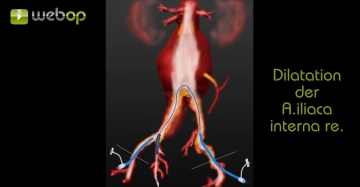
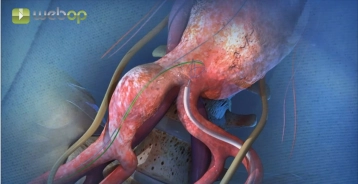
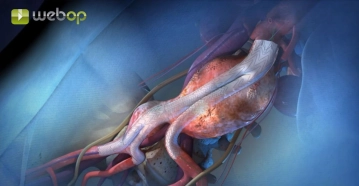
    After puncturing both groin arteries, two guidewires are first introduced from the right via a sheath. From the left, a Dormia basket is introduced over a long sheath. This is used to grasp one of the stiff wires and pull it from right to left in the groin over the sheath, so that the wire can be tensioned from both groins to position the endoluminal prostheses in the next steps. Now, the iliac prosthesis part with side arm for the internal iliac artery is introduced from the right with a delivery system, partially deployed, and positioned. Then, probing is performed with a delivery system from the left to advance the extension into the side arm up to the internal iliac artery and deploy it. Next, the iliac prosthesis part is completely released. In a further step, after probing the aorta with a stiff wire from the left femoral, a delivery system with the Y-prosthesis main body is introduced and deployed. Finally, the main body and the left-sided iliac prosthesis module are connected with another tubular prosthesis piece.

    In our case example, various steps were modified because it was necessary to dilate stenoses of the right common and internal iliac arteries. Also, an additional extension was introduced on the left iliac side for surgical tactical reasons.

    (Copyright (c) 2015 by W.L. Gore and Associates GmbH. Used with permission.)
  2. Bilateral inguinal access

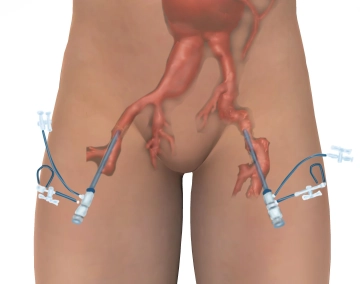
    Bilateral inguinal access
    Soundsettings

    Longitudinal incision in the area of both groins approximately 1 cm lateral to the palpable inguinal vessels, exposure and looping of the common femoral artery. Puncture of the femoral arteries on both sides using the Seldinger technique and insertion of suitable sheaths (e.g., 6F). Administration of 5,000 IU heparin on each side. Insertion of a pigtail catheter for angiography from the right. On the right, the stenosed external iliac artery is predilated with an 8 mm balloon.

    Tips:

    1. The access lateral to the femoral artery spares the lymphatic collectors and enables later a curtain closure with the goal of secure wound healing.

    2. Note the medial circumflex femoral artery, which sometimes lies hidden dorsally. Back-bleeding from this artery can be very intense.

    3. All subsequent manipulations with guidewires and prosthesis parts should always be performed under fluoroscopic control to avoid perforations and malplacements.

  3. Crossover Catheterization of the Right Common Iliac Artery, Dilation of the Right Internal Iliac Artery Origin

    Crossover Catheterization of the Right Common Iliac Artery, Dilation of the Right Internal Iliac Artery Origin
    Soundsettings

    Insertion of a guidewire (e.g., 0.035'' Terumo®) transfemorally from the left under fluoroscopic control. Catheterization of the right common iliac artery with a diagnostic or guiding catheter (SIMS 1, Hockey Stick or others) in crossover technique, then catheterization of the right internal iliac artery. The right internal iliac artery origin is in this case severely stenosed and is predilated with a 6 mm balloon. This is done in kissing balloon technique (internal and external/common iliac artery).

  4. Insertion and Prepositioning of the Iliac Branch Component

    Insertion and Prepositioning of the Iliac Branch Component
    Soundsettings

    First, using a basket catheter (Snare) from the left, a guidewire introduced from the right is captured and led out to the left, so that the wire ends can be tensioned on both sides to allow good positioning of even a bulky endoluminal prosthesis. This wire was introduced alongside the first right-sided guidewire. The Iliac Branch component is prepared and flushed with heparin-saline solution. From the right, the iliac component can then be advanced and placed.

    Tip:

    The placement of the Branch component must be done in such a way that the lumen of the left common iliac artery is not obstructed. Furthermore, the Branch component should be positioned a few millimeters before the origin of the right internal iliac artery to ensure catheterization.

  5. Partial Deployment of the Iliac Branch Component

    Partial Deployment of the Iliac Branch Component
    Soundsettings

    The iliac part of the prosthesis is slowly partially released and carefully positioned partly by pulling, partly by pushing with a contralaterally introduced mandrin.

    Tip:

    The prosthesis leg must have a few mm distance to the internal iliac artery (see above), so that the artery can still be probed.

  6. Insertion of an extension module into the internal iliac artery, complete deployment of the iliac branch component

    Insertion of an extension module into the internal iliac artery, complete deployment of the iliac branch component
    Soundsettings

    From the left, an extension module is introduced into the internal iliac artery via a guide catheter and a flexible sheath (crossover) that lies in the internal iliac artery. After exact placement with an approximately 1.5 cm long overlap, the prosthesis piece is deployed. Subsequently, the iliac side branch is completely released.

Modeling the partial prosthesis

Using dilatation balloons with diameters of 8 and 6 mm, the prosthesis segments are modeled. Subseq

Activate now and continue learning straight away.

Single Access

Activation of this course for 3 days.

US$9.30  inclusive VAT

Most popular offer

webop - Savings Flex

Combine our learning modules flexibly and save up to 50%.

from US$4.29 / module

US$51.56/ yearly payment

price overview

vascular surgery

Unlock all courses in this module.

US$8.59 / month

US$103.10 / yearly payment