Start your free 3-day trial — no credit card required, full access included

Interventional exclusion of a type Ia endoleak following bilateral endoluminal repair of an internal iliac artery aneurysm

Reading time readingtime 18:52 min.
Activate now
  1. Puncture of the common femoral artery after exposure of the left groin

    Video
    Puncture of the common femoral artery after exposure of the left groin
    Soundsettings

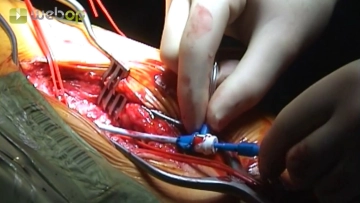
    In this case, exposure of the left groin was preferred over puncture because of the severe scarring in the groin following previous surgery and the large caliber of the delivery system. After encircling the common femoral artery proximally and distally, the artery is punctured using the Seldinger technique. A 7 F sheath is introduced over the guidewire. 5000 IU of heparin saline solution are administered locally into the vessel.

    Tip:

    To avoid vessel perforation, the stiff guidewire must not be advanced too far because of the severe kinking of the left iliac arteries and the paper-thin vessel walls.

  2. Probing the left iliac arteries, exploratory angiography

    Video
    Probing the left iliac arteries, exploratory angiography
    Soundsettings

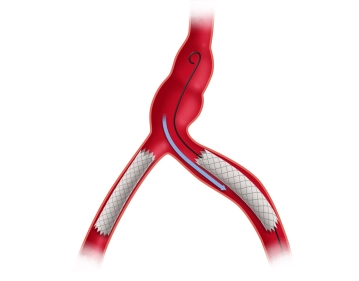
    The stiff guidewire is replaced by a soft hydrophilic-coated guidewire (here: Terumo®), which is advanced into the descending aorta. A pigtail catheter is now introduced over the indwelling guidewire, through which DSA is performed in road-mapping technique. DSA demonstrates successful exclusion of the right internal iliac artery aneurysm and the migrated left endoluminal vascular graft, the endoleak, and the perfused left internal iliac artery aneurysm. The infrarenal aorta is aneurysmatically dilated to around 35 mm, so that an endoluminal Y-graft could have been an alternative consideration.

    Tips:

    1. Advancing the Terumo® wire up may be difficult because of the severe kinking of the iliac arteries. If a straight or tip-curved Terumo® wire does not slide past the vessel wall, it is often necessary to employ a guiding catheter, which is better able to pass the tortuosities of the vessel (Road Runner®, H-Stick®, RDC® or similar). Sometimes the manoeuvre also succeeds with a pigtail catheter, which has to be used for exploratory angiography anyway.

    2. Roadmapping ("pathfinder"): This involves administering a small bolus of contrast medium to depict the abdominal aorta and iliac arteries as a roadmap. This image is saved as a mask. Subsequent images are then acquired without contrast medium and subtracted from the mask. In this way, for example, only a radiopaque catheter with its current position can be displayed. In the resulting subtraction images, the bright catheter is visible against the dark vessels, and the background irrelevant to this examination is suppressed.

    3. The endoluminal Y graft could have served as a salvage procedure in case of failure of the unilateral procedure in the video clip.

Introducing the endograft delivery system

After introducing a "superstiff" guidewire (e.g. Amplatz®, Backup Meier®, Lunderquist®), the indwel

Activate now and continue learning straight away.

Single Access

Activation of this course for 3 days.

US$9.30  inclusive VAT

Most popular offer

webop - Savings Flex

Combine our learning modules flexibly and save up to 50%.

from US$4.30 / module

US$51.61/ yearly payment

price overview

vascular surgery

Unlock all courses in this module.

US$8.60 / month

US$103.20 / yearly payment

to top