Start your free 3-day trial β€” no credit card required, full access included

Perioperative management - Interventional exclusion of a type Ia endoleak following bilateral endoluminal repair of an internal iliac artery aneurysm

  1. Indications

    PM 314-1
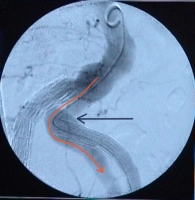
    Type Ia endoleak: Due to migration of the endograft in the left internal iliac artery, sealing of the proximal landing zone is inadequate.
    Endoleak classification

    Type I

    Inadequate sealing of the landing zones

    • A: proximal fixation
    • B: distal fixation
    • C: iliac occluder in aortoiliac endograft and femorofemoral cross-over bypass

    Type II

    Retrograde blood flow into the aneurysm sac via collateral vessels (mainly the inferior mesenteric artery and lumbar arteries, occasionally an accessory renal artery)

    • A: single vessel
    • B: multiple vessels

    Type III

    • A: junctional separation of modular components
    • B: defect in the graft fabric

    Type IV

    Porosity of the graft fabric (usually self-limiting)

    Type V

    Endotension (aneurysm growth without evidence of an endoleak)

    Type I and type III endoleaks are associated with a higher risk of aneurysm rupture -> prompt intervention recommended

  2. Contraindications

    • ASA IV
  3. Preoperative diagnostic work-up

    Thorough vascular surgery examination:

    • Pulse status
    • Doppler study of both legs
    • Possibly a walking distance test in case of concomitant PAOD and poorly palpable foot pulses
    • Abdominal ultrasonography
    • Carotid colour Doppler study
    • Echocardiography
    • Exercise ECG
    • Laboratory panels (electrolytes, coagulation, renal function, blood count, blood lipids)
    • Chest X-ray
    • Spiral CT -> exact dimensioning of the endografts required for repair of the endoleak
  4. Special preparation

    • Determine blood group, provide packed RBCs if needed
    • Remove the hair in the surgical field
    • Place a urinary catheter if needed
    • Prophylactic antibiotics are usually administered and are recommended by the German Society for Vascular Surgery (single-shot cefuroxime 30 minutes before skin incision); however, the benefit is currently subject to debate because of issues around antibiotic resistance (Robert Koch Institute).
  5. Informed consent

    General surgical risks

    • Major bleeding, blood transfusions, transmission of hepatitis/HIV through allogeneic blood products
    • Allergy/intolerance
    • Wound infection
    • Thrombosis/embolism
    • Skin, vascular and nerve damage, e.g., due to patient positioning
    • Keloids (in open surgery)

    Specific procedural risks

    • Vascular injuries, e.g., during graft placement: surgical haemostasis, blood transfusions; in case of massive bleeding or arterial rupture, immediate conversion to open surgery
    • Pseudoaneurysm of the punctured vessels, arteriovenous fistula, seroma
    • Inadequate graft fixation or graft leakage: corrective procedures, possibly open
    • Graft infection: possible after days, months or even years; endocarditis, sepsis, leg ischaemia, amputation; surgical removal of the vascular graft
    • Nerve lesions -> dysaesthesia, pain, paralysis of the abdominal wall and thigh muscles
    • Lymph fistula
    • Lymphoedema of the legs; temporary or permanent; compression stockings, lymphatic drainage
    • Secondary bleeding
    • Impotence
    • Compromise of renal function due to intraoperative angiography, chronic dialysis

    Risks due to impaired perfusion

    • Thrombosis/embolism: pulmonary embolism, apoplexy, myocardial infarction; prophylaxis: heparin -> HIT II risk
    • Legs: thrombosis of the graft and possibly adjacent vascular segments, possibly leg ischaemia, amputation (e.g., toes)
    • Gluteal muscles: due to overstenting of the iliac arteries, in particular bilaterally; claudication during walking, possibly gluteal necrosis
Anaesthesia

General anaesthesiaIn suitable patients (compliance), also local anaesthesia ... - Operations in ge

Activate now and continue learning straight away.

Single Access

Activation of this course for 3 days.

US$9.30  inclusive VAT

Most popular offer

webop - Savings Flex

Combine our learning modules flexibly and save up to 50%.

from US$4.30 / module

US$51.61/ yearly payment

price overview

vascular surgery

Unlock all courses in this module.

US$8.60 / month

US$103.20 / yearly payment

to top