Start your free 3-day trial — no credit card required, full access included

Anatomy - Alloplastic carotid-subclavian bypass for left subclavian artery stenosis

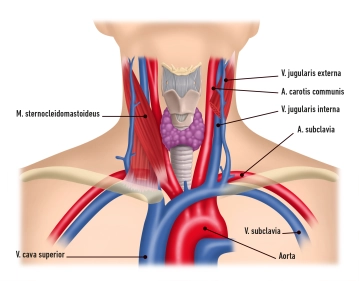
  1. A. carotis communis

    A. carotis communis
    Zum Vergrößern bitte anklicken

    Origin

    • left: Aortic arch
    • right: Brachiocephalic trunk

    Course

    • ascending behind the sternocleidomastoid muscle
    • within the carotid sheath

    Division

    • Carotid bifurcation (Bifurcatio carotidis): Division into internal and external carotid artery

    Vascular territory

    1. Internal carotid artery

    • Brain
    • Eye
    • Forehead
    • Anterior nasal cavity

    2. External carotid artery

    • Extracranial structures of the head and neck
  2. Subclavian artery

    Origin

    • left from the aortic arch
    • right from the brachiocephalic trunk

    Course

    • passes over the pleural dome between clavicle and 1st rib through the posterior scalene gap (between M. scalenus anterior and M. scalenus medius)

    Branches

    • internal thoracic artery
    • vertebral artery
    • thyrocervical trunk
    • costocervical trunk

    Main branches of the subclavian artery

    Branches

    Branches

    Supply area

    internal thoracic artery

    Ø

    • anterior thoracic wall
    • upper abdominal wall
    • mediastinum
    • pericardium
    • diaphragm

    vertebral artery

    Ø

    • brain
    • cervical spine (vertebrae, spinal cord)
    • deep neck musculature

    thyrocervical trunk

    • suprascapular artery
    • anastomosis with branches of the axillary artery
    • transverse cervical artery -> dorsal scapular artery
    • musculature of neck, nape, shoulder
    • ascending cervical artery
    • neck musculature 
    • inferior thyroid artery
    • trachea
    • larynx
    • thyroid gland
    • esophagus

    costocervical trunk

    • deep cervical artery
    • deep neck musculature
    • supreme intercostal artery
    • upper intercostal muscles

    After passing through the posterior scalene gap, the subclavian artery transitions into the axillary artery. This supplies the shoulder girdle and then becomes the brachial artery, whose supply area is the upper arm. In the elbow crease, the brachial artery divides into the radial artery and ulnar artery, which run along the forearm to the hand. The arteries are accompanied by veins of the same name.

  3. Venous System

    Superficial and deep venous systems unite in the Angulus venosus ("venous angle") to form the V. brachiocephalica and empty into the V. cava superior.

    1. Superficial Veins

    V. jugularis externa

    • runs in the lateral neck area covered by the Platysma
    • penetrates the Lamina superficialis of the cervical fascia
    • empties in the venous angle, possibly even earlier, into the V. jugularis interna, then into the V. cava superior

    V. jugularis anterior

    • usually runs over the M. sternocleidomastoideus
    • Vv. jugulares anteriores of both sides usually unite in the Spatium suprasternale to form the Arcus venosus jugularis
    • empties into venous angle or into the V. jugularis externa
    2. Deep Veins

    V. jugularis interna

    • see below

    V. subclavia

    • Continuation of the V. axillaris
    • runs in front of the M. scalenus anterior
    • empties in the venous angle together with the V. jugularis interna and forms the V. brachiocephalica → V. cava superior
  4. Lymphatic Vessels

    The lymphatic drainage of the head and neck empties into the paired jugular trunks.

    Left Jugular Trunk
    • Tributary Area: left half of head and neck
    • Termination: Thoracic Duct
    Right Jugular Trunk
    • Tributary Area: right half of head and neck
    • Termination: Right Lymphatic Duct
  5. Nervous System

    1. Cervical Plexus - predominantly motor innervation

    Nerve

    Segments

    Course, Special Features

    motor innervation

    sensory innervation

    Cervical Ansa

    • Radix superior: C1, C2
    • Radix inferior: C2, C3
    • Radix superior parallel with N. hypoglossus
    • M. geniohyoideus
    • infrahyoid musculature

    Ø

    N. phrenicus

    • C3 - C5
    • runs on M. scalenus anterior
    • in the mediastinum betw. mediastinal pleura and pericardium to the diaphragm
    • Diaphragm

    R. pericardiacus:

    • Pericardium
    • Mediastinal pleura
    • Diaphragmatic pleura

    R. phrenicoabdominalis:

    • Peritoneum diaphragm underside
    • Peritoneum gallbladder

    R. sternocleidomastoideus

    • C1 - C3
    • forms plexus with branches of N. accessorius (XI)
    • M. sternocleidomastoideus (together with XI)

    Ø

    R. trapezius

    • C2 - C4
    • M. trapezius (together with XI)

    Ø

    2. Cervical Plexus - purely sensory innervation

    Nerve

    Segments

    Course, Special Features

    Innervation

    N. occipitalis minor

    • C2, C3
    • runs dorsal to the M. sternocleidomastoideus
    • lateral occiput

    N. auricularis magnus

    • C2, C3
    • crosses over the M. sternocleidomastoideus
    • Skin below the auricle

    N. transversus colli

    • C2, C3
    • crosses over the M. sternocleidomastoideus
    • R. superior: forms anastomosis with R. colli n. facialis
    • anterior neck region

    Nn. supraclaviculares

    • C3, C4
    • fan-like course towards clavicle
    • Clavicle
    • upper chest region
    • Shoulder
    3. Sympathetic Cervical Ganglia

    Sympathetic Ganglion

    Special Features

    Nerves, Innervation Areas

    Ganglion cervicale superius

    • Level C2/3
    • emitted nerves run predominantly periarterially
    • N. jugularis: fibers for N. glossopharyngeus and N. vagus
    • N. caroticus internus: becomes N. petrosus profundus
    • Nn. carotici externi: salivary glands
    • Rr. laryngopharyngei: pharyngeal plexus
    • N. cardiacus cervicalis superior: cardiac plexus
    • Fibers to the pineal gland

    Ganglion cervicale medium

    • variable localization
    • N. cardiacus cervicalis medius: cardiac plexus

    Ganglion cervicale inferius

    • often fused with the 1st ganglion of the thoracic sympathetic trunk to form the stellate ganglion
    • N. cardiacus cervicalis inferior: cardiac plexus
    • N. vertebralis: sympathetic fibers to the cervical nerves
    • Ansa subclavia: connection between ganglion cervicale inferius and ganglion cervicale medium
    • Stellate ganglion: sympathetic fibers to sweat glands and skin vessels of the upper extremity
    4. N. vagus

    Below the jugular foramen at the skull base thickening to the extracranially located Ganglion inferius n. vagi and emission of mixed branches:

    N. laryngeus superior

    → R. externus: motor innervation M. cricothyroideus

    → R. internus: sensory innervation of the laryngeal mucosa above the glottis

    Further course in the carotid sheath between internal jugular vein and internal carotid artery and emission of mixed branches:

    N. laryngeus recurrens

    → loops around the aortic arch (N. laryngeus recurrens sinister) or the subclavian artery (N. laryngeus recurrens dexter) and runs around the larynx

    → motor innervation of the laryngeal muscles (except M. cricothyroideus, see above)

    → sensory innervation of the laryngeal mucosa below the glottis

    Left and right N. vagus pull to the esophagus and form here the esophageal plexus. From the fibers of the plexus form the Truncus vagalis anterior (left N. vagus) and Truncus vagalis posterior (right N. vagus) → Innervation of the upper abdominal organs.