Start your free 3-day trial — no credit card required, full access included

Anastomosis technique, biliodigestive, classical

  1. Principle

    Principle

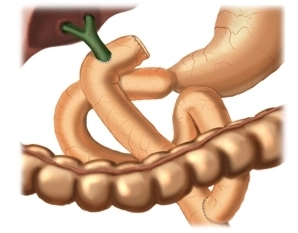
    The end-to-side hepaticojejunostomy with a retrocolically routed upper jejunal loop excluded from the passage by Roux-Y anastomosis represents the gold standard of biliodigestive anastomosis.
    In this case, the biliodigestive anastomosis is preferably created above the cystic duct insertion and approx. 2–3 cm below the hepatic bifurcation.

    • The widest possible anastomosis opening should be created (if the bile duct is too narrow, widening procedures are recommended, e.g. after Hepp-Couinaud).
    • The suture with single-row full-thickness interrupted sutures should be primarily watertight.
    • An exact adaptation of bile and intestinal mucosa must be aimed for.
  2. Exploration – Preparation of the Ligamentum hepatoduodenale

    Video
    Exploration – Preparation of the Ligamentum hepatoduodenale
    Soundsettings

    The anastomosis is explained in the context of a Whipple operation for pancreatic head carcinoma. A variant of the biliodigestive anastomosis (hilar hepatojejunostomy) can be found under Anastomosis technique, biliodigestive, according to Hepp-Couinaud.

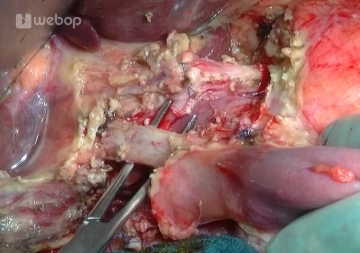
    In the area of the hepatoduodenal ligament, the proper hepatic artery, portal vein, and the common bile duct or hepatic duct are displayed. The bile duct itself is circumferentially dissected.

Preparation of the Common Bile Duct / Hepatic Duct

After circular dissection of the bile duct, the bile duct is transected directly proximal to the in

Activate now and continue learning straight away.

Single Access

Activation of this course for 3 days.

US$9.50  inclusive VAT

Most popular offer

webop - Savings Flex

Combine our learning modules flexibly and save up to 50%.

from US$7.38 / module

US$88.58/ yearly payment

price overview

general and visceral surgery

Unlock all courses in this module.

US$14.76 / month

US$177.20 / yearly payment

to top